Digital Marketing Specialist Resume: Examples & Writing Guide
This complete guide with detailed explanations and expert tips will teach you how to write an acting resume in record time!
Edit this resume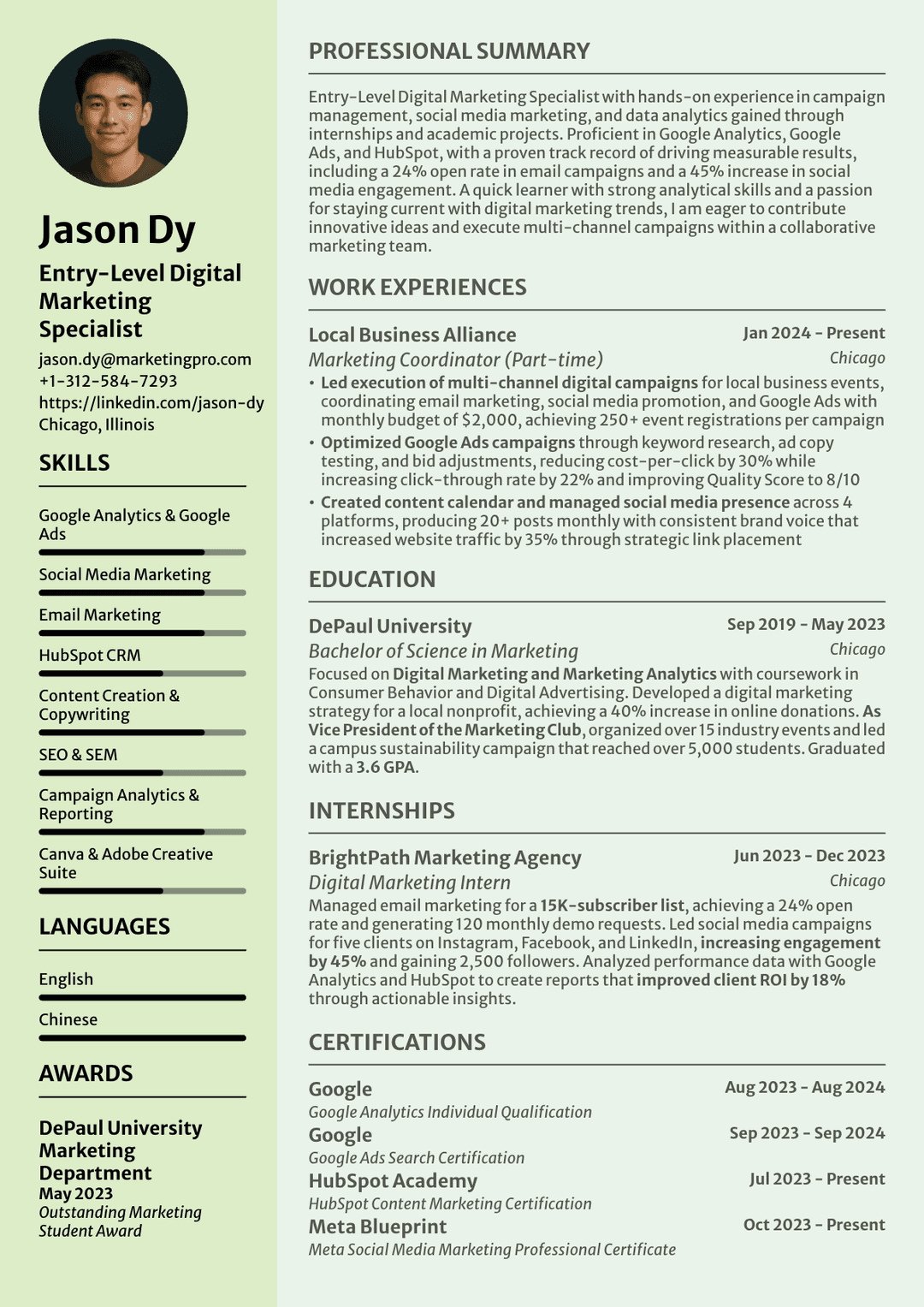
Creating a strong digital marketing specialist resume can feel overwhelming, especially when you’re trying to stand out in a competitive field where everyone claims to be “data-driven” and “experienced.” You may worry your skills won’t shine through or that your achievements won’t sound impressive enough to recruiters who scan dozens of resumes a day.
However, with the right strategy, you can present your experience, metrics, and tools in a way that instantly shows your value. In this guide, we break down exactly how to write a high-impact digital marketing specialist resume—with proven examples, expert tips, and a list of common mistakes to avoid.
- A strong digital marketing specialist resume includes essential sections such as contact information, a tailored summary or objective, quantified work experience, core skills, and certifications.
- Tailoring your resume to each job description—using relevant keywords, channel expertise, and aligned achievements—significantly increases your chances of passing ATS and impressing recruiters.
- Quantifying results is crucial; metrics like engagement rates, lead generation, ROI improvements, and growth percentages demonstrate real marketing impact.
- A balanced skill set combining technical expertise (SEO, analytics, ads management) with soft skills (communication, problem-solving, collaboration) is key to standing out.
- Avoid common mistakes like being overly generic, listing duties instead of results, overusing jargon, or leaving typos—clarity, precision, and measurable achievements make the resume compelling.
What Makes a Strong Digital Marketing Specialist Resume?
A strong digital marketing specialist resume showcases versatility without appearing unfocused. While you may have strengths in certain channels, your resume should prove you can contribute across the full marketing mix.
Unlike coordinators who provide support, specialists own campaign execution and optimization. Unlike managers who focus on strategy and leadership, specialists are hands-on practitioners who build, launch, and refine campaigns daily.
Basically, as a digital marketing specialist, you execute marketing strategies, implement campaigns across SEO, social media, email marketing, content marketing, and paid advertising while tracking performance and recommending optimizations.
Digital Marketing Specialist vs. Other Marketing Roles
This is a growing industry, and understanding how the specialist role differs from other marketing positions helps you position yourself effectively. According to Expert Market Research, the global digital marketing industry reached an estimated $598.58 billion in 2024, and it’s projected to grow at a 9.20% CAGR from 2025 to 2034, ultimately hitting $1.44 trillion by 2034.
That said, let’s see what different roles there are, and how they differ from a digital marketing specialist:
| Role | Description |
|---|---|
Digital Marketing Coordinator | Entry-level role focused on supporting campaigns, scheduling content, gathering assets, and assisting with reporting. Coordinators work under direct supervision and handle more administrative tasks. |
Digital Marketing Specialist | Mid-level role with ownership of campaign execution across multiple channels. Specialists work more independently, analyze performance data, make optimization recommendations, and may mentor coordinators. |
Digital Marketing Manager | Mid-level role with ownership of campaign execution across multiple channels. Specialists work more independently, analyze performance data, make optimization recommendations, and may mentor coordinators. |
Channel-Specific Specialists | Deep expertise in one channel with less emphasis on cross-channel coordination. |
Overall, your digital marketing specialist resume should reflect greater responsibility than coordinator roles by emphasizing independent project ownership, optimization decisions, and measurable results. However, it should show more hands-on execution than manager roles by detailing the campaigns you've personally built and launched rather than just strategic oversight.
Digital Marketing Specialist Resume Examples
Before we dive into actual resume writing, let’s take a look at seven real-world digital marketing specialist resume examples to get the feel of what is actually working.
#1. Entry-Level Digital Marketing Specialist Resume

#2. Mid-Level Digital Marketing Specialist Resume


#3. Senior Digital Marketing Specialist Resume


#4. B2B Digital Marketing Specialist Resume

#5. B2C Digital Marketing Specialist Resume

#6. SaaS Digital Marketing Specialist Resume

#7. E-Commerce Digital Marketing Specialist Resume


Essential Sections of a Digital Marketing Specialist Resume
There are several essential sections on your digital marketing specialist resume, as you might have seen from different resume examples above. Each key section follows a certain structure and contains specific information.
Let’s see which those sections are and what they contain.
Contact Information
The section containing your contact information is called a resume header. Here, make sure to include:
- Full name
- Phone number
- Professional email address
- City and state
- LinkedIn profile
For digital marketing specialists, a good LinkedIn profile is particularly important as it demonstrates your understanding of personal branding and professional online presence. Also, consider adding a professional website or portfolio if you have one, showcasing campaign examples, content samples, or case studies.
Some specialists, for instance, include their most active social media handle if it's professionally relevant. Your contact section is your first impression, so make sure every link works and presents you professionally.
Professional Summary or Objective
Your opening statement should immediately establish your identity as a digital marketing specialist and highlight your key value proposition.
If you have 2+ years of relevant experience, use a professional summary. A proven formula to follow is [job title] + [years of experience] + [channel specialties] + [key achievement] + [unique value], and here’s how it works in practice:
Digital Marketing Specialist with 4 years of experience driving multi-channel campaigns for B2C brands. Proven expertise in social media advertising, email automation, and content marketing. Increased qualified leads 215% through integrated campaigns while reducing customer acquisition cost 28%. Combines creative storytelling with data-driven optimization to maximize marketing ROI.
On the other hand, use an objective statement if you're transitioning into the specialist role. A good way to structure it would be [target role] + [relevant background] + [transferable skills] + [what you'll bring]. For example:
Marketing Coordinator seeking a Digital Marketing Specialist role to leverage 2 years of campaign support experience and Google Analytics certification. Skilled in social media management, email marketing, and performance tracking with proven ability to execute campaigns independently.
Work Experience Section
Your work experience is the most critical section of your digital marketing specialist resume. Use clear, results-focused bullet points that tell the story of your career progression and impact.
Each position should be structured in the following way:
- Job title, Company name, Location, Dates (MM/YYYY format)
- 4-6 bullet points describing achievements and responsibilities
- Start each bullet with strong action verbs
- Include specific metrics and results (percentage increases, dollar amounts, lead volumes, engagement rates)
- Show progression of responsibility across roles
Here’s a good example of a quantifiable achievement in your work experience section:
- Executed 12+ monthly social media campaigns across Facebook, Instagram, and LinkedIn, generating 450 qualified leads and achieving a 3.2% average engagement rate (45% above industry benchmark)
How to Write Your Digital Marketing Specialist Resume in 5 Simple Steps
Writing a digital marketing specialist resume is a structured process. That said, let’s examine each step in more detail to help you craft a compelling application.
#1. Choose the Right Resume Format
For digital marketing specialists, the reverse-chronological resume format is strongly recommended if you have a consistent work history, clear career progression, and relevant experience in digital marketing. However, consider a combination/hybrid format in cases such as:
- Transitioning from a different field with transferable skills
- Re-entering the workforce after an employment gap
- Pivoting from traditional to digital marketing
#2. Tailor Your Resume to the Job Description
Never send a generic resume. Digital marketing specialist roles vary significantly based on industry, company size, and specific channel focus. Therefore, it’s important to research the company and tailor your resume based on it.
To customize your resume properly, here are a few steps to take:
- Analyze the job description for required skills, tools, and experience
- Identify keywords that appear multiple times (these are priorities)
- Reorganize your skills section to prioritize what they're seeking
- Rewrite your professional summary to mirror their language
- Select achievements most relevant to their needs
- Adjust emphasis on different channels based on their focus
Even though customization might seem time-consuming, it's the difference between being one of 500 applicants and one of 50 who actually get interviewed.
#3. Quantify Your Achievements
Digital marketing is measurable, so every achievement should include specific numbers. Concrete metrics are important as they make all the difference between weak and strong candidates. Consider the following examples and how they differ:
| Aspect | Example |
|---|---|
Weak |
|
Strong |
|
#4. Optimize for ATS (Applicant Tracking Systems)
Most companies use ATS software to screen resumes before human review. Here’s a list of ATS-friendly practices you can use to make sure your digital marketing specialist resume reaches the employer:
- Use standard section headings (Work Experience, Education, Skills)
- Include keywords from the job description naturally
- Spell out acronyms on first use, then use the abbreviation: "Search Engine Optimization (SEO)"
- Use standard fonts (Arial, Calibri, Georgia, Times New Roman)
- Avoid tables, text boxes, headers/footers, and graphics
- Submit as .docx or PDF as requested
By including all of these practices, you’ll have a fully ATS-optimized resume.
#5. Showcase Certifications and Continuous Learning
Digital marketing evolves rapidly, so certifications demonstrate commitment to staying current. Create a dedicated "Certifications" section or include it within your Education section.
The list format should be Certification Name, Issuing Organization, Date Earned. That said, here are a few high-value certifications you should include:
- Google Analytics Individual Qualification (GAIQ)
- Google Ads Certification (Search, Display, Shopping, Video)
- HubSpot Inbound Marketing Certification
- HubSpot Content Marketing Certification
- Meta Blueprint Certification (Meta Certified Digital Marketing Associate)
- Hootsuite Social Marketing Certification
- Google Digital Marketing & E-commerce Certificate
- SEMrush Academy Certifications
Many of these certifications are free and can be completed in a few hours to a few days. They're worth the investment because they validate your knowledge and show you're committed to professional development.
Core Skills for Digital Marketing Specialist Resumes
Successful digital marketing specialists blend technical skills like SEO, analytics, and campaign management with essential soft skills including creativity, communication, and adaptability to drive measurable results and brand growth.
Technical/Hard Skills
Digital marketing specialists need a diverse technical toolkit. However, don't just list tools—consider your actual proficiency level. It's better to highlight 8-10 tools you genuinely know well than claim expertise in 20+ platforms.
Also, organize your hard skills by category for maximum impact.
- Marketing automation (HubSpot, Marketo, Pardot, ActiveCampaign)
- Email marketing (Mailchimp, Klaviyo, Constant Contact, SendGrid)
- Social media management (Hootsuite, Buffer, Sprout Social, Later)
- CRM systems (Salesforce, HubSpot CRM, Zoho)
- Google Analytics (GA4)
- Google Tag Manager
- Facebook Pixel & Conversions API
- Data visualization (Google Data Studio, Tableau)
- Excel/Google Sheets (pivot tables, VLOOKUP, formulas)
- Google Ads (Search, Display, Shopping)
- Meta Ads Manager (Facebook & Instagram)
- LinkedIn Campaign Manager
- Twitter/X Ads
- TikTok Ads Manager
- CMS (WordPress, Webflow, Squarespace)
- Canva, Adobe Creative Suite basics
- Basic HTML/CSS understanding
- Video editing basics (Premiere Rush, Canva video)
- Marketing automation (HubSpot, Marketo, Pardot, ActiveCampaign)
- Email marketing (Mailchimp, Klaviyo, Constant Contact, SendGrid)
- Social media management (Hootsuite, Buffer, Sprout Social, Later)
- CRM systems (Salesforce, HubSpot CRM, Zoho)
- Keyword research tools (SEMrush, Ahrefs, Ubersuggest)
- On-page optimization
- Link building fundamentals
- Google Search Console
Soft Skills
While technical skills get you noticed, soft skills demonstrate your ability to thrive in the role:
- Written communication for ad copy, email content, and reports
- Verbal communication for stakeholder updates and presentations
- Visual communication through campaign creative
- Data interpretation and insight generation
- Problem-solving and optimization mindset
- Critical thinking for campaign strategy
- Multi-project coordination
- Deadline management
- Prioritization and time management
- Attention to detail
- Cross-functional teamwork
- Vendor and agency coordination
- Adaptability to different team cultures
- Receiving and implementing feedback
- Campaign ideation
- Innovative problem-solving
- Content creativity
- Testing hypothesis development
6 Common Mistakes to Avoid on Digital Marketing Specialist Resumes
Even experienced professionals make resume mistakes that cost them interviews. Avoid these common pitfalls to ensure your application stands out for the right reasons and showcases your expertise effectively.
- Being too generic across channels. Claiming "expertise" in 10+ marketing channels without depth makes you appear unfocused. Focus on 3-4 core strengths while showing competency in others. It's better to be excellent in social media advertising, email marketing, and content marketing than mediocre across everything.
- Listing responsibilities instead of results. Recruiters don't care that you "managed social media accounts". They want to know the impact of your management. Transform every bullet point by adding the "so what?" After writing each line, ask yourself: "So what? Why does this matter?" If you can't answer that question, rewrite the bullet to demonstrate measurable impact and business value.
- Neglecting soft skills. Digital marketing specialists must collaborate with designers, copywriters, sales teams, and executives. Show your communication and project management abilities through examples of cross-functional projects and stakeholder management. Describe how you presented campaign results to executives, coordinated with sales on lead handoff processes, or collaborated with designers on creative assets to achieve campaign objectives.
- Overloading with jargon and buzzwords. Use industry-standard terminology where appropriate, but prioritize clarity and concrete examples over trendy language. Instead of calling yourself a "digital marketing guru," demonstrate your expertise through specific accomplishments, certifications, and measurable results that speak for themselves.
- Forgetting to proofread. Typos on a marketing resume are particularly damaging since attention to detail is critical in marketing. Use Grammarly, have someone else review it, and read it aloud to catch errors. A single typo might not disqualify you, but it creates doubt. Triple-check everything, especially company names and dates.
- Using outdated or irrelevant experience. If you have 8+ years of experience, focus on the most recent 10 years and most relevant 3-4 roles. Brief older experience or move it to an "Additional Experience" section. Recruiters care most about what you've done recently. Keep your resume focused on current, applicable experience.
Create a Standout Digital Marketing Resume With ResumeBuilder.so
ResumeBuilder.so provides industry-specific resume templates, helping you highlight campaign performance metrics, SEO achievements, social media growth, and content strategy expertise in a visually compelling format. Our AI-powered builder makes it easy to emphasize your technical skills—from Google Analytics and HubSpot to Facebook Ads Manager—while showcasing the business impact you've delivered.
Also, you can create a matching cover letter that maintains consistent branding and professional polish across your entire application. With customizable sections for certifications, portfolio links, and key achievements, ResumeBuilder.so helps digital marketing specialists present their multifaceted skill set effectively.
Final Thoughts
Creating an effective digital marketing specialist resume requires balancing versatility with focus, showcasing both technical skills and business impact. Your resume should tell a compelling story of how you execute marketing campaigns that drive measurable results while adapting to the constantly evolving digital landscape.
Remember that your resume is itself a marketing document—it needs to capture attention quickly, communicate value clearly, and drive the desired action (an interview request).
Whether you're an entry-level specialist building your first dedicated marketing resume or a senior specialist positioning yourself for management roles, focus on results, stay current with certifications, and tailor every application to the specific opportunity.
Digital Marketing Specialist Resume FAQ
#1. What should I put on my digital marketing specialist resume?
Your digital marketing specialist resume should include a professional summary highlighting your multi-channel expertise, detailed work experience with quantified campaign results, a comprehensive skills section, relevant education and certifications, and specific achievements across channels like social media, email, SEO, paid advertising, and content marketing.
#2. How do I show digital marketing results on my resume without revealing confidential information?
Use percentage increases rather than absolute numbers (grew revenue 145% instead of $2M to $4.9M), share relative performance (achieved 45% above industry benchmark CTR), use ranges (managed budgets of $50-75K monthly), or present anonymized data (increased B2B SaaS client's organic traffic 230% in 6 months).
#3. Should I include all marketing channels on my resume or focus on specific ones?
Emphasize 3-4 channels where you have strong expertise, while briefly mentioning others where you have working knowledge. Your core strengths should align with the job requirements while showing you can contribute across the marketing mix when needed. If a job emphasizes social media and email, lead with those achievements even if you've also done SEO and content work.
#4. What certifications matter most for digital marketing specialists?
The most valuable certifications for digital marketing specialists include Google Analytics Individual Qualification, Google Ads certifications (Search, Display, Shopping, Video), HubSpot Inbound Marketing, HubSpot Content Marketing, and Meta Blueprint certifications. These are widely recognized, demonstrate platform-specific expertise, and often appear in job requirements.
#5. Can I use my digital marketing specialist resume for both agency and in-house roles?
While the core content remains similar, tailor the emphasis based on the environment. For agency roles, highlight client management, diverse industry experience, fast-paced multi-project coordination, and quick turnaround capabilities. For in-house roles, emphasize deep product knowledge, long-term strategy execution, cross-departmental collaboration, and sustained growth metrics.

Maya Brooks believes that a fulfilling career shouldn’t come at the cost of your mental health. Having worked in corporate HR, she’s seen firsthand how burnout culture can wreck careers. Now, she shares real-world strategies for setting work boundaries, avoiding toxic workplaces, and finding joy in your job.