Manager Resume: Examples + Expert Writing Guide for 2026
This complete guide with detailed explanations and expert tips will teach you how to write an acting resume in record time!
Edit this resume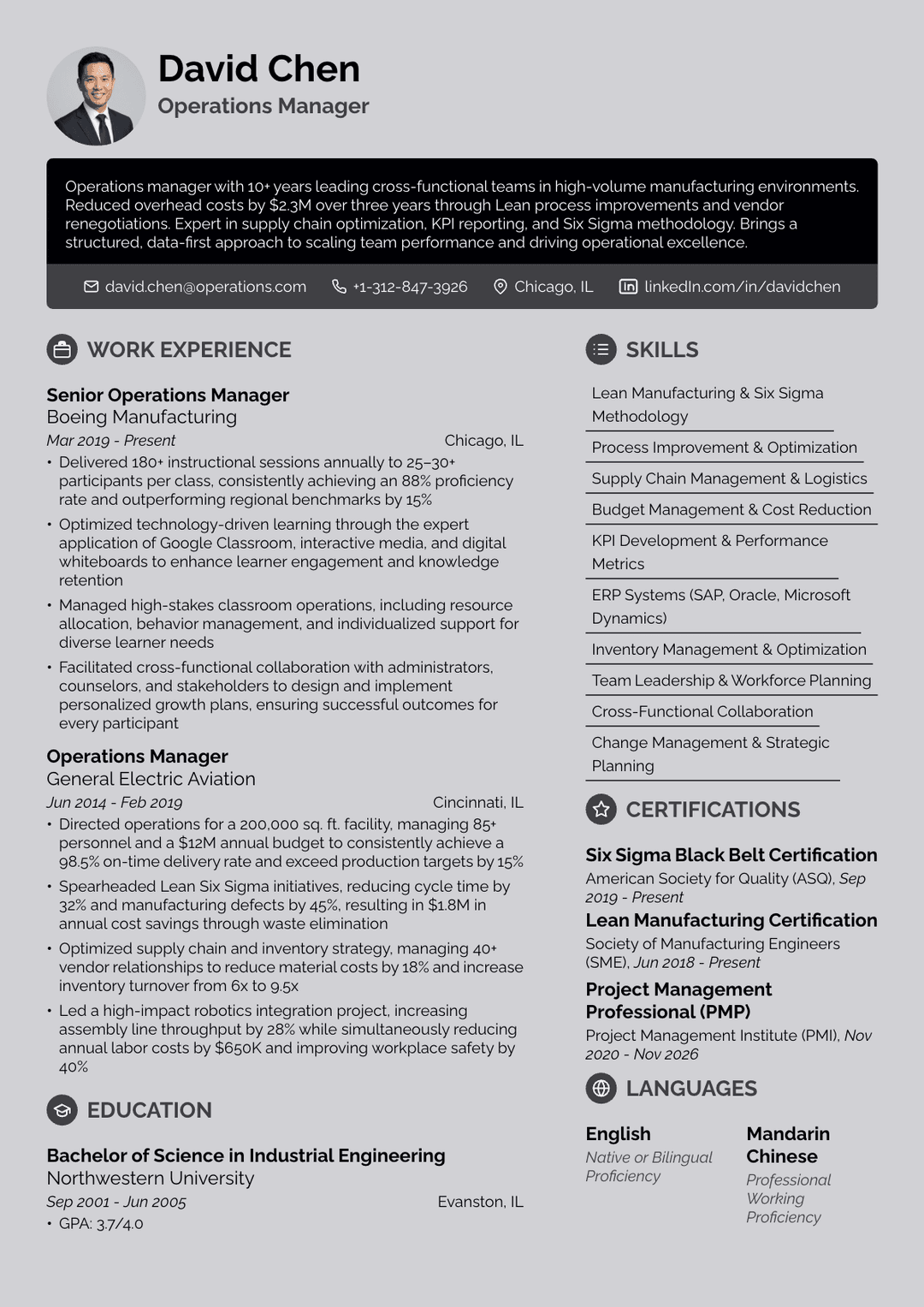
Management roles attract dozens of strong applicants, however, writing a compelling manager resume is tougher than most people expect. You've led teams, hit targets, and driven real results, but a generic, responsibility-heavy resume buries all of that. On the other hand, hiring managers don't want a list of duties; they want proof.
In this guide, we’ll show you how to write a strong manager resume, walking you through everything—from each essential section to a tested summary formula, resume examples, and the most common mistakes to avoid.
- A manager resume differs from a standard resume because scope, impact, and leadership language all matter more.
- Every manager resume needs a professional summary, work experience, skills section, education, and certifications.
- Your resume summary is the highest-leverage section; get it right and recruiters will keep reading.
- Hard and soft skills should be tailored to the specific job posting for ATS compatibility.
- Different industries—operations, project management, retail—require different emphasis and proof points.
- Common mistakes include listing responsibilities over achievements and ignoring ATS formatting rules.
What Makes a Strong Manager Resume?
A strong manager resume showcases leadership experience, team management skills, and measurable business results. It goes beyond listing job duties; it tells the story of what you built, what you fixed, and the impact you had.
Hiring managers at this level are looking for evidence, such as proven results, people management track record, sound decision-making skills, and the ability to work across functions. This includes how many people you led, what budget you controlled, and what happened to the business because of your decisions.
As for employment in management occupations, it is expected to grow faster than the average for all jobs according to the U.S. Bureau of Labor Statistics. On average, about 1.1 million openings are projected each year, driven by both new job growth and the need to replace professionals who permanently leave these roles.
The earning potential is higher than most career paths as well. As of May 2024, the median annual wage for management occupations is $122,090—well above the overall median annual wage of $49,500 across all occupations.
Given that management roles span every industry—retail, operations, project management, HR, marketing, and beyond—your resume needs to speak to the specific language of your field.
Also, leadership roles receive high application volumes, and 90% of Fortune 500 companies use Applicant Tracking Systems (ATS). Therefore, an ATS-compatible resume isn't optional for managerial roles.
Manager Resume Examples by Industry
Manager resume examples differ by industry because each field prioritizes different technical skills, certifications, and leadership styles. Now, before we show you how to write a resume, let’s see three professional resume examples by industry for managerial positions.
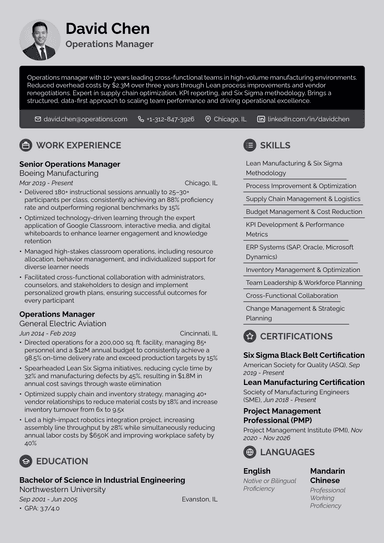
#1. Operations Manager Resume

#2. Project Manager Resume

#3. Retail Manager Resume

How to Write a Manager Resume: A Step-by-Step Guide
Writing a manager resume is all about following a structured approach. You should include a professional summary, work experience, key soft and technical skills, education, and relevant certifications.
Each of these sections should be written to demonstrate leadership potential. That said, here's how to approach each one.
#1. Contact Information
Your resume contact information should look professional and include:
- Full name
- City/state
- Professional email address
- Phone number
- LinkedIn URL
However, you don't need to include your full street address, just the city is fine for most applications. If the role is relevant, you can add a personal website or portfolio.

#2. Professional Summary
This is the most important section on your manager resume. Recruiters spend an average of 7.4 seconds on an initial scan, so your summary needs to hook them before they move on.
A strong resume summary opens with your years of experience, names your core management specialty, cites a measurable achievement, and closes with the value you bring.
Now, let’s see a few good resume summary examples you can use for inspiration:
Operations manager with 10+ years leading cross-functional teams in high-volume manufacturing environments. Reduced overhead costs by $2.3M over three years through Lean process improvements and vendor renegotiations. Expert in supply chain optimization, KPI reporting, and Six Sigma methodology. Brings a structured, data-first approach to scaling team performance.
Retail manager with eight years of progressive leadership across multi-location environments, consistently exceeding quarterly sales targets. Grew year-over-year store revenue by 22% and cut shrinkage by 18% through inventory discipline and targeted staff coaching. Skilled in NPS improvement, floor operations, and new store openings.
Certified PMP with 12 years delivering complex infrastructure and software projects on time and within budget. Managed a $14M portfolio of concurrent projects with cross-functional teams of up to 40 members. Expertise in Agile, Scrum, and stakeholder communication. Consistently earns 95%+ client satisfaction scores across project lifecycles.
If you're transitioning into management for the first time, swap the summary for a brief resume objective that frames your transferable skills and management ambitions.
#3. Work Experience
Your work experience is the heart of your manager resume and should take up the most space. Use a reverse-chronological format, and for each position include:
- Job title
- Company name
- Employment dates
- Four to six bullet points
Focus on leadership scope and achievements, i.e., the number of direct reports, budget managed, and revenue impact. For every bullet, use the following formula: action verb + task/responsibility + quantified result.

#4. Skills Section
Split this section into hard skills and soft skills. However, make sure the ones you list mirror the language in the job posting because ATS systems match keywords precisely. Limit the list to 10–15 of your most relevant skills, padding it with generic terms weakens the section.

#5. Education
In your education section, make sure to list:
- Degree
- Institution
- Graduation year
For most management roles, a bachelor's degree is the standard baseline. An MBA or relevant certification can serve as a meaningful differentiator. If your work experience is extensive, keep this section brief—one or two lines is enough.

#6. Certifications and Professional Development
Certifications add authority at the management level. PMP, Six Sigma, SHRM-CP, CAPM, and Scrum Master credentials are all worth highlighting. In this section, make sure to list:
- Certification name
- Issuing body
- Year obtained
Continuing education signals a growth mindset, and that’s something most organizations actively look for in leadership candidates.

Top Manager Resume Skills to Include in 2026
The top manager resume skills to include in 2026 are a mix of leadership skills and competencies, industry-specific technical abilities, and digital tools that reflect how modern management works.
Your skills have to cover both the strategic and the operational because management is both. That said, here's a quick breakdown of top manager skills to include on your resume in 2026:
| Hard Skills | Soft Skills |
|---|---|
Budget management & financial forecasting | Team leadership & motivation |
Project management (Agile, PMP, Scrum) | Conflict resolution & mediation |
Data analysis & KPI reporting | Strategic planning & decision-making |
Excel, Tableau, Power BI | |
CRM/ERP software (Salesforce, SAP) | Change management |
Workflow tools (Asana, Monday.com, Notion) | Coaching & mentoring |
Performance management systems (Workday, BambooHR) | Time management & prioritization |
5 Common Manager Resume Mistakes to Avoid
The most common manager resume mistakes include being too vague about leadership results, using outdated formats, and failing to tailor the resume to the specific job description.
These aren't beginners' resume mistakes. They show up on resumes from experienced professionals all the time — often because habits from earlier career stages carry forward. Here's what to watch for.
#1. Listing Responsibilities Instead of Achievements
Responsibilities describe what the role requires of you; achievements show what you actually did with it. For example:
- Increased team output by 28% over two quarters by restructuring sprint cycles
The above example is an achievement, and every bullet in your work experience section should clear this bar.
#2. Using a One-Size-Fits-All Resume
A generic resume rarely scores well with ATS. That’s because the manager role at a tech startup and the same job title at a Fortune 500 company require very different emphases.
Therefore, it’s important to customize your resume for each application. It takes 20 minutes, or less with ResumeBuilder.so.
#3. Ignoring ATS Optimization
If your resume uses text boxes, graphics, or non-standard section headers, there's a real chance the Applicant Tracking System won't parse it correctly and your application will be dropped.
With that said, here are three quick ATS tips:
- Mirror the exact language from the job posting
- Use a clean resume format
- Avoid anything decorative that isn't plain text
#5. Neglecting Soft Skills
Management is as much about people as it is about process. If your resume reads like an operations manual with no evidence of how you actually lead people, it'll feel incomplete.
The fix isn't to list "excellent communicator" in your skills section. It's to weave soft skills into achievement bullets. Here's a quick visual summary of what to avoid versus what actually works:
What to Avoid
Responsible for onboarding new employees
Led a team in the operations department
Good communication skills
Worked to improve store performance
Objective: Seeking a management role
Reduced new hire ramp time by 40% by redesigning the 3-week onboarding program
Managed a 14-person operations team responsible for $4.2M in annual throughput
Built cross-functional communication cadence that cut project delays by 22%
Grew store revenue 19% YoY and raised NPS from 62 to 78 within 12 months
10+ years of operations leadership — replace with a quantified summary of your impact
Build Your Manager Resume with ResumeBuilder.so in Minutes
You can build a professional manager resume with ResumeBuilder.so in minutes by choosing an ATS-friendly template, filling in your details, and letting the AI suggest optimized content for each section.
If everything in this guide felt a little overwhelming, that's what ResumeBuilder.so is built for. Here's how to use our AI-powered resume builder:
- Choose a management-focused template from our resume templates library; each one is pre-built for ATS compatibility and designed to highlight leadership clearly.
- Use the AI-powered content suggestions to craft your summary, work experience bullets, and skills section. The tool draws on your role and industry to recommend language that resonates with recruiters.
- Download your document and apply with confidence. With our platform, you get a clean, ATS-ready, and recruiter-approved resume.
Final Thoughts
Writing a strong manager resume comes down to three things: (1) showcasing quantified leadership results, (2) tailoring your content to the specific role, and (3) making sure the format passes ATS filters.
Your experience is real. Your results are real. The goal of your resume is simply to make sure those things come through clearly in the right format, with the right resume keywords, and with enough specificity that a recruiter understands your impact in the six seconds they give it.
Use the resume examples above as a starting point, but treat them as a framework, not a script. Every management role has different priorities, and the best manager resumes are the ones that speak directly to those priorities.
Manager Resume FAQs
#1. What should a manager put on their resume?
A manager should include a professional summary, quantified work experience showing team size, budget, and KPI impact, a targeted skills section, relevant certifications, and education. The focus should always be on achievements over responsibilities; metrics like revenue growth, cost savings, and team performance rates are especially compelling to hiring managers.
#2. How do I write a resume summary for a manager position?
You can write a manager resume summary by leading with your years of experience, naming your specialty, citing your biggest measurable result, and ending with the value you offer. Keep it to three to five sentences and avoid vague phrases like "results-driven" without a number to back them up.
#3. What skills should a manager list on a resume?
The best skills to list on a manager resume are a combination of hard skills— budgeting, project management, data analysis—and soft skills like team leadership, conflict resolution, and strategic planning. Always mirror language from the job posting to improve ATS performance.
#4. How long should a manager resume be?
A manager resume should typically be one to two pages. If you have fewer than 10 years of experience, aim for one page. Senior managers or executives with extensive, directly relevant history may use two pages, but every line should earn its place. Never pad a resume to fill space; it makes the strong parts harder to find.
#5. Should a manager use a resume objective or summary?
A manager should use a resume summary rather than an objective statement in most cases. Summaries highlight proven accomplishments, which is far more compelling at the management level. Reserve a resume objective for situations where you're transitioning into management for the first time and need to frame your intent.
#6. What format is best for a manager resume?
The reverse-chronological format is best for a manager resume because it leads with your most recent and most relevant experience. It's also the format most compatible with ATS systems, which most mid-to-large companies use to screen applications before any human review.
#7. Do I need a cover letter with my manager resume?
Yes, submitting a cover letter with your manager resume is strongly recommended. A well-written cover letter lets you expand on your leadership philosophy, provide context your resume can't capture, and demonstrate the communication skills that matter at the management level.
#8. Can I use a resume template for a management position?
Yes, you can use a resume template for a management position as long as it's ATS-friendly and professionally designed. ResumeBuilder.so offers management-specific resume templates that are optimized for both human readers and applicant tracking systems, so your resume looks polished without sacrificing parseability.

Max Harper is the resume guru who actually makes job searching easier. With years of experience as a hiring manager, Max knows what makes a resume stand out in a pile of 200+ applications. From breaking down ATS myths to helping you craft bullet points that pop, Max shares easy-to-digest, no-BS resume advice.