Electrician Resume Examples, Skills & Writing Guide
This complete guide with detailed explanations and expert tips will teach you how to write an acting resume in record time!
Edit this resume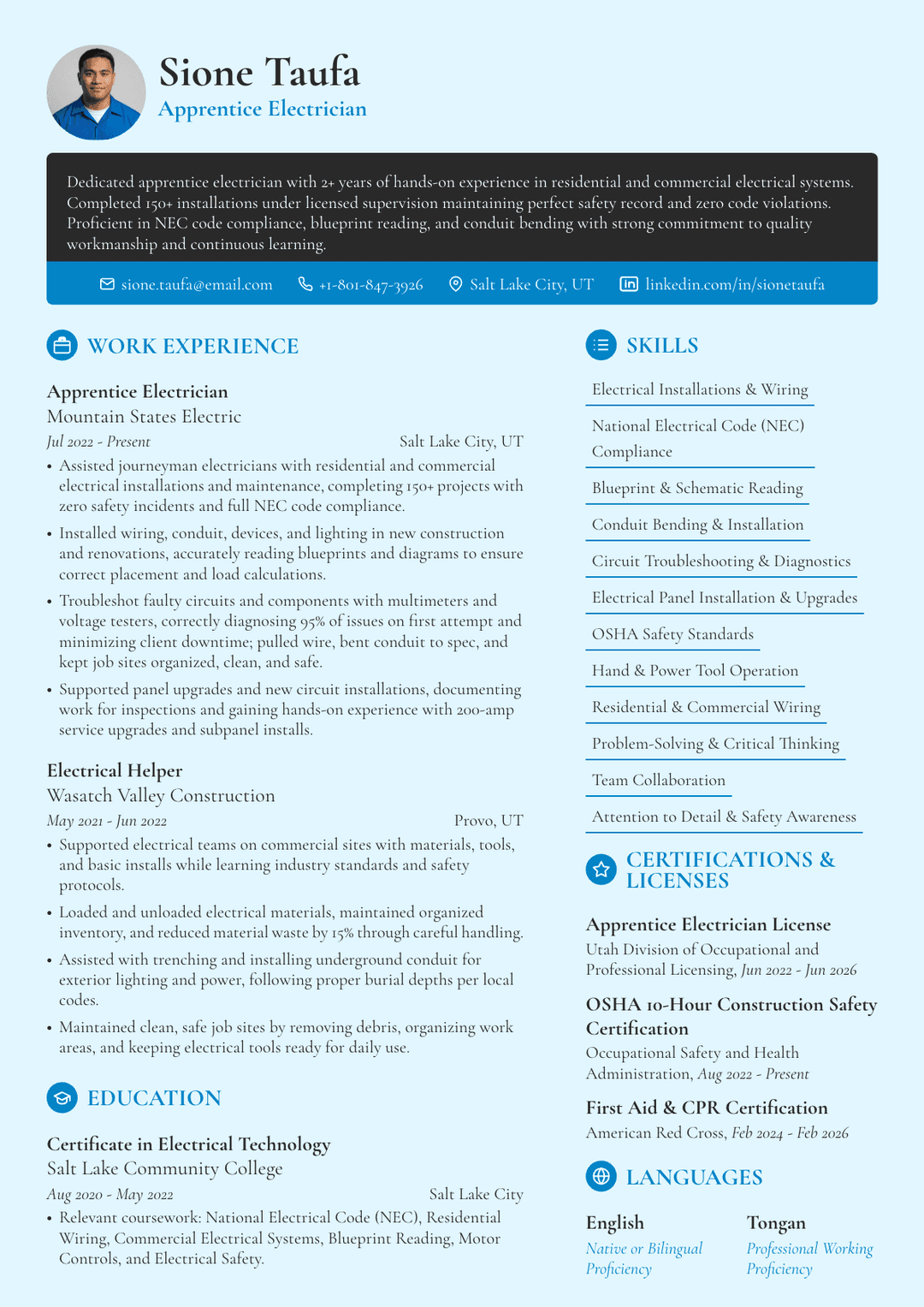
An electrician resume presents your qualifications, practical experience, and compliance with industry standards in a clear, verifiable way.
This type of resume focuses on your ability to install, maintain, and repair electrical systems while following safety regulations and local codes. Plus, beyond a basic work history, it demonstrates reliability, precision, and hands-on expertise, all of which are qualities employers depend on when hiring for roles that directly impact safety and functionality.
Instead of repeating the usual checklist, this article breaks things down more practically. You’ll see how to structure your experience so it reads clearly, which skills actually matter in this field, and how to present the relevant information without clutter. It also covers common mistakes that quietly weaken applications and ways to avoid them.
- Certifications and licenses play a central role in an electrician resume and should be clearly presented in a dedicated section, as employers often review them first.
- Optimizing your resume for applicant tracking systems is essential, which means using relevant keywords from the job posting and keeping the format simple and readable.
- The work experience section should go beyond listing responsibilities by highlighting specific achievements and, when possible, measurable results.
- Choosing the right resume format depends on your level of experience, with reverse-chronological being the most common and effective for steady career progression.
- Tailoring your resume to each job application by adjusting titles, skills, and phrasing can significantly improve your chances of getting noticed.
What Is an Electrician Resume?
An electrician resume is a one-page job-application document that showcases your electrical training, certifications, hands-on experience, and technical skills. Its purpose is to convince prospective employers you're the right candidate for a position in this field.
Everyone entering or advancing in the trade needs one, be they apprentices just wrapping up training, journeymen mid-career, master electricians stepping into leadership, or even career changers coming from related fields. The structure and purpose of writing such a document are the same; what changes is what you emphasize.
Electricians need to put heavy emphasis on credentials. Licenses, certifications, and specific technical competencies aren't optional in their resumes, but often the first thing a hiring manager scans for.
Additionally, their resume also needs to pass through ATS (applicant tracking systems) before any human sees it, which means keyword placement matters as much as formatting.
The BLS projects a job outlook of 9% for this field, which means the competition could be real. Yet, strong, experienced electricians get filtered out every day, even though they obviously don’t lack the skills, because their resume never makes it past ATS. Having this in mind, it’s vital to do your best to optimize yours so that it gets noticed.
3 Exceptional Electrician Resume Examples
To begin with, here’s what several well-built resume examples look like in practice, depending on the expertise level or specific position:
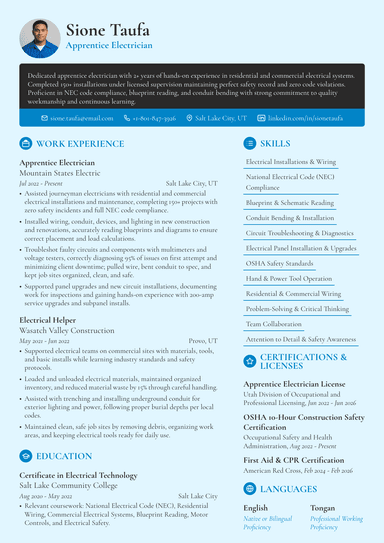
#1. Apprentice Electrician Resume

#2. Electrical Technician Resume

#3. Electrician Resume (No Experience)

Writing an Electrician Resume: A Step-by-Step Explanation
Learning how to write an electrician resume is straightforward when you follow the right structure, which usually looks like this:
#1. Start with a Strong Resume Header
The resume header serves as the introduction, so it’s best to keep it brief and factual. It should contain your full name, phone number, email address, city and state (no full street address needed), and optionally a LinkedIn URL.
Michael Torres
Journeyman Electrician
Phoenix, AZ
(602) 555-8142
m.torres@email.com
It’s recommended to use an ATS-safe font, such as Arial, Calibri, or Times New Roman in 11–12pt, but make your name slightly larger or bold so it anchors the page visually. However, you can skip the photo, Social Security number, and date of birth, as none of those belong on a modern resume and might even cause some hiring discrimination.
#2. Write a Compelling Resume Summary or Objective
The electrician resume summary sits at the very top of your document, just below the header. It should be two to three sentences long, tight, specific, tailored to the role you’re applying for, and focused on your best achievements.
Meanwhile, since entry-level applicants don’t have much (or any) experience, they should opt for a resume objective that spotlights career goals and transferable skills instead. Its purpose is to show that the candidate is willing to learn and accomplish great results even without an extensive work history.
The best way to go here is to mirror the exact wording from the job description in your summary. Speaking the same language as the employer will likely do well with ATS and make the hiring managers notice you.
Now, let’s see how an electrician should write their resume summary:
Licensed Journeyman Electrician with 6 years of experience in residential and commercial wiring. Completed 300+ installations with a perfect safety record. Holds OSHA 30 certification and is proficient in NEC code compliance.
#3. Detail Your Work Experience Section
Use reverse-chronological order and mention your most recent job first. For each position, include job title, employer name, city/state, dates of employment, and four to six bullet points that speak of your best results and accomplishments within the role.
It’s also recommended to start every bullet with a strong action verb, such as installed, diagnosed, managed, reduced, supervised, coordinated, etc. These should also be followed by quantifying the result wherever possible and mentioning suitable KPIs.
The work history section of an electrician looks like this:
Work Experience
Journeyman Electrician
Desert Spark ES, Phoenix, AZ
June 2020 – Present
- Installed and maintained electrical systems in residential and light commercial buildings
- Interpreted blueprints and technical diagrams to complete wiring projects accurately
- Performed troubleshooting on faulty circuits, reducing downtime for clients
- Ensured all work met National Electrical Code (NEC) and local regulations
- Supervised apprentices and reviewed completed work for safety and quality
Electrician Apprentice
Sun Valley Electric, Phoenix, AZ
March 2017 – May 2020
- Assisted licensed electricians with installations, repairs, and inspections
- Pulled wire, installed outlets, switches, and lighting fixtures
- Maintained tools and ensured job sites were clean and safe
- Gained hands-on experience with residential and small commercial systems
As a plus, make sure you also mention project types (residential, commercial, industrial) and any team leadership you handled, especially if you supervised apprentices.
#4. Highlight Your Electrician Skills
Picking the right electrician skills for a resume is critical because that's where ATS systems and recruiters look first when they need a quick read on your technical qualifications. Therefore, it might be best to divide your skills into hard and soft ones and pull directly from the job posting you're targeting.
Let’s see what each of these two categories entails:
| Hard Skills | Soft Skills |
|---|---|
| |
Here’s an example of what it looks like on a resume:
Skills
Hard Skills
- Electrical installations & wiring
- Blueprint & schematic reading
- Troubleshooting & diagnostics
- NEC code compliance
- Panel upgrades & circuit installation
- Preventive maintenance
- OSHA safety standards
Soft Skills
- Team collaboration
- Time management
- Communication
- Problem-solving
- Attention to detail
- Reliability
#5. Mention Industry-Specific Certifications and Licenses
Next, it’s time to pick the electrician certifications for a resume, as they are arguably the most important section. They also don't belong buried inside your education block; they need their own dedicated section.
For each certification, you must include:
- License type (apprentice, journeyman, or master)
- Issuing state
- License number (if you're comfortable sharing it; it’s not mandatory, but could be beneficial)
- Expiration date
Some of the common (and rather appreciated) ones would be:
- Journeyman or Master Electrician License (state-issued)
- OSHA Outreach Training Program
- NFPA 70 compliance training
- NFPA 70E (electrical safety in the workplace)
- BICSI (low-voltage and data cabling)
- EPA 608 (if your work overlaps with HVAC)
- NABCEP (if you work in solar)
- Manufacturer-specific certifications (Siemens, Square D, etc.)
List the most prestigious or job-relevant credential first.
Let’s see what this may look like on a resume:
Certifications & Licenses
- Journeyman Electrician License, State of Arizona. License #: AZ-JE-48291. Expires: March 2027
- Apprentice Electrician License, State of Arizona. License #: AZ-AE-77320. Expires: May 2020
- Master Electrician License, State of Arizona. License #: AZ-ME-15984. Expires: January 2028
Also, don’t stack licenses like this unless they actually apply. Keeping outdated or redundant ones can make the resume look padded rather than stronger, and that won’t benefit your job application.
#6. Add an Education Section
Most electricians don't need a four-year degree, but they still need an education section on their resume, though.
Here, you should list your trade school or apprenticeship program name, location, and completion year.
If you have an associate's or bachelor's degree in electrical engineering or a related field, place it above your trade school entry, as it will definitely carry more weight. Meanwhile, a high school diploma or GED only needs to appear on your resume if you have no other educational credentials to list.
Recent graduates of apprenticeship programs (within the last five to seven years) should also include their completion date; still, if it was more than a decade ago, the year matters less.
A well-written education section looks as follows:
Education
Electrical Technology Certificate
Arizona Western College, Yuma, AZ
Completed: 2017
#7. Tailor Your Resume to the Job Posting
ATS systems scan resumes for keyword matches before a human ever reads them. So, if your resume doesn't hit enough of the right terms, it gets filtered out automatically. Here's how to pass this check and reach the hiring managers:
- Copy the exact job title from the posting (e.g., "Industrial Electrician," not just "Electrician").
- Mirror key phrases from the job requirements section verbatim.
- Avoid graphics, text boxes, and information placed in headers or footers since ATS parsers often skip them entirely.
- Submit as .docx or .pdf, depending on what the posting requests; when in doubt, .pdf preserves formatting better.
- Run your resume through a checker before submitting to make sure it’s ATS-friendly.
How to Pick the Best Resume Format for an Electrician?
The best resume format for an electrician depends on where you are in your career. There are three worth knowing:
- Reverse-chronological. This is the right choice for most electricians or anyone with two or more years of consistent work history. Its purpose is to place your most recent experience on top and work down chronologically. Recruiters prefer it because it shows career progression clearly, and ATS systems handle it reliably.
- Functional. These resumes shed light on skills and are perfect for candidates making a significant career change into electrical work from another field, or if you have substantial employment gaps you'd rather not attract attention to. Yet, many ATS systems parse functional resumes less reliably, which can hurt your visibility, so you should use this format strategically, not as a default.
- Combination. Also known as a hybrid format, this one opens with a strong skills or competencies summary, then flows into a full reverse-chronological work history below. It's a solid fit for journeyman electricians who have both a meaningful skill set to highlight and a solid job history to back it up. It's slightly longer than a straight chronological resume, but when executed well, it covers both bases.
We Have the Recipe for a Perfect Electrician Resume
ResumeBuilder.so makes the process of writing an electrician resume far less trial-and-error and much more structured. Instead of starting from scratch, you’re guided through each section with an intuitive builder that tells you exactly what to include and how to format it.
Our AI-powered assistant suggests skills, bullet points, and job descriptions tailored to your experience, helping you turn basic information into stronger, more professional content!
Beyond that, the platform offers ATS-friendly templates and real resume examples, so you’re not guessing what a “good” resume looks like. You can pick your electrician resume template, its layout, customize it, and instantly preview changes while the system ensures your formatting stays clean and readable.
In short, we combine guidance, design, and AI suggestions in one place so you end up with a resume that looks polished and professional.
Final Thoughts
An electrician resume wins jobs when it's tailored to the role, packed with the right keywords, and makes your certifications and quantified experience easy to find within seconds. Be it an apprentice just entering the trade or a master electrician eyeing a foreman or contracting role, the right structure and language benefits everyone.
The good news is that a strong electrician resume isn't complicated to build; it just needs to be deliberate. Use ResumeBuilder.so to create a professional, ATS-ready electrician resume in minutes with ready-made templates and AI-powered content suggestions, and you’ll get that interview invite in no time!
Electrician Resume FAQ
#1. What should an electrician put on a resume?
An electrician should put a summary, work experience with quantified achievements, a technical skills section, certifications and licenses, trade school or apprenticeship education, and accurate contact information on a resume.
#2. What skills should I list on an electrician resume?
The skills you should list on an electrician resume include hard skills like NEC code compliance, conduit bending, circuit troubleshooting, and blueprint reading, alongside soft skills like problem-solving, attention to detail, and communication.
#3. How do I write an electrician resume with no experience?
To write an electrician resume with no experience, pay special attention to your resume objective, trade school or apprenticeship training, any relevant certifications you obtained, and the description of your transferable skills/volunteer work you've completed.
#4. What certifications should an electrician include on a resume?
The certifications an electrician should include on a resume are their journeyman or master electrician license, OSHA 10 or OSHA 30 certification, NFPA 70E (electrical safety), or any other manufacturer or specialty certifications. It’s also vital to always include the issuing organization and expiration date alongside each entry.
#5. How long should an electrician resume be?
An electrician resume should be one page for candidates with under 10 years of experience, while master electricians or those with extensive project portfolios can extend to two pages.
#6. Do I need a cover letter for an electrician job?
A cover letter isn't always needed for electrician jobs, but it gives you space to explain your career goals, highlight a standout project, and add some personality to your application. It’s best to pair it with your resume for a stronger overall submission.

Max Harper is the resume guru who actually makes job searching easier. With years of experience as a hiring manager, Max knows what makes a resume stand out in a pile of 200+ applications. From breaking down ATS myths to helping you craft bullet points that pop, Max shares easy-to-digest, no-BS resume advice.