How to Craft a Solid Investment Banker Resume (+ Examples)
This complete guide with detailed explanations and expert tips will teach you how to write an acting resume in record time!
Edit this resume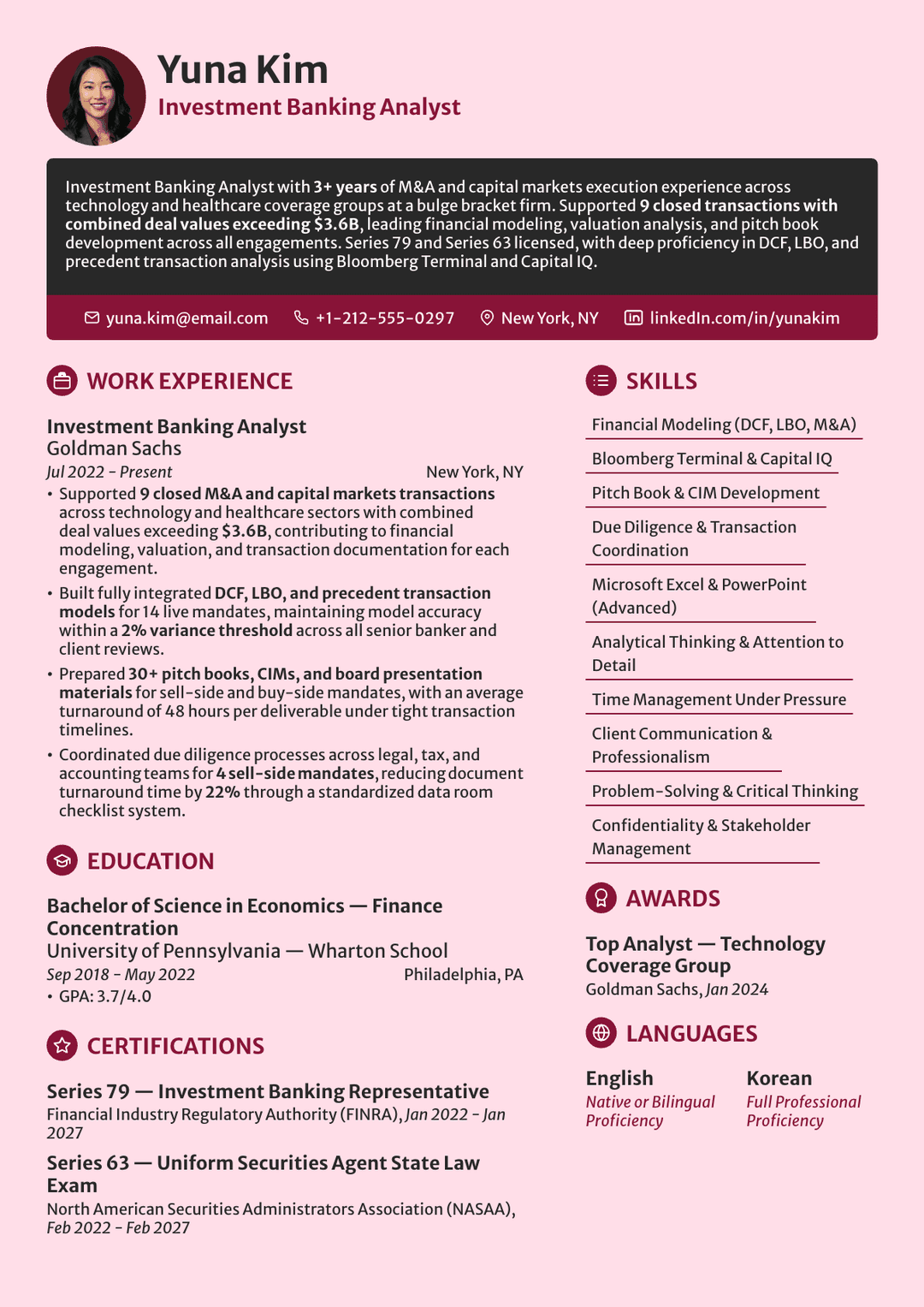
An investment banker resume presents your finance experience, analytical skills, deal exposure, and ability to support high-value transactions. It shows employers that you can handle financial modeling, valuation, market research, pitch books, and other challenges in a fast-paced, high-pressure environment.
In this guide, we’ll break down how to write a resume for investment banking that looks sharp, focused, and credible. You’ll learn which sections to include, what skills hiring managers expect to see, and how to tailor your resume for roles in this and related financial services positions.
- An investment banker resume needs to be precise, highly targeted, and focused on finance-specific experience, including deal exposure, valuation work, financial modeling, and transaction support.
- The most important sections are contact information, a resume summary or objective, education, work experience, skills, certifications, and optional sections such as leadership, languages, or research.
- Good resume bullets should start with action verbs, include measurable results, and show concrete achievements rather than simply listing responsibilities.
- Formatting matters heavily in investment banking, so the resume should usually be one page, clean, text-based, ATS-friendly, and free from icons, columns, graphics, or inconsistent spacing.
- Common mistakes include using a generic template, leaving out a strong GPA, exceeding one page as an analyst candidate, writing vague experience bullets, and allowing even minor spelling or formatting errors.
What Is an Investment Banker Resume?
An investment banker resume is a precision-formatted professional document that presents your academic credentials, deal experience, and finance-specific achievements to hiring managers. It represents a targeted instrument built specifically for the demands of the recruiting pipelines of this field.
Having this in mind, this type of resume must speak the industry's language, which means naming deal types, transaction sizes, modeling methodologies, and software platforms. In other words, you need to show both what you did and confirm you've done the right things in the right way.
GPA matters more in investment banking than almost anywhere else in finance, and 3.5 or above is generally the floor at target schools. Your school's brand carries real weight, too, though candidates from non-target programs can and do break in with strong internship experience and presentation.
According to the Bureau of Labor Statistics, the median salary per year for these professionals is around $101,910, and the job outlook remains faster than average. Given this, it’s safe to say that competition for investment banking roles specifically is intense and unlikely to ease, so to stand out, your resume must be perfect
3 Professional Investment Banker Resume Examples
To better illustrate what this document should look like, you can check out the following examples:
Entry-Level Investment Banker Resume Example

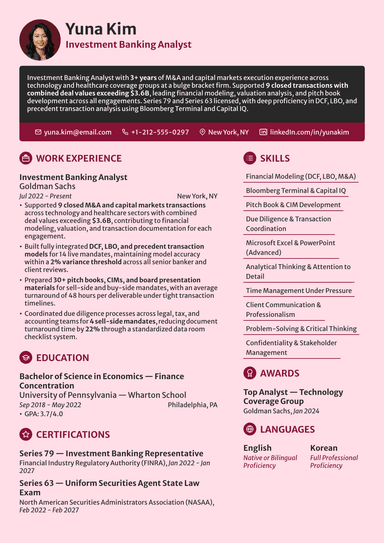
Investment Banking Analyst Resume Example

Investment Banking Associate Resume Example

7 Key Parts of an Investment Banker Resume
Every competitive IB resume is built from the same core sections, and missing or mishandling any one of them can disqualify you before the first interview. Let’s see what these are:
#1. Contact Information
Your contact information section should include your full name, phone number, email address (firstname.lastname@gmail.com), LinkedIn profile, and city/state. Keep your name in a slightly larger font (14–16pt) and the rest in standard 10–11pt text.
Your LinkedIn profile must actually be optimized and consistent with your resume. Recruiters check this, so if, for example, your resume claims you closed a $200M deal, but your LinkedIn profile is sparse, that's a red flag.
Daniel Brooks
New York, NY
(212) 555-0186
daniel.brooks@email.com
linkedin.com/in/danielbrooks123
#2. Resume Summary or Objective
The choice between a resume summary and a resume objective depends on where you are in your career. If you have relevant experience (even an internship), choose the former; if you're a career changer or a student with no finance experience at all, the latter will work better.
For a summary, follow this formula: [Role Target] + [Top Credential] + [Key Strength] + [Value Proposition]. It should be short (2 to 3 sentences) and concise.
Finance graduate from Wharton with a 3.8 GPA and two IB internships seeking an analyst role. Skilled at building detailed operating models, preparing pitch books, conducting market research, and supporting senior bankers through all stages of transaction execution.
#3. Education
In investment banking, especially for undergrad candidates, education often comes before work experience. This part should include institution, degree, GPA (if 3.5 or above), relevant coursework (Valuation, Corporate Finance, Financial Accounting, M&A), honors, and extracurriculars like finance clubs or investment competitions.
If you’re an MBA candidate pursuing associate roles, you should also note the program, graduation year, and any concentration. Firms like to see the school brand clearly, so don't bury it in a dense block of text.
Education
Bachelor of Science in Finance
University of Illinois Urbana-Champaign, Champaign, IL
Graduated: May 2018
- GPA: 3.8/4.0
- Relevant coursework: Corporate Finance, Investment Analysis, Financial Statement Analysis, Econometrics, Business Valuation
#4. Work Experience
The work experience section typically makes or breaks a finance resume. Every bullet should start with a strong action verb and include a quantified result. For each position, you should disclose the job title, the name and location of the company, employment dates, and three to five quantified achievements.
Work Experience
Investment Banking Associate
Morgan Stanley, New York, NY
July 2021 – Present
- Led financial modeling and valuation work for 12+ M&A and capital markets transactions with a combined value of more than $4.8B.
- Built three-statement models, discounted cash flow analyses, leveraged buyout models, and precedent transaction comps to support client recommendations.
- Prepared 40+ pitch books, board presentations, confidential information memoranda, and management discussion materials for technology and industrial clients.
- Coordinated due diligence processes across legal, tax, accounting, and operational teams, reducing document turnaround time by 18%.
- Analyzed company financials, market trends, competitive positioning, and investor materials to identify strategic acquisition and financing opportunities.
- Mentored and reviewed work from 4 junior analysts, improving model accuracy and presentation consistency across the deal team.
- Supported senior bankers during client meetings by preparing briefing materials, transaction updates, and tailored financial analysis.
Deal experience, even in supporting roles, carries significant weight. If you've touched a live transaction, you should name it (within confidentiality limits), too, and quantify your contribution.
#5. Banking Resume Skills
This section should be split into two clear subsections: hard and technical abilities and soft skills. Let’s see the examples of some you can use in your resume:
| Hard/Technical Skills | Soft Skills |
|---|---|
|
|
Skills
Hard/Technical Skills
- Financial modeling
- Mergers & acquisitions
- Discounted cash flow analysis
- Pitch book development
- Due diligence
- Capital markets
- SEC filings
- Bloomberg Terminal
- Capital IQ
- Microsoft Excel
- Microsoft PowerPoint
Soft Skills
- Analytical thinking
- Attention to Detail
- Client communication
- Time management
- Problem-solving
- Confidentiality
- Adaptability
#6. Certifications & Licenses
Certifications show commitment to the profession and, in some cases, are required.
The Series 79 license requirements from FINRA govern who can legally engage in investment banking activities, and meeting them is expected for registered analysts and associates. Series 63 is often paired with it, and the CFA (Level I through III) is a respected credential, too, particularly for research-adjacent and buy-side moves.
When mentioning certifications in your resume, you should state the name, the issuing body, and the expiration date.
Certifications
Series 79 – Investment Banking Representative
FINRAExpires: December 2027
Series 63 – Uniform Securities Agent State Law Exam
NASAAExpires: December 2027
If you’re in the process of obtaining a certification, you can still list it; you just need to note the expected completion date (e.g., “CFA Level II Candidate (Expected June 2025)").
#7. Additional Sections (Optional)
These sections add dimension to your candidacy, especially for non-target school applicants:
- Leadership & activities: finance club president, investment fund manager, case competition placements
- Languages: highly valued for international desks and cross-border deal work
- Publications or research: relevant for candidates with academic finance backgrounds
- Volunteer work: particularly when it demonstrates financial or analytical skills
These sections won't replace strong experience or credentials, but they can create memorable differentiation, and occasionally, a recruiter connection point.
How to Format an Investment Banker Resume
Formatting in an investment banking resume refers to setting the following aspects:
- Length: One page is optimal for analysts and interns. Associates with meaningful pre-MBA experience and MBA credentials may use two pages, but only if every line genuinely adds value.
- Font: Times New Roman or Garamond at 10–12pt is IB-standard for a reason. Avoid anything decorative or "modern" because it looks out of place.
- Margins: 0.5–1 inch on all sides, never below 0.5 inch.
- Header: Name at 14–16pt bold, contact info at 10pt directly below.
- Section dividers: Thin horizontal rules between sections only; you shouldn’t add any icons, color bars, graphics, or columns.
- ATS compatibility: Save as .docx or .pdf (when the ATS explicitly allows PDF), and avoid tables, text boxes, and headers/footers for any meaningful content. ATS systems frequently misread or skip them entirely.
- Consistency: All dates should be right-aligned, all bullets aligned, and you should use uniform verb tenses for past roles.
Recruiters and MDs who spend their careers reviewing pitch books and CIMs have zero patience for messy documents. A poorly formatted resume communicates poor attention to detail before anyone reads a single word, and that’s the last thing you want as a candidate.
6 Common Investment Banker Resume Mistakes to Avoid
Investment bankers are detail-obsessed by trade; it's literally the job, so any error on your resume, however minor, shows you might not be cut out for it. These are the mistakes that quietly tank otherwise strong applications:
- Using a generic resume template with columns, icons, or color bars. These fail ATS and look unprofessional to finance recruiters who expect a clean, text-based document. Instead, you can check out ResumeBuilder’s expert-made templates that are simple, neat, and ATS-friendly.
- Listing responsibilities instead of achievements. Recruiters want to see impact. "Assisted with financial modeling" is a responsibility; "built LBO model supporting $300M acquisition" is an achievement.
- Omitting GPA when it's above 3.5. In IB, leaving out a strong GPA raises flags; recruiters may assume you're hiding a weak one.
- Exceeding one page as an analyst candidate. It signals poor judgment about what's important, which is, ironically, exactly the judgment investment banking demands.
- Inconsistent formatting, such as mixed fonts, misaligned dates, or irregular bullet spacing. One pass of careful proofreading catches this.
- Spelling or grammar errors. One typo is enough for immediate rejection. Read your resume out loud, and then have someone else read it, just in case.
Final Thoughts
An investment banker resume is a precision instrument that sells you to prospective employers, and every word, number, and formatting choice gets evaluated. The firms you're targeting spend their careers analyzing details; your resume is the first test of whether you share that instinct.
Once you're ready to write your job application, ResumeBuilder.so's generator is the fastest way to go from notes to a polished, recruiter-ready document. Use our templates and resume examples as your foundation, as well as our finance resume tips, and you’ll have better chances of catching the attention of the people who may be your next employers!
Investment Banker Resume FAQ
#1. What GPA should I include on an investment banker resume?
Include your GPA if it's 3.5 or above; that's the general threshold in investment banking recruiting. If your major GPA is stronger than your cumulative one, list both. Omitting a GPA below 3.5 is acceptable and common; recruiters understand the signal.
#2. Do I need a cover letter for investment banking applications?
Yes, most investment banking applications should contain a cover letter, particularly alongside bulge bracket resumes and for elite boutique firms. You can use it to explain your motivation for the specific bank, group, and role.
#3. How do I write an investment banker resume with no experience?
When writing an investment banker resume with no experience, emphasize your education section, relevant coursework, finance club leadership, or investment competition results. Additionally, any internship (even non-IB finance roles) belongs in your experience section and can help you show your skills.

Max Harper is the resume guru who actually makes job searching easier. With years of experience as a hiring manager, Max knows what makes a resume stand out in a pile of 200+ applications. From breaking down ATS myths to helping you craft bullet points that pop, Max shares easy-to-digest, no-BS resume advice.