Mechanical Engineering Resume: Tips for Writing a Solid One
This complete guide with detailed explanations and expert tips will teach you how to write an acting resume in record time!
Edit this resume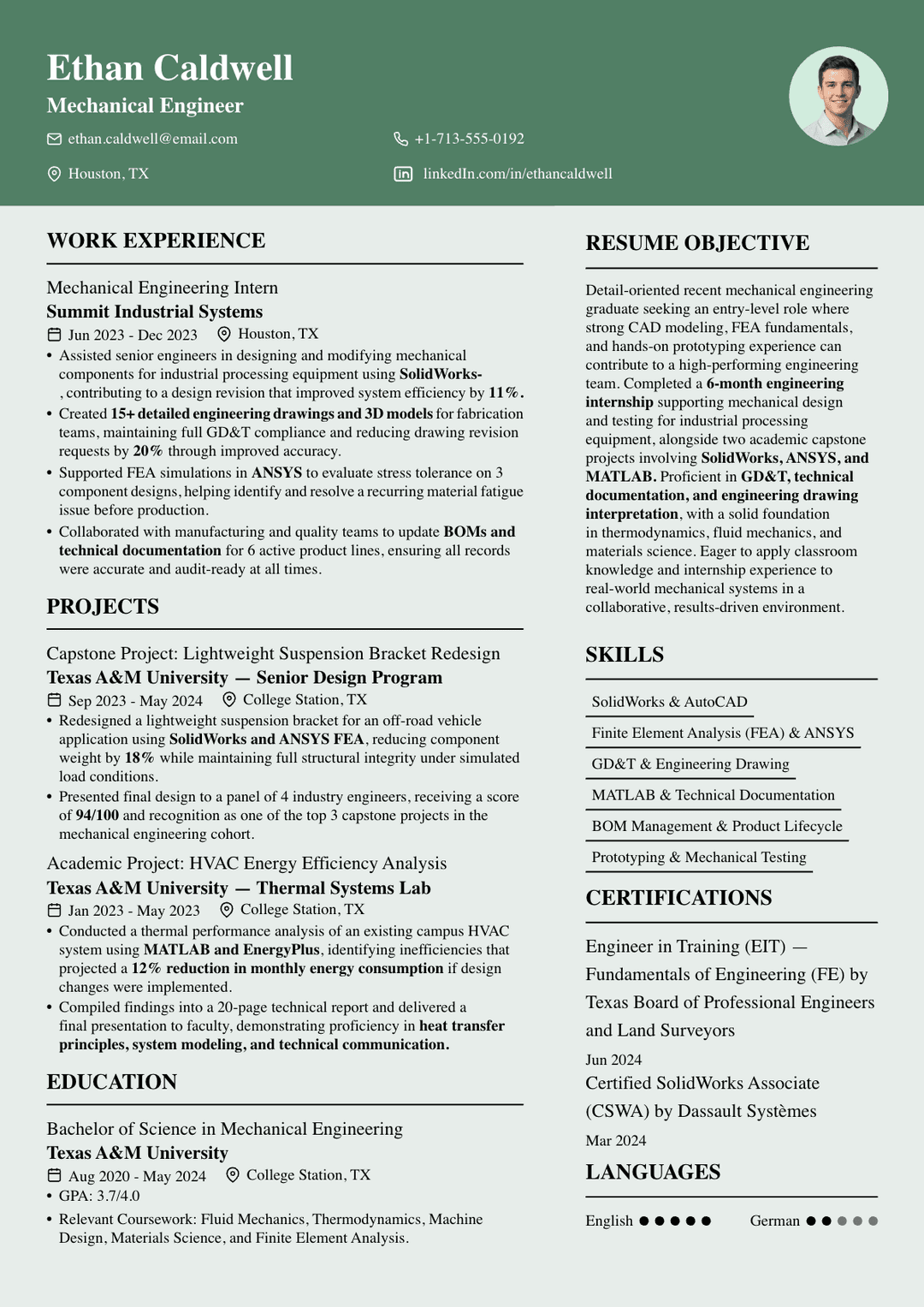
A mechanical engineering resume is a short job application document that highlights the technical knowledge, experience, and problem-solving abilities needed to succeed in this field. It shows employers how well you can apply engineering principles to design, test, manufacture, and improve mechanical systems and components.
To help you write one, we offer a step-by-step breakdown of every resume section, tailored examples for entry-level, mid-career, and senior engineers, and practical tips for passing ATS. We'll also cover everything from the right format to choose, to which certifications to list, to the exact kind of bullet points that make hiring managers stop scrolling.
- A mechanical engineering resume should clearly show your technical skills, software knowledge, engineering specialty, and the measurable results of your work.
- The reverse-chronological format is usually the best choice because it highlights career growth clearly and works best with ATS systems.
- A strong skills section should group technical skills into categories and separate them from soft skills so the resume is both ATS-friendly and easy to read.
- Work experience bullet points should focus on achievements, engineering tools, and quantified impact instead of vague duties or generic responsibilities.
- Tailoring your resume and cover letter to each job posting by matching relevant keywords and requirements can significantly improve your chances of getting noticed.
What Is a Mechanical Engineering Resume?
A mechanical engineering resume presents your technical skills, work history, and qualifications to employers hiring in this field. Its purpose is specific: to demonstrate hands-on engineering competencies, software proficiency, and the quantified impact of your projects.
Mechanical engineering is a broad discipline that covers everything from HVAC systems and automotive components to aerospace structures and medical devices. So, your resume needs to communicate not just that you're an engineer, but which kind of engineer, and what you've actually built, optimized, or solved.
Additionally, most mid-to-large engineering employers run applications through applicant tracking systems (ATS) before a human ever sees them. To pass this check, you should write a resume that’s structured and keyword-rich enough to clear that first gate.
After all, the job outlook for mechanical engineering jobs is 9%, and there will be roughly 18,100 new openings every year. That's a lot of competition, so a well-crafted resume for your specific role is what can separate you from others and increase your hiring chances.
Mechanical Engineering Resume Examples
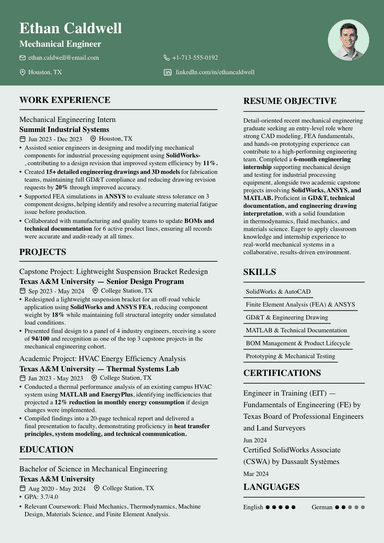
Before we go into the sections that a good mechanical engineering resume should contain, let’s see a few examples of the entire document:
Entry-Level Mechanical Engineering Resume

Mid-Level Mechanical Engineering Resume

Senior Mechanical Engineering Resume

How to Format a Mechanical Engineering Resume
Mechanical engineering resumes can follow one of the three main formats:
#1. Reverse-Chronological Format
As the best resume format for engineers with two or more years of experience, the chronological format lists your most recent role first and works backward. It's what most hiring managers expect, and it's also the most compatible with ATS systems.
Besides that, this format shows career progression clearly, including promotions, increasing project scope, expanding responsibilities, and similar. This is why it’s almost always the right call for standard mechanical, manufacturing, aerospace, and automotive roles.
#2. Functional (Skills-Based) Format
The functional resume is the best option for career changers or candidates with significant gaps in their work history. Its primary focus is on a robust skills section before listing employment dates.
This format is less common in engineering, and some ATS systems handle it poorly, which can hurt your chances before anyone reads a word. Therefore, it’s recommended to use it only when a straightforward timeline would raise more questions than it answers.
#3. Combination (Hybrid) Format
And finally, the hybrid (or combination) resume format stands as the best one for senior engineers switching industries or specialists with a wide skill set that's hard to convey through job titles alone. A prominent skills block sits at the top, followed by a complete reverse-chronological experience section.
If you're moving from defense engineering into medical devices, for example, this format helps surface transferable expertise quickly.
Mechanical Engineering Resume Sections
Here's how to build each section of your mechanical engineering resume from top to bottom:
#1. Contact Information
Keep this clean and professional; include your full name, email address, phone number, and city/state, skipping the full street address. You can also add your LinkedIn profile URL; engineers are expected to have one, and recruiters will definitely check for it.
Additionally, if you have a GitHub profile, a design portfolio, or a personal engineering site worth showing, link to it here, too. It’s best to avoid photos, date of birth, or anything that invites unconscious bias, which may cause hiring discrimination.
Here’s what this looks like:
Daniel Bowman
Houston, TX 77002
(713) 555-0184
daniel.bowman@email.com
LinkedIn: linkedin.com/in/danielbowman123
Portfolio: danielbowmanjr.com
#2. Mechanical Engineer Resume Summary or Objective
This short paragraph at the beginning of your resume is your first impression, and it should be written in a way that gives a hiring manager a reason to keep reading. There are two types you can choose from, depending on your experience level:
- Resume summary (for candidates with 2+ years of experience). This option should illustrate your engineering specialty, years of experience, and one concrete achievement.
- Resume objective (for entry-level candidates or career pivots): A mechanical engineer resume objective should focus on career goals, transferable skills, and what the candidate brings to the employer rather than what they want from the company.
An example of a well-written resume summary would be:
Detail-oriented Mechanical Engineer with 5+ years of experience designing, testing, and improving mechanical systems for manufacturing and industrial applications. Skilled in CAD modeling, FEA, root cause analysis, and cross-functional project coordination. Proven track record of reducing production costs, improving equipment reliability, and supporting product development from concept to implementation. Strong communicator with hands-on problem-solving abilities and a solid background in process optimization.
#3. Skills Section
For mechanical engineers, this might be the most ATS-critical section in the entire document.
Parsers scan it aggressively for software names, methodologies, and industry terms, so you should break it into subcategories so it's readable for humans, too. As per the occupational profile for mechanical engineers, the most in-demand competencies include systems analysis, complex problem-solving, and design software proficiency.
A mechanical engineering resume skill section can include:
- Software & tools, such as SolidWorks, AutoCAD, CATIA, ANSYS, MATLAB, LabVIEW, Pro/ENGINEER, and COMSOL
- Engineering methods, including FEA (Finite Element Analysis), GD&T, Lean Manufacturing, Six Sigma, DFMEA, etc.
- Manufacturing processes, e.g., CNC machining, additive manufacturing, 3D printing, and rapid prototyping
- Soft skills, such as cross-functional collaboration, project management, communication, and similar
It’s important not to list skills you can't back up. Interviewers will probe the skills section directly, so, for instance, claiming ANSYS proficiency when you've only done basic tutorials is a conversation you don't want to have.
Here’s an example of a skills section for this role:
Skills
- CAD & Design Software: SolidWorks, AutoCAD, CATIA
- Engineering Analysis & Testing: Finite Element Analysis (FEA), ANSYS, Mechanical Testing, Root Cause Analysis, Tolerance Analysis
- Manufacturing & Process Improvement: Lean Manufacturing, Six Sigma Principles, DFMEA, PFMEA, Prototyping, Preventive Maintenance Planning
- Technical Knowledge: GD&T, Product Design, HVAC Systems Knowledge, PLC Fundamentals, Technical Documentation, BOM Management
- Programming & Engineering Tools: MATLAB
- Soft Skills: Problem-solving, Analytical Thinking, Team Collaboration, Communication, Project Coordination, Time Management, Adaptability, Attention to Detail, Leadership, Decision-Making
#4. Work Experience
Your work experience section should feature the roles you previously held in reverse-chronological order: job title, company name, location, dates of employment, and bullet-pointed achievements below each entry.
Numbers, software names, scope of impact; that's what makes a bullet worth reading. You should imitate the language from the job description wherever it fits naturally; keyword matching here strengthens your ATS score without feeling forced.
You can do it like this:
Work Experience
Mechanical Engineer
LS Process Systems, Houston, TX
June 2021 – Present
- Designed and modified mechanical components and assemblies for industrial processing equipment, improving system efficiency by 14%.
- Created detailed 3D models and engineering drawings in SolidWorks for fabrication and production teams.
- Conducted FEA simulations to evaluate stress tolerance and reduce material failure risks during product development.
- Collaborated with manufacturing, quality, and procurement teams to cut production costs by $48,000 annually through design improvements.
- Led root cause investigations on recurring equipment issues, reducing unplanned downtime by 19%.
- Developed and updated BOMs, technical reports, and design change documentation to support product lifecycle management.
Mechanical Design Engineer
Red Canyon Manufacturing, Dallas, TX
March 2018 – May 2021
- Developed mechanical designs for custom metal assemblies and machine components used in high-volume production environments.
- Improved assembly line tooling layouts, increasing production throughput by 11%.
- Performed tolerance stack-up analyses and applied GD&T principles to improve part fit and manufacturability.
- Coordinated prototype builds and test procedures, helping shorten development cycles by 16%.
- Supported quality assurance efforts by analyzing product defects and implementing corrective design changes.
- Partnered with vendors and internal teams to ensure compliance with cost, quality, and performance requirements.
#5. Education
The standard minimum for a mechanical engineering role is a Bachelor of Science in Mechanical Engineering. However, closely related fields, such as materials science, aerospace engineering, or mechatronics, are also accepted by many employers.
Your education details should feature the university name, location, degree, and graduation year. It’s recommended to include your GPA if it's 3.5 or above, too, but if you graduated more than five years ago, you can safely drop it.
For entry-level resumes, it can also be beneficial to add relevant coursework, such as fluid mechanics, thermodynamics, materials science, machine design, etc. Honors, thesis projects, and extracurricular engineering teams (SAE Formula, ASME student chapter, robotics competitions) can substitute for limited work history on a junior resume, too.
In practice, this section looks as follows:
Education
Bachelor of Science in Mechanical Engineering
Texas A&M University, College Station, TX
Graduated: 2017
- GPA: 3.8
#6. Certifications and Licenses
Certifications tell employers you've met an external standard, and in engineering, some of them carry significant weight. The most valuable ones for mechanical engineers include:
- Professional Engineer (PE) License: highly respected, especially for public-sector, infrastructure, or consulting work, and legally required for certain projects.
- Engineer-in-Training (EIT) / Fundamentals of Engineering (FE): essential for recent graduates who haven't yet earned their PE.
- Certified SolidWorks Professional (CSWP): a vendor-recognized credential that signals genuine software fluency.
- Lean Six Sigma (Green or Black Belt): valued in manufacturing and operations roles.
- Project Management Professional (PMP): increasingly relevant for senior engineers moving into program management.
List each with the certification name, issuing body, and year obtained. If you're currently pursuing one, note "In Progress" with the expected completion date.
Here’s how:
Certifications
- Engineer in Training (EIT), Texas Board of Professional Engineers and Land Surveyors, 2017
- Certified SolidWorks Associate (CSWA), Dassault Systèmes, 2018
- Lean Six Sigma Green Belt, International Association for Six Sigma Certification (IASSC), 2020
#7. Projects Section (Optional but Recommended)
For entry-level candidates with limited work history, this section can make or break a resume. Academic capstone projects, personal engineering builds, competition entries, and open-source CAD contributions all count and belong here.
You should format it as you did with work experience, by stating the project name, a short description, and the outcome. If you're a senior engineer, consider weaving your most notable project directly into the relevant work experience entry rather than maintaining a separate section.
Let’s see how you should format this section:
Projects
Automated Conveyor Redesign
- Redesigned a conveyor support system for a manufacturing client, reducing vibration issues by 22% and extending equipment lifespan.
- Used SolidWorks and ANSYS to model and test revised structural components before fabrication.
Energy Efficiency Upgrade Initiative
- Supported a plant-wide mechanical upgrade project focused on reducing energy consumption in pump and motor systems.
- Contributed to an analysis that helped lower monthly energy usage by 9%.
How to Make an ATS-Friendly Mechanical Engineering Resume
You can make a mechanical engineering resume ATS-friendly by:
- Mirroring job description language. If the posting says "finite element analysis," use that exact phrase, not just "FEA."
- Using normal section headings. It should be "Work Experience," "Education," "Skills"; avoid creative titles like "Where I've Been."
- File format matters. Submit as .docx or .pdf; check the job posting, because some systems handle one better than the other.
- Work in keywords naturally. Aim for 8–12 relevant technical terms and software names distributed throughout the document.
- Use a solid resume template. ResumeBuilder.so offers a wide selection of industry-specific templates made by experts. You can pick one, enter the basic information we need about your work history and skills, and we can make you a resume that will pass any ATS check in no time.
Writing a Mechanical Engineer Cover Letter
Pairing your mechanical engineer resume with a focused cover letter meaningfully increases your response rate, especially when the role is competitive. Here are some tips for writing one:
- Open with a hook, which can be a specific achievement or the exact role title from the posting.
- In the second paragraph, connect your most relevant technical skills and tools to the job's requirements, and make sure you’re as concrete as possible.
- The third paragraph should show you've done your homework on the company: their products, their industry challenges, or something specific about their engineering culture.
- Close with a clear call to action and a note on your availability.
- Keep it to one page and match the formatting of your resume.
Besides helping you polish your resume, our platform also offers professional cover letter examples and templates you can use for your job application!
Final Thoughts
Writing a strong mechanical engineering resume requires a clear structure, tailored keywords, and quantified impact. The principles are the same regardless of your previous experience; you need to show what you built, how you built it, and what difference it made.
Knowing how to write a solid job application for this role and pair it with a strong cover letter, as well as tailoring both documents to every specific application, makes a true difference. Do so, and you'll be well ahead of most candidates in any engineering job search!
Mechanical Engineering Resume FAQ
#1. What is the best format for a mechanical engineering resume?
The best mechanical engineering resume format is reverse-chronological. It places your most recent and relevant experience first, making it easy for hiring managers to assess your career progression, and it's the most compatible with ATS systems. This is especially important, as most large employers screen digitally.
#2. How do I write a mechanical engineering resume with no experience?
You can write a mechanical engineering resume with no experience by leading with your education, listing relevant coursework, academic projects, and internships, and highlighting the technical tools you're proficient in, such as SolidWorks or MATLAB. A clear resume objective can also frame your potential and fit for the specific role.
#3. How long should a mechanical engineering resume be?
A mechanical engineering resume should be one page for candidates with fewer than five years of experience, and up to two pages for senior engineers. Every line should earn its place, so make sure you never increase your resume length with generic responsibilities or filler phrases.
#4. Do I need a PE license for a mechanical engineering resume?
You don't need a PE license for most mechanical engineering positions. That said, listing one (or mentioning an EIT/FE certification for recent graduates) significantly strengthens your resume, particularly for public-sector, infrastructure, or consulting roles where licensure is either expected or legally required.

Max Harper is the resume guru who actually makes job searching easier. With years of experience as a hiring manager, Max knows what makes a resume stand out in a pile of 200+ applications. From breaking down ATS myths to helping you craft bullet points that pop, Max shares easy-to-digest, no-BS resume advice.