Product Manager Resume: How To Write One and Get the Job
This complete guide with detailed explanations and expert tips will teach you how to write an acting resume in record time!
Edit this resume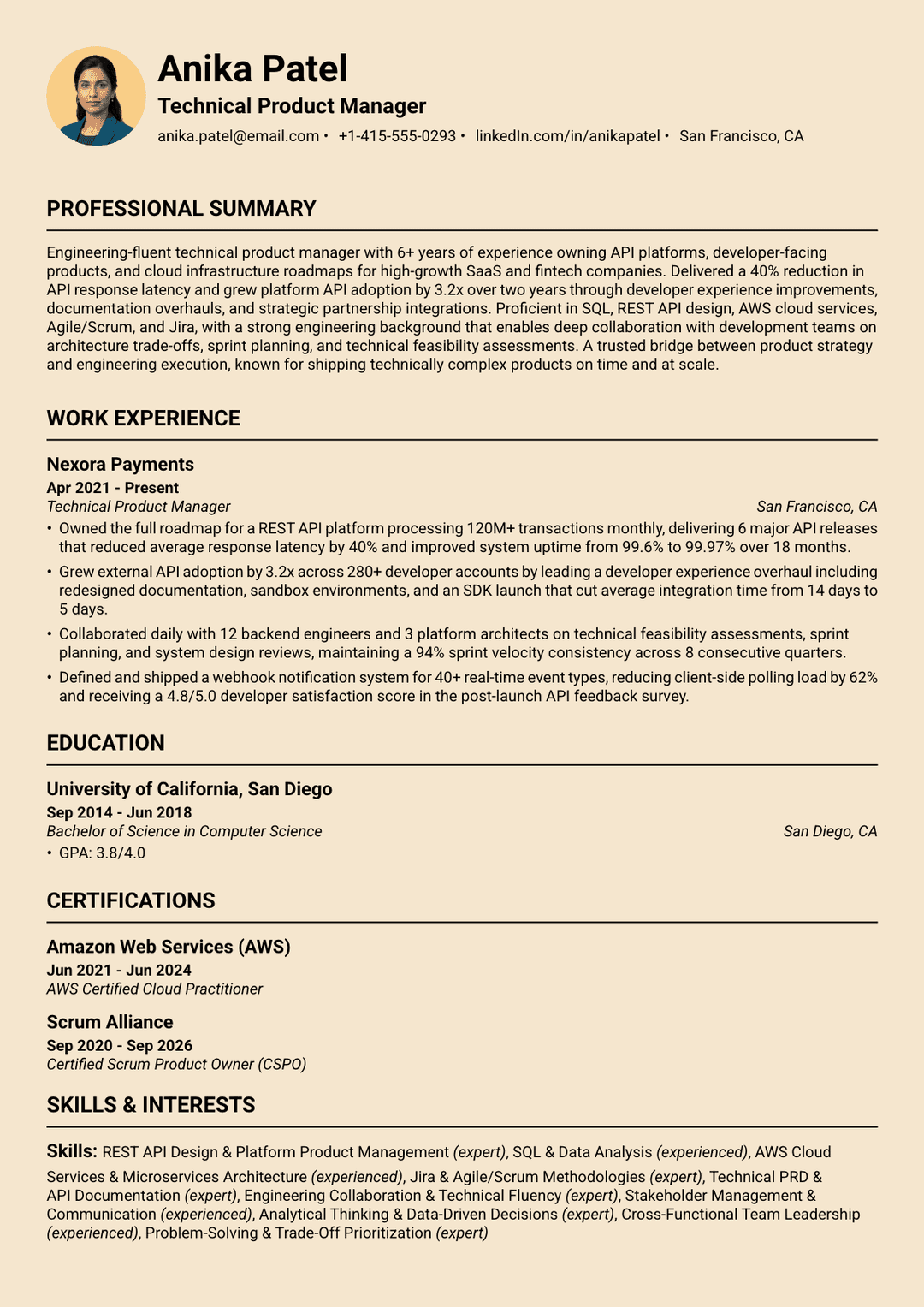
A product manager resume is a short but powerful document that highlights all the abilities and competencies that make you a good fit for such a role. It should show employers how you define product strategy, work with cross-functional teams, analyze data, prioritize features, and deliver results that improve user experience and business performance.
In this guide, you’ll learn how to write a strong product manager resume that presents your experience clearly and convincingly. We’ll cover what to include in each section, how to describe your achievements with measurable results, and which product management skills are worth highlighting. Let’s get to reading!
- A solid product manager resume should prove product leadership through measurable achievements, not just list responsibilities.
- The reverse-chronological format is usually the best choice because it puts your most recent and relevant PM experience first.
- Product manager resume bullets should include metrics such as revenue growth, user growth, churn reduction, engagement rates, or faster release cycles.
- An ATS-friendly product manager resume needs simple formatting, clear section headers, and keywords taken directly from the job description.
- Every product manager resume should be tailored to the specific role by adjusting the summary, skills, and work experience bullets to match the employer’s priorities.
What Is a Product Manager Resume?
A product manager (PM) resume is a professional document that presents your experience, skills, and accomplishments specifically through the lens of product leadership. Rather than a simple, general work history, it's a curated argument for why you can own a product from conception to launch and deliver measurable results.
The main difference between a PM resume and a generic one lies in what it proves. Hiring managers aren't reading to learn what a product manager does because they already know that. They're, in fact, looking for evidence that you've done it well, including proof of your cross-functional leadership, data-driven decisions, product strategy, and real business impact.
Additionally, according to the Bureau of Labor Statistics, management roles like product management specialist continue to grow with a steady outlook (6%), which means competition is stiff and differentiation matters more than ever.
4 Product Manager Resume Examples
Here are four tailored product manager resume examples across experience levels and backgrounds:
#1. Entry-Level Product Manager Resume Example

#2. Senior Product Manager Resume Example

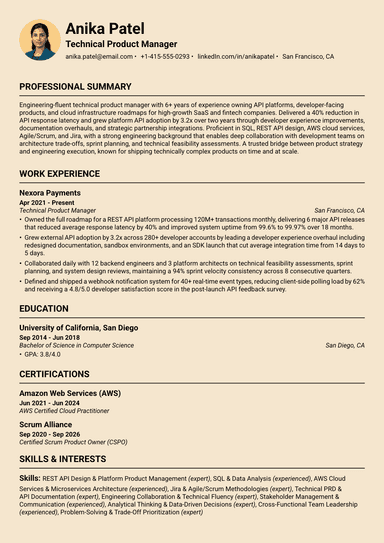
#3. Technical Product Manager Resume Example

#4. Career Changer Product Manager Resume Example

How to Write a Product Manager Resume: A-Z Guide
Writing a strong product manager resume comes down to telling a clear, results-driven story section by section, without fillers. Here's how to build it:
#1. Choose the Right Format
First of all, when it comes to resume format, reverse-chronological is the right call for most product manager candidates. It puts your most recent and relevant experience first, while functional or hybrid formats work for career changers with limited PM experience (and they tend to raise flags with recruiters who've seen them used to hide gaps).
Also, modern PDFs parse cleanly through most ATS platforms, so default to PDF unless the job posting says otherwise.
#2. Write a Strong Product Manager Resume Summary
Your resume summary is the first thing a recruiter reads after your name, and often the last thing if it doesn't grab them. It counts as your 30-second pitch compressed into 2–4 sentences, and it should cover:
- Years of experience
- Your core competency
- Headline achievement
- The type of PM role you're targeting.
Here's the before/after version:
Weak
"Experienced product manager with 7 years in tech."
"Product manager with 7+ years launching B2B SaaS products. Grew ARR by $4M and reduced churn by 18% through data-driven roadmap decisions. Seeking a senior PM role at a growth-stage startup."
The second version takes 10 seconds to read and gives a recruiter three concrete reasons to keep going.
For entry-level candidates, a product manager resume objective works better than a summary, as it focuses on what you're aiming for rather than a career history you don't yet have.
#3. Describe Your Work Experience with Metrics
This is where most PM resumes either win or lose the application. Each entry you add to this section should feature the job title you held, the name and location of the company, as well as dates of employment.
Every bullet in your experience section should follow the Task-Action-Result (TAR) structure, or Google's XYZ formula ("Accomplished X, as measured by Y, by doing Z"). The rule is simple: if a bullet doesn't include a result, it's just a job description.
In your work experience section, hiring managers are specifically looking for revenue impact, user growth, engagement rates, time-to-market gains, and efficiency improvements. Estimates are fine if exact figures are confidential, since "approximately 30% reduction" is still better than no number at all.
Here are three examples of strong PM experience bullets using action verbs that carry weight:
- "Led cross-functional team of 11 engineers to launch a mobile payments feature, increasing monthly active users by 34%."
- "Streamlined sprint planning using Scrum, cutting release cycle time by 3 weeks across two product squads."
- "Defined and shipped an AI-powered recommendation engine that boosted average order value by 19% within 90 days of launch."
Tailor these bullets to the specific job description by following its language and product manager resume keywords because ATS systems reward exact-match terminology.
#4. List the Right Product Manager Resume Skills
The key product manager skills for a resume include a mix of hard technical competencies and interpersonal leadership abilities, and how you frame them matters as much as which ones you list.
According to Springboard’s 2024 State of the Workforce Skills Gap report, strategic and critical thinking were the top soft skills that leaders said their companies needed most, while communication was also among the top three, cited by 46% of leadership.
Yet, listing a skill isn't enough; you should prove it wherever possible. If "data analysis" is on your skills list, your experience bullets should reference SQL queries you ran, Amplitude dashboards you built, or A/B tests you designed. Skills that aren't reflected in your work history look like wishful thinking.
Furthermore, you should cross-reference three to five job descriptions for the roles you're targeting and note which skills appear repeatedly. Those are your priority inclusions; everything else is secondary.
Finally, the skills section isn't a place to dump every tool you've ever touched. It should be a curated, strategic list that directly maps to what the hiring team is looking for. Split it into two categories:
- Hard skills (technical and tool-based), which should include abilities such as:
- Product roadmapping (Aha!, Productboard, Jira)
- Agile/Scrum methodologies (Jira, Linear, Notion)
- Data analysis (SQL, Amplitude, Mixpanel, Google Analytics)
- A/B testing and experimentation (Optimizely, LaunchDarkly)
- User story writing/backlog management (Jira, Azure DevOps)
- Wireframing and prototyping (Figma, Balsamiq)
- Soft skills (apart from those mentioned above), which should entail:
- Cross-functional team leadership
- Stakeholder management
- Presentation skills
- Customer empathy and UX intuition
#5. Add Your Education and Certifications
For experienced PMs, education goes below work experience because your accomplishments speak louder than the studies you finished. However, you should still include your highest degree, institution, and graduation year in this section; you just need to keep it brief.
Furthermore, product manager certifications for a resume carry more weight than many product managers realize, especially for career changers or candidates with shorter direct PM experience.
Some high-value options include:
- Certified Scrum Product Owner (CSPO): widely recognized, especially at Agile-native companies
- PMI Agile Certified Practitioner (PMI-ACP): rigorous, respected across industries
- Product School certifications (practical and PM-specific)
- Google Project Management Certificate (via Coursera/edX): accessible and increasingly common on entry-level resumes
If you're pivoting from another field, a relevant certification listed prominently near the top can bridge a lot of credibility gaps.
#6. Make It ATS-Friendly
Applicant tracking systems (ATS) scan your resume before a human ever reads it. At large companies, their filters can eliminate dozens of applicants automatically. So, a resume that's formatted incorrectly might strip out key content entirely, even if your experience is perfect for the role.
Here are some practical rules you should follow to avoid this:
- Use simple resume section headers, such as "Work Experience" or "Skills".
- Avoid columns, text boxes, headers/footers, graphics, or tables in the resume structure itself
- Stick to recommended resume fonts, such as Arial, Calibri, or Times New Roman, at 10–12pt
- Include keywords from the job description verbatim without paraphrasing
- Save as PDF (unless the posting says otherwise)
How to Tailor Your Product Manager Resume for Each Application
The difference between a generic and a tailored product manager resume comes down to three steps:
- Read the job description carefully. Highlight every required skill, tool, and outcome they mention. These are your keywords.
- Match your bullets and summary language. If the job description says "own the product roadmap," your experience section should use that phrase, not "managed the backlog" or "led product planning." ATS systems and recruiters both reward this kind of alignment.
- Adjust your skills section. Lead with the competencies most relevant to this specific role. A growth PM role should surface experimentation and analytics; an enterprise PM role should front stakeholder management and executive communication.
5 Product Manager Resume Mistakes to Avoid
Here are five resume mistakes product managers often make that you should watch for:
- Listing duties instead of achievements. Recruiters want to know what you did better, faster, or differently than other candidates and whether you can prove it with numbers.
- Using one resume for every application. Generic resumes fail ATS screening and don’t speak to the specific needs of each role. A few minutes of tailoring per application makes a meaningful difference in response rates.
- Burying experience under a “bloated” summary. Your summary should be three to four lines. Every sentence after that is an addition that should go to your work history, which is what actually gets you hired.
- Ignoring ATS formatting rules. Graphics look great in design terms, but often get parsed incorrectly, making your content useless in the process. Meanwhile, clean, simple formatting is always a great idea.
- Skipping quantification. Any achievement without a number is a missed opportunity. Be it revenue, users, time saved, or error rates reduced, you should pick the metric that makes your impact concrete.
Build a Top-Notch Product Manager Resume Faster With Our Platform
Making a new product manager resume from scratch can take hours, especially if you’re trying to balance strategy, technical skills, leadership, and measurable product outcomes. Luckily, ResumeBuilder.so can make the process much easier by guiding you through each step of resume creation and helping you build a professional document in minutes!
The platform offers an easy-to-use builder, real-time preview, multiple download formats, and AI-powered suggestions based on your industry and experience level. Additionally, our templates are designed and tested to pass applicant tracking systems, which can help you create a cleaner, ATS-friendly product manager resume in no time.
For extra guidance, you can also browse our resume examples by profession and use them as an idea of how to describe your own experience, achievements, and skills. Instead of copying an example directly, you can use it to understand structure, wording, and the kind of results-focused bullet points employers expect.
Final Thoughts
Good product manager resumes share three qualities: they're achievement-driven, ATS-optimized, and tailored to each role. The gap between getting screened out and getting called in is almost always a formatting issue, a missing metric, or a mismatch in keywords, not a lack of actual experience.
Before sending your resume, take one final pass through it with the job description beside you. A well-written one should both list what you were responsible for and prove that you can identify problems, align teams, make smart trade-offs, and ship products that move business goals forward.
When your resume is clear, specific, and closely matched to the role, it gives hiring teams fewer reasons to hesitate and more reasons to move you forward!
Product Manager Resume FAQ
#1. How long should a product manager resume be?
A product manager resume should be one page long in most cases, especially if you’re a professional with under 10 years of experience. Yet, senior PMs with extensive portfolios may extend to two pages, but they should avoid filler content that dilutes the impact of their strongest material.
#2. What skills should a product manager put on a resume?
Product managers should include both hard skills (like roadmapping, Agile, SQL, and analytics tools) and soft skills (such as stakeholder management, cross-functional leadership, and strategic thinking). You should always tailor your list of abilities to match the keywords in the specific job description you're applying to.
#3. How do I write a product manager resume with no experience?
To write a product manager resume with no experience, you should opt for a resume objective and then highlight internships, academic projects, or side products you've managed. Besides this, you should also include PM certifications and relevant coursework, and focus on transferable skills from previous roles that map to product thinking.
#4. What format is best for a product manager resume?
The reverse-chronological format is best for most product manager resumes because it shows your most recent and relevant experience first, which recruiters prefer. Still, career changers with limited PM experience may benefit more from a hybrid or functional format that leads with transferable skills.
#5. Do product manager resumes need to be ATS-friendly?
Yes, product manager resumes must be ATS-friendly because many companies use applicant tracking systems to filter resumes before a recruiter ever sees them. To avoid getting eliminated from the candidate pool, make sure you use simple formatting without graphics, and include keywords from the job description verbatim to pass initial screening.

Max Harper is the resume guru who actually makes job searching easier. With years of experience as a hiring manager, Max knows what makes a resume stand out in a pile of 200+ applications. From breaking down ATS myths to helping you craft bullet points that pop, Max shares easy-to-digest, no-BS resume advice.