Student Resume: How to Write One That Actually Gets Noticed
This complete guide with detailed explanations and expert tips will teach you how to write an acting resume in record time!
Edit this resume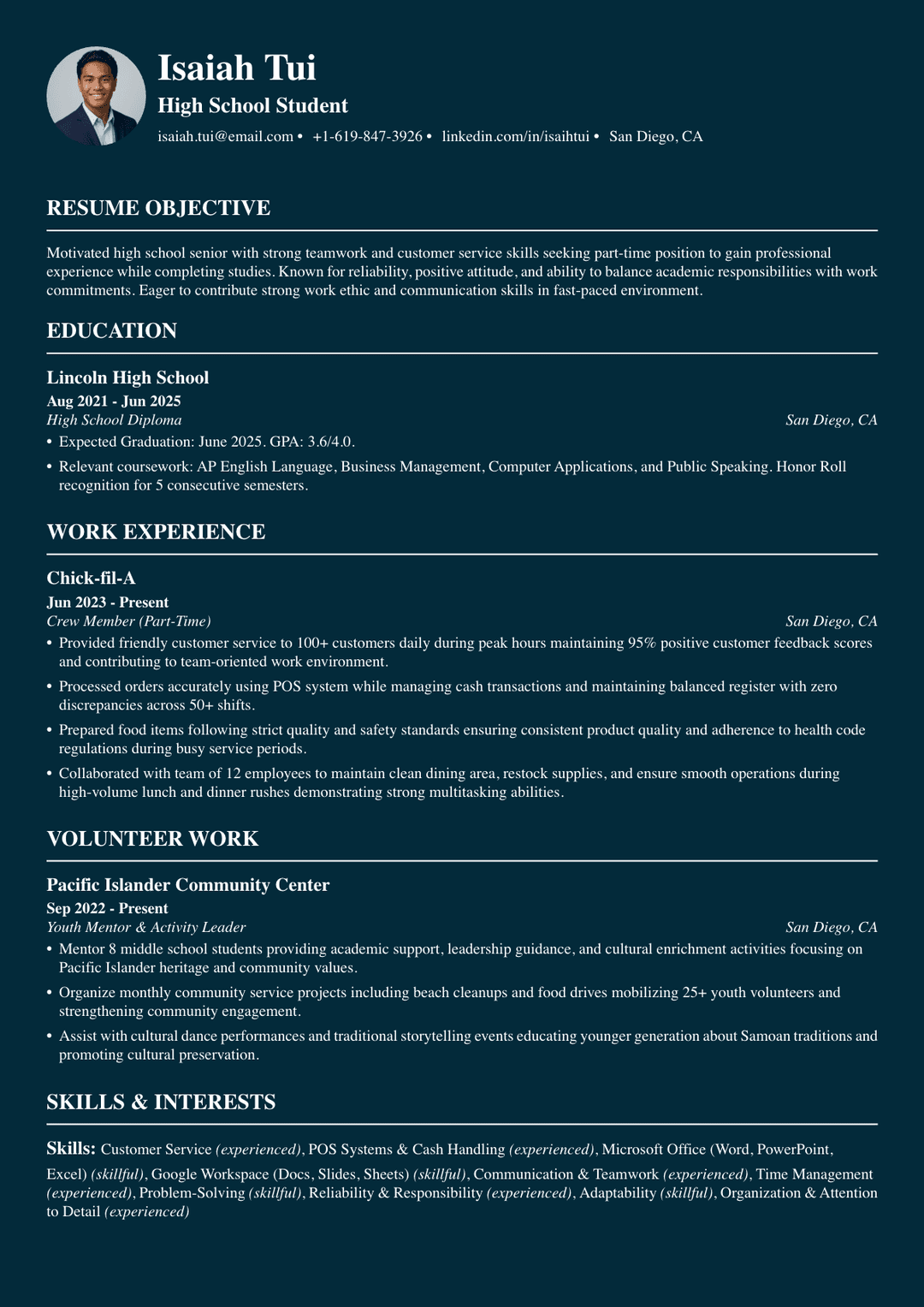
A student resume is a professional document that highlights a candidate’s education and skills to show employers they still bring something to the table even if they don’t have official work experience.
Because many students have limited work history, this type of resume often focuses on academic achievements, coursework, projects, extracurricular activities, volunteer work, and transferable skills. When structured well, it helps demonstrate potential, work ethic, and readiness to learn, even if professional experience is still developing.
In this article, you’ll learn how to create a student resume that presents your strengths clearly and professionally. We’ll cover the essential sections to include and explain how to showcase academic and extracurricular accomplishments in order to stand out when making a resume for internships, part-time jobs, or entry-level roles.
- A student resume focuses on education, projects, extracurricular activities, and transferable skills rather than extensive work history.
- Education typically appears first, with relevant coursework, GPA (if strong), and academic achievements helping demonstrate capability and potential.
- Even small roles (part-time jobs, volunteering, campus work, or class projects) can show reliability, teamwork, and initiative when framed with clear accomplishments.
- Skills should be divided into hard and soft categories and aligned with keywords from the job description to pass ATS screening.
- The most effective documents of this type stay concise (one page), use simple ATS-friendly resume formatting, and avoid common mistakes like vague duties, typos, and unnecessary details.
What Is a Student Resume?
A student resume is a one-page document that highlights your education, skills, and early experiences to demonstrate your competencies to employers or colleges. It's your first real pitch to the working world, and it doesn't need to be perfect; it needs to be clear, relevant, and tailored.
A resume for a student doesn't rely on a long work history; your education section comes first, and things like class projects, campus involvement, and volunteering carry significant weight. A hiring manager reviewing a college freshman's resume doesn't expect the same resume as someone with 10 years in the field; they know the difference and are looking for different signals.
Different students may need such a document for different reasons. For instance, high schoolers typically need one for part-time jobs or scholarship applications. College students use it for internships and campus positions, while recent graduates use it to land their first full-time role. In all three cases, the goal is the same: show employers what you're capable of, even while your experience is still growing.
What to Include on a Student Resume
Here’s a list of the basic sections you should include in your student resume:
#1. Contact Information
Every resume starts with a proper contact information section, which should contain your full name, phone number, email address, as well as city and state. If your LinkedIn profile is updated and complete, you should add the URL that leads to it.
One tip that sounds obvious but gets skipped all the time is to opt for a professional email address; the “firstname.lastname@gmail.com” format works perfectly. Additionally, tech or design students can also benefit from disclosing their GitHub profile or portfolio link.
That being said, you should skip full home address, date of birth, and headshot, as these aren't standard on US resumes and can actually cause unconscious bias issues.
#2. Resume Objective
A resume objective for students is a 2- or 3-sentence statement that explains your career goals and the value you offer an employer. It looks forward rather than back, which makes it a better fit than a resume summary when you don't have a long track record yet.
Here's an example of a high school student resume objective:
Motivated high school senior with strong customer service skills seeking a part-time retail position. Known for reliability, attention to detail, and a positive attitude.
And here's how a college student could write this part:
Finance junior at State University seeking a summer internship to apply financial modeling skills and support data-driven decision-making at a growth-focused firm.
#3. Education
For students, education always goes above work experience. Each entry should include:
- School/institution name
- Degree/program/diploma type
- (Expected) graduation date
- GPA (if it's 3.5 or above) and relevant coursework
- Honors and Dean's List mentions (if applicable)
According to the U.S. Bureau of Labor Statistics, workers with a bachelor's degree or higher earn significantly more and face lower unemployment rates than those without one. This alone should be enough for framing your education as an active asset.
The section can be written this way:
Finance junior at State University seeking a summer internship to apply financial modeling skills and support data-driven decision-making at a growth-focused firm.
#4. Work Experience
This section is where many students get stuck, as most of them don't have any work experience whatsoever. Still, they can leverage any side jobs they used to have, be it babysitting, campus work, unpaid internships, or helping out at a family business.
Format each role using the formula “Job Title | Company | Dates” followed by 2–4 bullet points about what you accomplished in the role, not just what you were assigned. If you want, you can use the PAR (Problem, Action, Result) formula to shape your bullets when possible.
Here's what this section could look like:
Sales Assistant (Part-Time)
BookWorld, Manchester, UK
June 2023 – Present
- Assisted customers in locating books and recommending titles based on their interests, helping improve overall customer satisfaction.
- Processed transactions through the POS system while maintaining accuracy during busy periods.
- Organised store displays and restocked shelves to maintain an attractive and accessible retail environment.
- Handled customer queries and minor complaints in a professional manner.
- Collaborated with team members during seasonal promotions and store events.
Student Library Assistant
University of Manchester Library, Manchester, UK
October 2022 – May 2023
- Supported daily library operations by checking books in and out and assisting students with basic catalogue searches.
- Maintained organised shelving systems to ensure materials were easy to locate.
- Helped manage study room bookings and provided general assistance at the information desk.
- Contributed to a quiet and productive study environment by monitoring library rules and assisting visitors.
- Developed strong communication and organisational skills while working in a fast-paced academic setting.
If you genuinely have no work experience, skip this part entirely and expand your Projects, Volunteer Work, and Skills sections instead.
Another important thing is that not every job on your student resume needs to be impressive. Consistency and reliability (even in a basic retail or food service role) signal real character to hiring managers. Therefore, frame even simple jobs with honest, specific bullets, and you'll be surprised how professional they read.
#5. Skills
You need to split the skills for a student resume into two categories:
- Hard skills (specific, teachable things like Python, Adobe Photoshop, or data analysis)
- Soft skills (transferable qualities like communication, leadership, or time management)
It can look like this:
Hard Skills
- Microsoft Word, PowerPoint, and Excel
- Basic data entry and spreadsheet management
- Point-of-sale (POS) systems
- Internet research and information sourcing
- Presentation preparation
- Basic social media management (Instagram, TikTok)
- Email communication and scheduling tools
- Google Docs and Google Slides
Soft Skills
- Communication
- Teamwork and collaboration
- Time management
- Organisation and attention to detail
- Problem-solving
- Adaptability
- Customer service mindset
- Reliability and responsibility
Pull resume keywords directly from the job description; ATS systems scan for exact matches, and missing key terms can filter your resume out before anyone reads it. Also, keep the list to 6–10 skills since relevance always beats quantity.
#6. Volunteer Work and Extracurricular Activities on a Resume
This section matters far more to employers than most expect, as student government, debate club, sports teams, hackathons, and community service show real initiative and leadership beyond the classroom.
You should format it the same way as work experience: Activity | Role | Organization | Dates, and then add a bullet or two showing real impact, e.g.: "Led a team of eight in organizing a charity fundraiser, raising $2,000 for local food banks."
#7. Projects & Academic Achievements
The part that lists projects and academic achievements is especially powerful for tech, design, business, and research students. Here, you can list real projects (even class assignments) along with the tools you used, your role, and any measurable outcome. Plus, academic honors like scholarships, awards, published papers, or Dean's List recognition go there too.
If you studied something technical, go specific with your tools, e.g., "Built a machine learning model in Python using scikit-learn to predict customer churn with 85% accuracy." Meanwhile, if your project was collaborative, you can mention your role: team lead, researcher, developer, or designer, as employers want to know where you fit on a team.
Student Resume Formatting Instructions
You can format a student resume by using a clean, single-column layout, a readable font, consistent spacing, and clear section headers that are easy for both recruiters and ATS software to scan.
Length
The rule is not to let your resume length exceed one page, and there are almost no exceptions for students. If you're finding yourself squeezing onto page two, cut the filler and make sure you prioritize what's most relevant to the specific role you're applying for.
Best Resume Format for Students
There are three resume formats you can consider:
- Reverse-chronological: Usually the safest and most effective choice; it lists your most recent education and experience first. Best for students who have some experience to show.
- Functional (skills-based): This one puts your skills front and center and is the best resume format for freshers or students with little to no work experience.
- Hybrid/combination: This format blends the two previous approaches; it’s useful when your skills and experience both deserve equal attention.
Design & Readability Tips
- Font: Arial, Calibri, or Georgia at 10–12pt; you should never go smaller than 10pt.
- Margins: 0.75–1 inch on all sides.
- White space: No cramming everything in, because recruiters scan your resume within only a few seconds on a first pass.
- Consistent formatting: Bold section headers and uniform date format (Month YYYY).
- ATS-friendliness: Avoid tables, columns, headers/footers, and decorative graphics because these break resume parsers.
- File format: Should be saved as PDF unless the job posting specifically requests .docx.
4 Student Resume Examples You Can Follow
Here are several student resume examples across different majors and career stages you can use as inspiration:
High School Student Resume Example

College Student Resume Example

Student Resume With No Experience Example

Common Student Resume Mistakes to Avoid
Before we wrap this guide up, let’s have a look at some resume mistakes many students make when writing a resume for the first time:
- Exceeding the optimal length. A recruiter who spots a two-page student resume or an unprofessional email address often moves on without a second look; not because they're harsh, but because they have many more applications in the queue. Your job is to make sure nothing on your resume gives them a reason to stop reading.
- Listing duties instead of achievements. Employers want results, not job descriptions. Use action verbs and quantify wherever you can; even rough numbers beat vague language.
- Ignoring ATS formatting rules. As previously mentioned, tables, text boxes, and fancy graphics confuse most resume parsers. Therefore, you should stick to simple, ATS-friendly templates, like those we offer at ResumeBuilder.so.
- Skipping proofreading. Spell check catches typos, not everything. Read your resume out loud, or ask someone to review it with fresh eyes before you hit the send button.
Make Your Student Resume Stand Out With Our Resume Builder
Getting past ATS screening is one challenge, catching a recruiter's eye is another, and ResumeBuilder.so makes sure both of them are tackled.
Our vast collection of expert-made templates allows you to choose one based on your industry and generate a submission-ready job application document in minutes. Besides that, we also offer dozens of solid resume examples so that you can see how other professionals in your field write theirs!
Final Thoughts
A student resume doesn't need to be a masterpiece; it needs to be honest, targeted, and well-structured. You don't need years of experience to build something compelling; projects, coursework, campus involvement, and transferable skills tell a real story about who you are and what you're capable of.
Your first resume won't be your last, and every version you build will be better than the one before it. Still, you have to start somewhere, and beginning with a well-structured, ATS-friendly document gives you the best possible chance at the opportunities that matter!
Student Resume FAQ
#1. How do I write a student resume with no experience?
You can write a student resume with no experience by focusing on your education, relevant coursework, academic projects, volunteer work, and transferable skills. These all demonstrate your value to employers, even without paid work history.
#2. What format should a student use for their resume?
Students should generally use the reverse-chronological format for their resume, because it lists their most recent education and experience first. If you have no experience at all, a functional (skills-based) format may serve you better by highlighting what you can do rather than what you've done.
#3. Should I include extracurricular activities on my student resume?
Yes, you should include extracurricular activities on your student resume, especially when you have limited work experience. Activities like clubs, sports, volunteering, or student government demonstrate leadership, teamwork, and initiative, and these are exactly the qualities every employer looks for in entry-level candidates.
#4. Do I need a cover letter with my student resume?
Yes, including a cover letter with your student resume is strongly recommended. It lets you explain your motivation, highlight skills that aren't visible on the resume, and show genuine interest in the specific role, which can set you apart from other applicants who skipped that step.

Max Harper is the resume guru who actually makes job searching easier. With years of experience as a hiring manager, Max knows what makes a resume stand out in a pile of 200+ applications. From breaking down ATS myths to helping you craft bullet points that pop, Max shares easy-to-digest, no-BS resume advice.