Web Developer Resume: Examples and Writing Guide for 2026
This complete guide with detailed explanations and expert tips will teach you how to write an acting resume in record time!
Edit this resume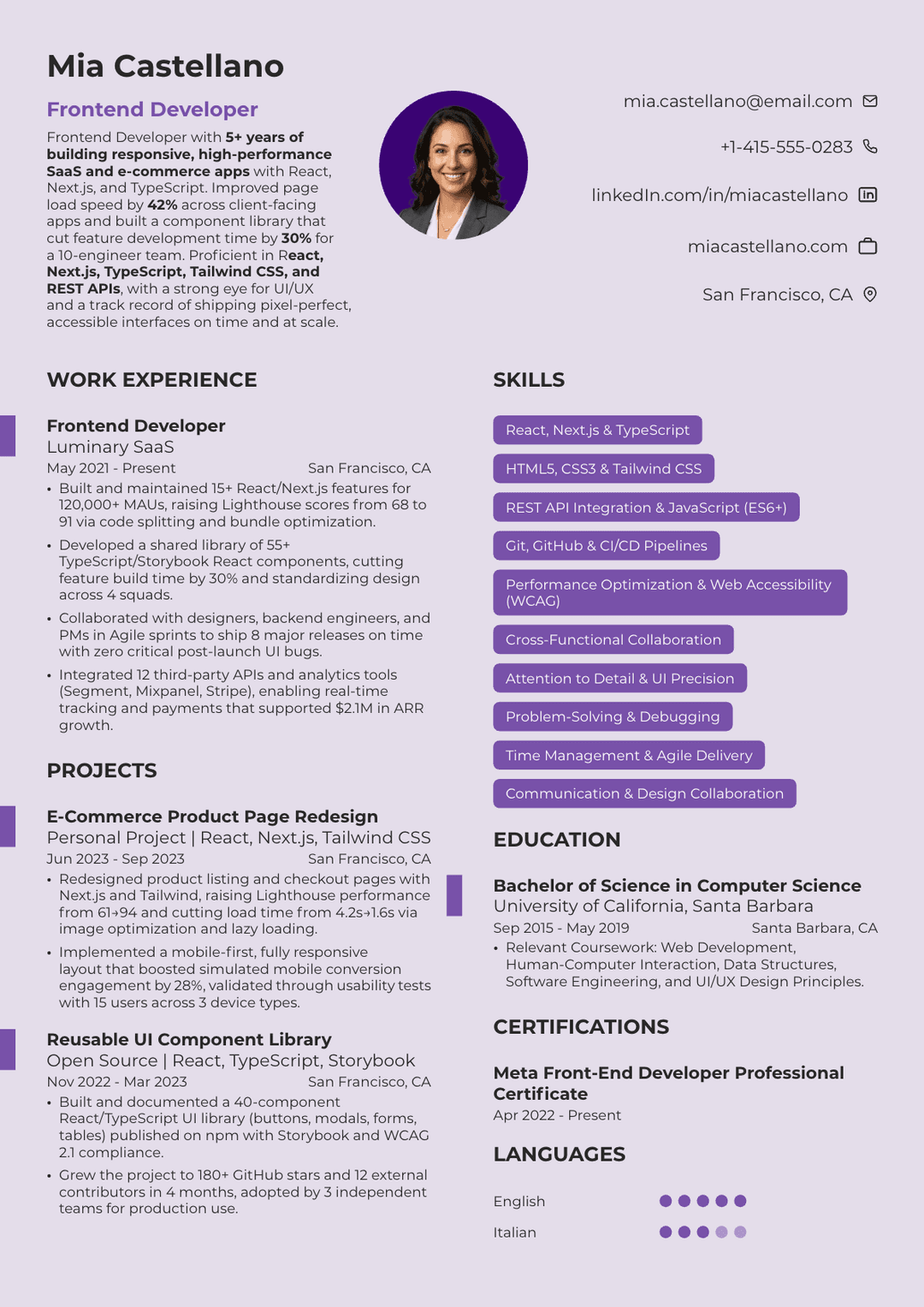
A web developer resume is a job application document that shows employers how well you can build, maintain, and improve websites or web applications. In this field, practical ability matters as much as formal experience.
With a strong resume, you translate your projects and technical knowledge into something hiring managers can quickly understand and trust. That’s why we’ll show you how to write a web developer resume that feels relevant to modern hiring expectations rather than generic or outdated ones.
- A strong web developer resume should highlight your technical skills, relevant projects, and measurable results instead of just listing tools or job duties.
- ATS-friendly formatting and job-specific keywords matter because even a well-written resume can get filtered out if the structure is too complex.
- The document includes a clean header, a targeted summary or objective, a structured technical skills section, quantified work experience, and relevant projects.
- Project work can be just as important as formal employment, especially for entry-level developers or candidates with limited public-facing professional experience.
- Tailoring your resume for each application, using action verbs, and backing up your claims with numbers can significantly improve your chances of getting interviews.
What Is a Web Developer Resume?
A web developer resume is a formal document that presents your technical skills, work history, projects, and qualifications to prospective employers in the software and web development field. It requires specific elements that reflect the nature of development work, including a dedicated tech skills section, project documentation, and portfolio links.
This type of resume needs bullets that go beyond job titles to show what you actually built and what happened as a result. This is because employers want proof of your success, not a list of technologies you've encountered.
Finally, most companies now run applications through applicant tracking systems (ATS) before a recruiter reads them. That means your resume layout and keyword choices matter just as much as the content itself. A beautiful, graphic-heavy resume can look sharp as a PDF and score zero inside an ATS parser; formatting isn't a stylistic preference but a strategy.
3 Web Developer Resume Examples
Seeing real examples is the fastest way to understand how to write a resume. Below are three different resume examples for web developers:
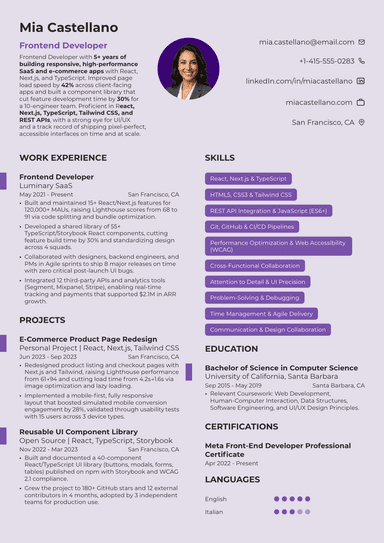
#1. Frontend Developer Resume Example

#2. Full-Stack Developer Resume Example

#3. Entry-Level Web Developer Resume

How to Write a Web Developer Resume: Full Guide
Writing a web developer resume means going beyond listing job titles and requires structuring your experience so that both ATS systems and hiring managers immediately see your value. Here's how to build each section, from top to bottom:
#1. Start With a Resume Header
The header of your web developer resume should be simple, professional, and easy to scan. Its job is not to impress anyone with creativity, but to make it effortless for employers to identify you, understand your location, and reach you without confusion.
In most cases, this section belongs at the top of the page and should include your full name, phone number, email address, city and state, LinkedIn profile, portfolio website, and, when relevant, a GitHub link. Since web development is a portfolio-driven field, links to your work matter more here than they do in many other professions.
However, keep in mind that a GitHub account is not automatically a portfolio. A useful GitHub presence has pinned repositories, a short README for each, and a commit history that shows ongoing activity. Uploading files with no context, meanwhile, tells nothing.
Furthermore, keep this section clean and current; do not add unnecessary personal details like your full street address, date of birth, photo, or multiple phone numbers. Also, use a professional email address, make sure every link works, and keep usernames consistent across platforms where possible.
This way, your contact section immediately signals professionalism and gives hiring managers direct access to both your résumé and your work.
On a resume, it looks like this:
Jane Carter
Austin, TX 78701
(512) 555-0147
jane.carter@email.com
linkedin.com/in/janecarter123
github.com/janecarter123
portfolio: janecarterdev.com
#2. Come Up With a Solid Web Developer Resume Summary or Objective
The top of your resume sets the tone for everything below it. Here, you should put a resume summary, which works best if you have two or more years of experience. In this snapshot, you should briefly explain who you are professionally, what you specialize in, and what you've accomplished.
If you're entry-level or switching careers, a resume objective is a better choice because it sheds light on what you're looking for and why your skills are relevant, even without a long track record.
Here’s an example:
Detail-oriented Web Developer with 6+ years of experience building responsive websites and web applications for e-commerce, SaaS, and service-based companies. Skilled in front-end and back-end development, performance optimization, and cross-functional collaboration. Strong track record of improving user experience, reducing load times, and delivering clean, scalable code aligned with business goals.
#3. Build a Web Developer Resume Skills Section That Actually Gets Read
The skills section of a web developer resume needs structure. A flat list of 30 technologies reads like noise; therefore, you need to group your technical abilities by category so hiring managers can immediately see your stack. Like this, for example:
Technical Skills
- Languages: HTML5, CSS3, JavaScript, TypeScript, PHP
- Frameworks and Libraries: React, Next.js, Bootstrap, jQuery
- Tools and Platforms: Git, GitHub, WordPress, Shopify, Visual Studio Code
- Web Technologies: REST APIs, Responsive Design, Cross-Browser Compatibility, SEO Basics
- Testing and Debugging: Chrome DevTools, Browser Testing, Bug Fixing, Performance Optimization
- Additional Skills: Website Maintenance, CMS Management, Accessibility Best Practices
Match what you list to what the job description actually asks for. ATS software scans for keyword matches, and a skills section that mentions the same abilities/keywords as the job posting significantly improves your ranking.
#4. Write Work Experience Bullets That Show Impact
This is where most web developer resumes either win or lose, depending on how you present your previous professional endeavors.
Each entry in the work history section should feature:
- Role you held
- Company name and location
- Years/dates of employment
- Short bullet list with quantified professional accomplishments you made in the position (numbers make claims credible, while vague bullets make you forgettable)
You can go with something along the lines of:
Work Experience
Senior Web Developer
BP Digital, Austin, TX
March 2021 – Present
- Developed and maintained 30+ custom websites and web applications for clients in retail, healthcare, and technology using JavaScript, React, PHP, and WordPress.
- Improved average website load speed by 38% by optimizing images, reducing unnecessary scripts, and implementing lazy loading techniques.
- Built reusable front-end components that shortened development time for new projects by 25% and improved consistency across client sites.
- Collaborated with designers, SEO specialists, and project managers to launch 20+ responsive websites on schedule and according to client requirements.
- Integrated 15+ third-party APIs, payment systems, and CRM tools to expand site functionality and support lead generation.
- Mentored 3 junior developers and conducted regular code reviews, helping reduce recurring coding errors and improve development efficiency across the team.
Web Developer
NorthNode, Dallas, TX
June 2018 – February 2021
- Designed, coded, and updated 40+ client websites using HTML, CSS, JavaScript, jQuery, and Bootstrap.
- Increased mobile conversion rates by 19% for a retail client by redesigning landing pages for better responsiveness and usability.
- Maintained website security, CMS updates, and plugin functionality across 40+ active websites, reducing downtime and technical issues.
- Partnered with back-end developers to connect front-end interfaces with databases and API-driven tools for 12 client projects.
- Strengthened QA and browser testing processes, helping reduce post-launch bug reports by 30%.
#4. Add a Projects Section
For web developers, the projects section is often more revealing than work experience, especially if you're early in your career or have worked on products you can't publicly share.
Here, you should list 3–5 projects with the following for each:
- Project name (with a live URL or GitHub link)
- Tech stack
- What it does
- Your role
- A result or metric (if available)
The projects section separates a developer who can talk about code from one who can show it. Pair it with a clean GitHub portfolio with pinned repos and readable READMEs, and you've given recruiters something concrete to review before the interview even happens.
This section can follow this pattern:
Projects
Portfolio Website
- Built a personal portfolio site showcasing 8 development projects, coding samples, and a contact form that increased inbound freelance inquiries.
E-commerce Product Page Redesign
- Redesigned a product page experience that improved page speed, mobile usability, and checkout engagement.
Content Management System Migration
- Supported the migration of a 200+ page website to WordPress while preserving URL structure and minimizing SEO disruption.
#5. Format Your Education and Certification Details
Formal CS degrees, bootcamp credentials, and self-taught backgrounds all belong on a web developer resume; you just need to frame them correctly. For mid-career developers (3+ years of experience), education goes near the bottom; meanwhile, for recent graduates or bootcamp graduates, it moves up, often just below or alongside the projects section.
The education section should contain your highest degree, the name and location of the institution that issued it, as well as the graduation year.
There are also some certifications worth listing, which include:
- AWS Certified Developer or Solutions Architect
- Google Cloud Professional Developer
- Meta Front-End Developer Certificate
- Microsoft Azure certifications
You can present all this in the following way:
Education
Bachelor of Science in Computer Science
University of Texas at Dallas
Richardson, TX
Graduated: 2016
Certifications
- Certified Front End Web Developer, W3C
- Google Analytics Individual Qualification
5 Impactful Web Developer Resume Tips
Here are the best web developer resume tips on how to fix some aspects that recruiters and hiring managers actually care about:
A single static resume submitted to 50 jobs will underperform every time. ATS systems rank applications by relevance to the specific job description, so mapping your skills and bullet points to the keywords in each posting directly affects whether you clear the first filter. You should swap your summary for each role, too; it takes five minutes and meaningfully increases your response rate.
Multi-column layouts, icons, graphics, and embedded tables can look polished as a PDF but become unreadable inside an ATS parser. To avoid this, you should stick to a single-column layout with normal section headers, such as Experience, Education, Skills, Projects, etc.
The good news is that the resume templates we offer at ResumeBuilder.so can handle this automatically! All you need to do is to input the essential information about your skills and career so far, and our resume builder generates an ATS-friendly web developer resume that passes all the checks!
"Improved performance" means nothing to a recruiter, but "reduced API response time by 60ms on a platform handling 200K daily requests" tells a story and gets remembered. Use percentages, user counts, load times, uptime metrics, revenue impact, and other industry-specific metrics. And if you genuinely don't have numbers, estimate conservatively and note the context.
For developers with fewer than five years of experience, one page is the right call, while two pages are reasonable for senior engineers or staff-level roles with extensive project histories. When you aren’t sure about your resume length, cut older or less relevant experience.
Start every bullet with a strong, specific action verb. For web developers, that means including words such as built, deployed, optimized, architected, integrated, migrated, automated, debugged, refactored, shipped, and similar. Avoid passive or vague phrasing like "responsible for," "helped with," or "worked on", as these tell a recruiter almost nothing about what you actually did.
Entry-Level Web Developer Resume: What to Do When You Have No Experience
An entry-level web developer resume without traditional work experience is still a competitive document if you know where to focus. Here's what you need to prioritize:
- Lead with a strong web developer resume objective that names your specialization, core skills, and what kind of role you're seeking.
- Put your projects section above work experience; three to five polished personal or open source projects carry more weight than a blank employment history.
- Be specific about your education. If you completed a bootcamp, name the program, list the duration, and note the technologies covered. "Completed a 6-month full-stack bootcamp in JavaScript, React, and Node.js at [Program Name]" is more useful than "studied web development."
- Include freelance, volunteer, or open source contributions. A pull request merged into a real project is real work, even if you weren't paid for it.
Final Thoughts
As you can see, a winning web developer resume needs to have the right structure, ATS-friendly formatting, and concrete proof of your skills; not just a list of technologies you've touched. Recruiters want to see what you built, what happened when you built it, and whether your stack matches what they need.
According to the Bureau of Labor Statistics, employment in this industry is projected to grow 7% over the coming decade, which is much faster than the average for all occupations. The field is actively looking for new talent, and even though standing out among the others might look like a challenge, a well–crafted resume will definitely increase your chances.
Web Developer Resume FAQs
#1. What skills should I list on a web developer resume?
The skills to list on a web developer resume depend on the role, but commonly include HTML, CSS, JavaScript, a frontend framework (React, Vue, or Angular), backend experience (Node.js, Python, etc.), Git, and any databases or cloud platforms you've worked with. Always cross-reference the job description; that will be your keyword guide.
#2. Should I include a portfolio link on my web developer resume?
Yes, you should always include a portfolio or a GitHub link in your resume header. These are among the first things technical recruiters check, and they give you a meaningful advantage over candidates who list skills alone. Before you apply, make sure your GitHub has pinned, documented repositories.
#3. What is a good resume summary for a web developer?
A good web developer resume summary is 2–3 sentences long and covers your specialization (frontend, backend, or full-stack), years of experience, core technologies, and one specific achievement. Keep it tight because it should read like a pitch, and tailor it to each role rather than using one version across every job application.
#4. What format is best for a web developer resume?
The best format for a web developer resume is reverse chronological because it puts your most recent and relevant experience first. It should also feature a standard structure with clean typography and consistent spacing so it parses correctly and reads quickly.

Max Harper is the resume guru who actually makes job searching easier. With years of experience as a hiring manager, Max knows what makes a resume stand out in a pile of 200+ applications. From breaking down ATS myths to helping you craft bullet points that pop, Max shares easy-to-digest, no-BS resume advice.