Accountant Cover Letter: Writing Guide and Examples [2025]
This complete guide with expert tips and real examples will teach you how to write a compelling cover letter — fast and stress-free!
Edit this cover letter![Accountant Cover Letter: Writing Guide and Examples [2025]](/_next/image?url=https%3A%2F%2Fcdn.sanity.io%2Fimages%2Fbcftoxbw%2Fproduction%2Fb6019f433bddaf4036669ff2c149d81bedbaf3bc-1190x1683.png&w=1080&q=75)
In accounting, attention to detail and professionalism are critical. Therefore, your accountant cover letter is the first demonstration of these essential qualities to potential employers. However, many struggle to translate their technical expertise into compelling content. The key is to tell a story that complements your resume, highlighting quantifiable achievements and demonstrating your understanding of the company's financial challenges.
To aid you in your job search, we’ve made this comprehensive guide, breaking down every aspect of a winning accountant cover letter, from writing tips and industry-specific examples to ATS formatting strategies that get your application noticed.
- Effective accountant cover letters establish credibility through relevant certifications, software experience, and quantified achievements.
- Essential elements include a professional header, targeted opening paragraph, skills, quantified accomplishments with specific metrics in the letter body, and a strong closing.
- To optimize for ATS, use exact keywords from job postings, maintain simple formatting without tables or graphics, and ensure consistency between your accountant cover letter and resume.
- Avoid generic applications lacking company-specific details, focusing on job duties instead of quantified achievements, neglecting to mention required software proficiencies, and poor formatting that undermines your attention to detail.
What Makes an Effective Accountant Cover Letter?
An effective accountant cover letter needs to grab attention immediately if you want to stand out from the crowd, especially in today’s job market. This is a promising occupation, projected to grow 5% in the next decade. Unlike many fields where soft skills might take center stage, accounting positions demand a unique blend of technical expertise, regulatory knowledge, and analytical thinking that your cover letter must clearly demonstrate.
Your cover letter needs to establish your credibility within the accounting profession. This means mentioning relevant certifications, software experience, and industry knowledge right upfront. The most effective accountant cover letter bridges the gap between your technical skills and the human element that makes you an ideal team member. It shows not just what you've done, but how your work has impacted previous employers through cost savings, process improvements, or enhanced financial reporting accuracy.
Essential Elements to Include in Your Accountant Cover Letter
An effective accountant cover letter requires specific elements you need to include as well. Each element serves a distinct purpose in showcasing your value to potential employers and should be positioned to capture attention while maintaining a clear, organized structure.
- Contact information. Place your full name, phone number, professional email address, and city/state at the top of the page. Include the date and employer's details below, following standard business letter format. Add your LinkedIn profile if it strengthens your application and credibility.
- Targeted opening paragraph. Research the hiring manager's name through LinkedIn or the company website and address them directly to show initiative. State the specific accounting position and mention where you found the listing. Open with a strong statement like quantifying years of experience or highlighting a key certification that immediately establishes your qualifications.
- Quantified achievements and technical skills. Showcase 2-3 specific accomplishments using numbers and percentages. List relevant software proficiencies, including QuickBooks, SAP, or Excel advanced functions. Connect each achievement directly to the requirements mentioned in the job posting to demonstrate you've thoroughly reviewed their needs.
- Cultural fit and enthusiasm. Reference specific company values, recent news, or initiatives you admire to show genuine interest beyond just needing employment. Explain why this particular organization appeals to you and how your professional goals align with their mission. Close with a confident call to action, requesting an interview and thanking them for their consideration.
Accountant Cover Letter Examples
Now that we’ve covered which elements to include in your accounting cover letter, let’s see some real-world examples and how these elements work together in creating a compelling narrative.
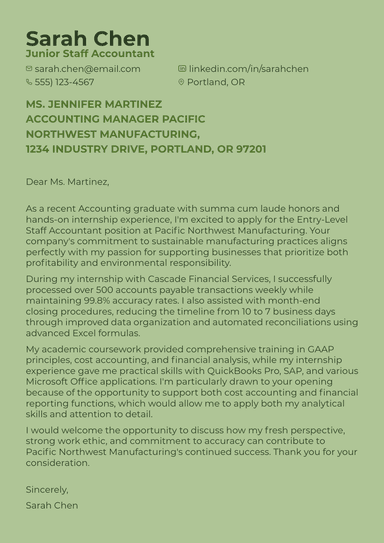
Entry-Level Accountant Cover Letter Example

This entry-level cover letter effectively combines academic achievements with practical internship experience, includes specific quantifiable results, and shows research into the company's values. Also, it addresses potential concerns about limited work experience by emphasizing transferable skills and enthusiasm for the role.
Experienced Accountant Cover Letter Example

This experienced professional cover letter demonstrates career progression, includes specific achievements with dollar amounts, shows industry knowledge by referencing the company's recent funding, and positions the candidate as someone who can handle complex financial challenges.
Career Change to Accounting Cover Letter

This career change cover letter directly addresses the unconventional background, emphasizes transferable skills, demonstrates commitment through education and results, and shows understanding of accounting's role in business operations.
How to Write an Accountant Cover Letter in 7 Simple Steps
Writing a cover letter doesn't need to be difficult. By following these seven steps, you can create a compelling document that highlights your skills and qualifications and secures interviews with potential employers.
#1. Analyze the Company and Position
The key is to research the company to learn about their financial landscape, industry challenges, and corporate culture. Start by reviewing their website, particularly the "About Us" and "Investor Relations" sections if it's a public company. Look for recent press releases, financial statements, or news articles that mention the company's financial performance, expansion plans, or industry positioning.
Pay special attention to the specific job posting requirements and preferred qualifications. Many accounting positions have unique software requirements, industry-specific experience needs, or particular certification preferences. Create a list of every qualification mentioned and prepare to address how your background matches these requirements.
#2. Create a Professional Header
Your professional header should match your resume contact information, creating a cohesive application package. Make sure to include the following:
- Full name
- Professional email address
- Phone number
- City and state
- LinkedIn profile (optional)
Always address your letter to a specific person whenever possible. When you can't find a specific name, use "Dear Hiring Manager" or "Dear Accounting Department" rather than outdated salutations.
Here’s a good example:
Michael Rodriguez, CPA
Senior Financial Analyst
(555) 987-6543 | michael.rodriguez@email.com
Austin, TX | linkedin.com/in/michaelrodriguezcpa
[Date]
Mr. Robert Kim
Finance Director
TechStart Innovations
5678 Silicon WayAustin, TX 78701
#3. Craft a Compelling Opening
Your opening paragraph must immediately capture attention, clearly stating your purpose and value proposition. Start with the specific job title and where you found the posting, then quickly transition to your most compelling qualification or achievement.
Avoid generic openings like "I am writing to apply for the accountant position." These waste valuable real estate and fail to differentiate you from other candidates. Instead, demonstrate immediate value by leading with your strongest selling point. Begin with a quantifiable achievement, relevant certification, or specific experience that directly relates to their needs.
For example:
As a CPA with seven years of experience reducing audit findings by 40% through improved internal controls, I was excited to find your Senior Accountant opening focused on compliance and process improvement.
#4. Highlight Relevant Skills and Experience
The body of your accountant cover letter should showcase technical competencies, software proficiency, and professional achievements that directly address the job requirements. Organize this information logically, starting with your most relevant qualifications for their specific needs.
Technical skills form the backbone of accounting competency, so be specific about your software expertise. Instead of simply listing "proficient in Excel," explain that you "created complex financial models using advanced Excel functions, including VLOOKUP, pivot tables, and macros to automate quarterly reporting processes."
Additionally, industry knowledge and regulatory experience should be highlighted when relevant to the position. If you're applying for a healthcare accounting role, mention your familiarity with Medicare billing regulations or HIPAA compliance. For public company positions, emphasize SOX compliance experience or SEC reporting knowledge.
Soft skills in accounting often involve communication, problem-solving, and collaboration abilities. However, rather than simply stating these qualities, provide concrete examples. Instead of "strong communication skills," describe how you "presented monthly financial analysis to C-level executives, translating complex data into actionable business insights that influenced strategic decisions."
Additionally, your career achievements should be integrated naturally into your skills discussion. Use specific numbers whenever possible. Here are a few good examples:
- Reduced the month-end closing time from 12 to 8 days
- Managed accounts payable for 200+ vendors totaling $3.2M monthly
- Identified cost savings opportunities worth $75,000 annually through expense analysis
#5. Address Specific Requirements
Carefully reviewing the job posting for specific requirements allows you to systematically address each qualification in your cover letter. Create a two-column list with job requirements on one side and your corresponding qualifications on the other. This visual exercise helps ensure you address every major requirement and identify areas where you might need to strengthen your case or provide additional context.
When you have all required qualifications, confidently state your experience and provide brief examples. For requirements where your experience is limited, focus on transferable skills, related coursework, or your ability to quickly learn new systems or processes.
Be honest about areas where you don't meet exact requirements, but frame these situations positively. If they want five years of experience and you have three, emphasize the depth and quality of your experience or additional qualifications that compensate for the time difference.
#6. Write a Strong Closing
Your closing paragraph should reaffirm your interest in the position, summarize your key value proposition, and provide clear next steps for the hiring process. This section should feel confident without being presumptuous, and professional while maintaining the personal connection you've established throughout the letter. Follow these three steps to achieve this:
- Restate your enthusiasm for the specific role and company. Reference something specific about their organization or the role that particularly appeals to you, whether it's their growth trajectory, industry leadership, or the opportunity to work with particular technologies or client types.
- Briefly summarize your strongest qualifications. It should be one compelling sentence that reminds the reader why you're an ideal candidate. This summary should focus on the most relevant aspects of your background for their specific needs rather than trying to cover everything.
- Thank the reader and indicate your preferred next step. This might be expressing interest in scheduling an interview, mentioning that you'll follow up within a specific timeframe, or simply stating that you look forward to hearing from them.
Let’s see how this works on an actual example:
I'm particularly excited about the opportunity to work with an innovative team that's disrupting the fintech space. Your recent Series B funding announcement demonstrates the kind of dynamic environment where my analytical skills and strategic thinking can make the greatest impact.
I would appreciate the opportunity to discuss how my proven track record of financial leadership can support TechStart's continued growth. Thank you for your time and consideration.
Best regards,
Michael Rodriguez, CPA
#7. Format and Proofread
Professional formatting for your accountant cover letter should reflect the same attention to detail you'd apply to financial statements or audit reports. The table below outlines the best cover letter formatting practices:
| Element | Recommended | Standard Why It Matters |
|---|---|---|
Font Style | Arial, Calibri, or Times New Roman | Professional, easily readable across all devices and systems |
Font Size | 10 - 12 point | Ensures readability without appearing too large or cramped |
Margins | 0.5 - 1 inch on all sides | Creates balanced white space and a professional appearance |
Letterhead | Match resume exactly (name, title, contact info, LinkedIn) | Demonstrates consistency and organizational skills |
Paragraph Spacing | Single-space within, double-space between | Improves readability and creates clear visual separation |
Alignment | Left-aligned for all sections | Follows standard business letter format conventions |
Proofreading Method | Three passes: content flow, grammar/spelling, read aloud | Catches different types of errors through varied approaches |
File Format | Both the DOCX and PDF versions | PDF preserves formatting; Word allows ATS compatibility |
File Naming | FirstName_LastName_Cover_Letter_CompanyName.pdf | Makes your application easy to identify and organize |
How to Optimize Your Accountant Cover Letter for ATS
Applicant Tracking Systems (ATS) screen cover letters using keyword matching and formatting analysis before human reviewers see your application. Understanding how these systems work ensures your carefully crafted accountant cover letter reaches hiring managers instead of being filtered out automatically.
[Visual element: Split-screen showing ATS-friendly vs ATS-unfriendly cover letter formats]
Keyword optimization begins with carefully analyzing the job posting to identify specific terms, skills, and qualifications mentioned multiple times or emphasized as requirements. Include exact phrases from the posting when they accurately describe your experience, such as "accounts payable," "financial analysis," or "month-end close procedures."
Simple formatting helps ATS systems parse your content correctly. Avoid complex layouts, tables, graphics, or unusual fonts and formatting that might confuse automated scanning. Use standard cover letter format with clear section breaks and consistent spacing throughout your document.
Integration with your accountant resume ensures consistency across your application materials. Use similar keywords, maintain the same contact information format, and ensure your cover letter supports rather than contradicts the information in your resume.
Common Mistakes to Avoid in Your Accountant Cover Letter
There are several cover letter mistakes people make, but generic cover letters represent one of the biggest ones in accounting job applications. Your cover letter should reference the company by name, mention specific requirements from their job posting, and show you've researched their industry or recent financial news.
Here’s a quick comparison:
- I am excited to apply for the Senior Staff Accountant position at Deloitte, where your recent expansion into ESG reporting aligns with my sustainability accounting expertise.
- Dear Ms. Johnson, I was impressed by ABC Corporation's 20% revenue growth reported in your Q3 earnings, and I'm eager to contribute my financial analysis skills to support continued expansion.
- I am specifically interested in the Tax Accountant role (Job ID: 12345) because of my specialized experience with multi-state tax compliance."
DON'T DO THIS
- I am writing to apply for the accounting position at your company.
- Dear Hiring Manager, I saw your job posting and think I would be a good fit.
- I am applying for any available accounting positions.
| DUTY-FOCUSED | ACHIEVEMENT-FOCUSED |
|---|---|
Prepared monthly financial statements | Delivered accurate monthly financial statements 5 days ahead of schedule, enabling leadership to make faster strategic decisions |
Reconciled bank accounts | Maintained 100% accuracy across 50+ bank reconciliations monthly, identifying and resolving $75K in discrepancies |
Assisted with annual audits | Streamlined audit preparation process, reducing external auditor time by 15 hours and saving the company $3,000 in audit fees |
Managed accounts payable | Processed $2M in monthly vendor payments with zero late fees while negotiating early payment discounts that saved $18K annually |
Created financial reports | Automated quarterly reporting dashboard using Power BI, reducing report generation time from 8 hours to 45 minutes |
Neglecting to mention relevant software experience can immediately disqualify you from consideration. Many accounting positions require proficiency with specific platforms, and failing to address these requirements suggests you haven't carefully read the job posting or lack the necessary technical skills.
Lastly, poor formatting that doesn't reflect professional standards sends the wrong message about your attention to detail. Your cover letter should be perfectly aligned, use consistent formatting, and be completely free of spelling or grammatical errors—the same standards you'd apply to any financial document.
Build Your Perfect Accountant Application With ResumeBuilder.so
ResumeBuilder.so provides powerful tools to create ATS-optimized application materials that get noticed. Our platform offers professional cover letter templates that effectively showcase your financial expertise, certifications, and technical proficiencies.
With built-in keyword optimization, you can ensure your resume and cover letter include the exact terminology recruiters search for, from GAAP compliance to ERP system experience. Our intuitive builder helps you transform job duties into quantified achievements while maintaining the professional formatting standards expected in the accounting industry.
Final Thoughts
Writing an effective accountant cover letter requires balancing technical expertise demonstration with personal connection and genuine enthusiasm for the specific role and organization. Remember that your cover letter works in partnership with your resume to tell a complete professional story. While your resume provides detailed employment history and technical qualifications, your cover letter offers the opportunity to explain your career motivations, highlight your most relevant achievements, and demonstrate your communication skills.
The accounting profession values precision, accuracy, and professionalism. Your cover letter should reflect these same standards, so carefully proofread and format the letter. With all these elements aligned, you have built a compelling case for an interview invitation.
Accountant Cover Letter FAQ
#1. How long should an accountant cover letter be?
An accountant cover letter should be one page long, typically 3-4 paragraphs, and around 250-400 words to maintain recruiter attention while covering essential qualifications. This cover letter length allows you to highlight your most relevant achievements and technical skills without overwhelming the recruiter.
#2. Should I mention salary expectations in my accountant cover letter?
Only mention salary expectations if specifically requested in the job posting. Focus on demonstrating value through achievements and qualifications rather than compensation requirements.
#3. What accounting software should I mention in my cover letter?
Mention software specifically listed in the job posting, plus widely-used programs like QuickBooks, Excel, SAP, or industry-specific systems relevant to the position. Be honest about your proficiency level and emphasize software that directly relates to their stated requirements or the type of accounting work they perform.
#4. How do I write a cover letter with no accounting experience?
Focus on transferable skills like analytical thinking, attention to detail, and mathematical abilities. Highlight relevant coursework, internships, volunteer work, or certifications that demonstrate accounting knowledge and commitment. Emphasize your eagerness to learn and any experience with financial analysis, budgeting, or data management in other contexts.
#5. Should I include my GPA in an accounting cover letter?
Include GPA only if you're a recent graduate and it's 3.5 or higher. Experienced professionals should focus on work achievements and certifications instead. Academic performance becomes less relevant as your professional experience grows, so emphasize practical accomplishments over classroom success.
#6. Can I use the same cover letter for different accounting positions?
No, customize each cover letter for the specific position and company. Tailor keywords, skills, and experiences to match the job requirements for better ATS compatibility and employer engagement. The extra time spent customizing significantly improves your chances of getting interviews compared to generic applications.

Sophia Martinez knows what it’s like to start over—because she did it herself. After switching careers twice, she’s now helping others navigate the transition with confidence. Whether you’re shifting industries, returning to the workforce after a break, or feeling stuck in your current role, Sophia’s insights will help you take the next step.