Dentist Resume: Examples and Best Writing Practices in 2026
This complete guide with detailed explanations and expert tips will teach you how to write an acting resume in record time!
Edit this resume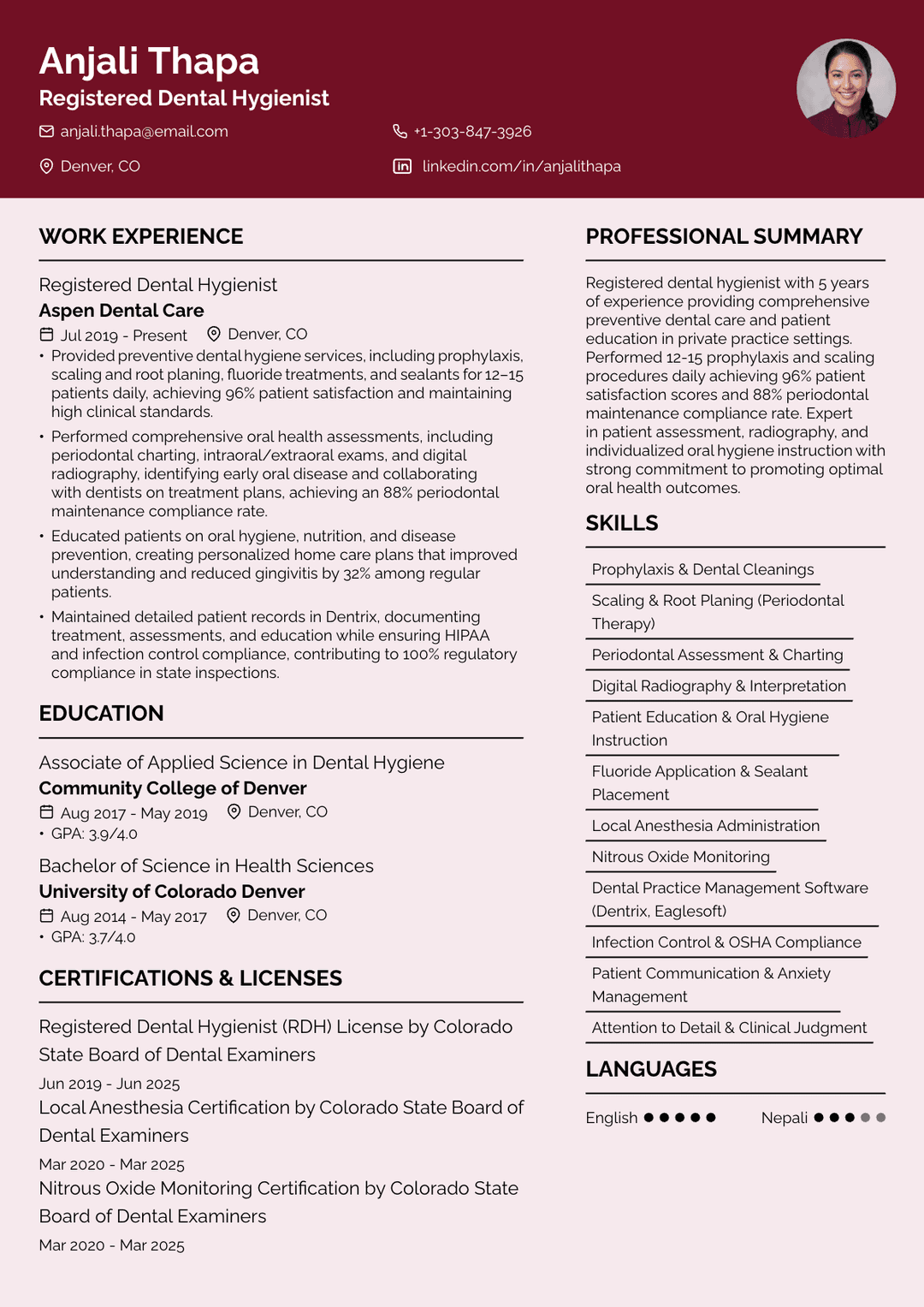
A dentist resume is a one-page document whose purpose is to show a candidate’s clinical expertise, qualifications, and ability to deliver high-quality patient care. It should clearly present their education, licensing, industry-specific technical skills, and hands-on experience, but also reflect their attention to detail and professionalism.
To help you create one that will set you apart from other candidates, we offer this guide with some essential tips! You’ll learn how to write your dentist resume effectively, what structure you should follow, what information to prioritize, and how to present your skills in a way that appeals to employers.
- A dentist resume must go beyond basics—it needs to clearly show clinical expertise, state licensing, certifications, and measurable results, not just responsibilities.
- Structure matters: include a header, summary/objective, experience, education, skills, and a dedicated licenses & certifications section with issuing bodies and expiration dates.
- Quantify everything you can (patient volume, satisfaction rates, revenue impact) to stand out from candidates who only list duties.
- Tailoring is not optional; you need to align your summary and skills with each job posting to improve ATS performance and interview chances.
- Formatting can make or break your resume: stick to clean, single-column layouts and avoid design elements that confuse ATS systems.
4 Expert-Made Dentist Resume Examples
Before we show you how to write a resume and which key sections to include, let’s see a few dentist resume examples that cover different experience levels and specializations:
#1. General Dentist Resume Example

#2. Dental Assistant Resume Example

#3. Dental Resume (No Experience) Example

#4. Dental Hygienist Resume Example

How to Write a Dentist Resume
Writing a strong dentist resume is all about following the right structure. A proper one should include a top section with contact details, a career summary, as well as your work experience, education, clinical skills, licenses, and certifications.
While it follows the same core structure as any professional resume, a dentist resume has unique requirements that set it apart. These include state-specific licensing, board credentials (INBDE, ADEX), DEA registration, and procedure-specific competencies. The U.S. Bureau of Labor Statistics projects 4% growth through 2034 and around 4,500 openings annually for dentists.
This means competition remains consistent, and hiring managers at DSOs and large dental groups consider all of the aforementioned skills and qualifications as must. Therefore, a well-written resume is critical to stand out.
That said, let’s explore how to write each section of a dentist resume in more detail.
#1. Resume Header
Your resume header should include your full name with your DDS or DMD credential listed directly after it, followed by your phone number, email address, location, and optionally a LinkedIn URL. Including your degree title in the header signals credibility the moment a recruiter opens your file, and it's truly a small detail with a real effect.
It should look like this:
Dr. Gina Morgan, DDS
Chicago, IL
(312) 555-7890
gina.morgan.dds@email.com
linkedin.com/in/ginamorgandds
#2. Dentist Resume Summary or Objective
Experienced dentists should use a resume summary: a two- to four-sentence-long candidate description that states their years of practice, clinical specialization, and one standout measurable achievement. On the other hand, new college graduates should use a dentist resume objective instead, as it focuses more on career goals, relevant clinical competencies, and total supervised hours.
First, let’s see what a resume summary for this role looks like:
Board-certified general dentist with 8 years of experience in high-volume private practice. Performed 20+ restorative procedures weekly with a 97% patient satisfaction score. Seeking a senior associate role with a growing DSO.
And then there’s a resume objective example:
Recent DDS graduate from NYU College of Dentistry with 2,000+ supervised clinical hours. Seeking an associate position to apply strong restorative and preventive care skills in a collaborative group practice.
#3. Work Experience
When creating a work history section on your resume, you should list your previous positions in reverse-chronological order, starting with your most recent role. Each entry should mention the job title you held, the name and location of the company, the period you spent there, and some notable accomplishments you made in that role.
The real differentiator here is specificity, so you need to quantify everything you reasonably can: patient volume per day, chair time efficiency, case acceptance rates, satisfaction scores, and other dental KPIs.
Furthermore, the bullets can follow a What + How + Result structure, and non-dental experience can usually be omitted or summarized in a single brief line unless it directly supports the application.
Here’s how to craft this part:
Work Experience
General Dentist
NiceSmile Dental Group, Chicago, IL
June 2020 – Present
- Perform routine and complex dental procedures, including fillings, crowns, bridges, and extractions for 20–30 patients daily
- Develop personalised treatment plans based on patient needs and oral health assessments
- Educate patients on oral hygiene and preventative care, improving patient retention by 25%
- Collaborate with hygienists and specialists to ensure comprehensive care
- Maintain accurate patient records in compliance with HIPAA regulations
Associate Dentist
Leighton Family Dentistry, Chicago, IL
August 2018 – May 2020
- Delivered high-quality general dentistry services, including root canals and cosmetic procedures
- Assisted in increasing clinic revenue by 15% through patient satisfaction and treatment acceptance
- Built strong patient relationships through clear communication and empathetic care
- Stayed current with advancements in dental techniques and technology
#4. Education
In the education-related section, you need to list your DDS or DMD degree with:
- Full degree name
- University/institution that issued it and its location
- Graduation year
If you graduated within the last three to five years, placing education above experience often makes sense since, in such a case, your degree is still your strongest credential. New graduates can also include relevant coursework (anatomy, biochemistry, oral pathology) to fill the section out.
However, if you're applying to academic or research institutions, this section expands into a fuller dental CV format. Here, you can mention relevant publications, teaching experience, and grants.
A regular education section of a dentist resume can look like this:
Education
Doctor of Dental Surgery (DDS)
University of Illinois at Chicago College of Dentistry
2014 – 2018
Bachelor of Science in Biology
University of Illinois Urbana-Champaign
2010 – 2014
#5. Dental Resume Skills
The dentist skills section should be divided into hard skills and soft skills, as well as tailored directly to the job posting you’re applying to. Namely, ATS systems scan for exact keyword matches, so mirroring the specific language from the listing matters more than you might expect.
Here are some hard skills to consider:
- Restorative dentistry (crowns, bridges, veneers)
- Dental implants and bone grafting
- Endodontic therapy (root canals)
- Pediatric dentistry
- Orthodontics / Invisalign
- Digital radiography / CBCT imaging
- CAD/CAM systems (CEREC)
- Oral surgery (extractions, biopsies)
- Periodontal treatment
Additionally, you can also mention the following soft skills:
- Patient communication and anxiety management
- Attention to detail
- Time management and chair time optimization
- Team leadership and staff mentoring
- Problem-solving and clinical judgment
#6. Licenses and Certifications
This is the section where you can include your:
- State dental license
- INBDE or ADEX board score
- DEA registration (if applicable)
- BLS/ACLS certification
- Nitrous oxide monitoring certification
- Invisalign certification
- Any sedation permits
For each of these dentist resume certifications and licences, you should include the issuing body and expiration date. This is because hiring managers at DSOs and multi-specialty practices often filter applications by certification status before they ever read a summary.
This part can be formatted in the following way:
Licenses & Certifications
- Doctor of Dental Surgery (DDS), Illinois Department of Financial and Professional Regulation. Expires: 03/2029
- CPR & Basic Life Support (BLS), American Heart Association. Expires: 03/2030
#7. Optional Sections
For senior or academic-facing roles, a few additions can strengthen your dentist resume considerably, including:
- Publications and research
- Continuing education (CE) hours
- Professional memberships (ADA, AGD, specialty boards)
- Awards
- Volunteer dental work
How to Choose the Best Dentist Resume Format
Choosing the best dentist resume format depends on your years of experience and the type of role you're targeting. The three main options serve different career situations, so it's worth understanding what separates them before you commit to one:
#1. Reverse-Chronological Format
This is the right choice for experienced dentists with three or more years of clinical history. It leads with your most recent role and works backward, which comes off as straightforward and familiar. Plus, the chronological format is also the one ATS systems parse most cleanly.
#2. Functional Format
Less common, but useful for dentists with employment gaps or those shifting between specializations, a functional resume focuses on skills rather than job titles. Yet, it’s worth noting that some ATS platforms don't parse these well, so this format works best when your situation genuinely calls for it—not as a default choice.
#3. Combination (Hybrid) Format
Finally, the combination format, also known as hybrid, is the best option for specialists (orthodontists, endodontists, oral surgeons) making a lateral move or transitioning from private practice to academia or consulting. Its biggest advantage, though, is that it gives equal weight to your clinical skill set and career history.
4 Biggest Dentist Resume Mistakes to Avoid
The most common dentist resume mistakes include missing licensure details, vague work descriptions, generic documents, and ignoring ATS optimization. Such errors can cost you an interview, sometimes before any human has read a single word of your resume, so you should make sure they don’t happen.
There's a real difference between saying "Performed dental procedures" and "Performed 15+ restorative procedures weekly with a 98% patient satisfaction rate." While the first is a mere job description, the second actually describes a professional who delivers results.
Plus, achievement-based bullets are far more persuasive to hiring managers, and they're what separate competitive candidates from forgettable ones.
Many dentists assume their DDS or DMD implies licensure, but it doesn't; at least not to a recruiter scanning dozens of resumes under time pressure.
You should always list your state license, DEA number (if applicable), and specialty certifications explicitly. This is especially critical for candidates applying across multiple states or to practices with strict compliance requirements.
Every dental practice has a different focus, so sending the same document everywhere reduces the ATS pass rate and interview callbacks more than most candidates realize. This means you need to tailor your resume summary and skills section to each job description, even if it only takes 15 minutes.
Tables, columns, text boxes, and unusual fonts can confuse ATS parsers and cause your resume to display garbled or not be read at all. To avoid this, use clean, single-column layouts, standard section headers, and common fonts like Calibri or Arial.
Let ResumeBuilder.so Craft Your Dentist Resume in a Breeze
Building a dentist resume from scratch can be extremely time-consuming, especially when you're balancing a clinical schedule.
The good news is, ResumeBuilder.so's AI-powered resume builder speeds up the process considerably. Choose a suitable template from our vast library, briefly enter the crucial details, and the tool will generate a polished, ATS-friendly dentist resume in minutes!
On our platform, you can also find well-written examples that show the perfect structure and content ideas for a solid resume and can serve as inspiration if you still want to do the work yourself.
Final Thoughts
As you could see, a strong, job-winning dentist resume is specific, metric-driven, license-forward, and tailored to each role. Format choice matters, too, and ATS optimization is a baseline requirement for modern dental job applications, not an afterthought.
If you use a ResumeBuilder.so's dentist resume template or example as your starting point, you’re increasing your chances of landing the desired dental position more easily and standing out among other candidates!
Dentist Resume FAQs
#1. What should a dentist include on a resume?
A dentist should include contact details, a resume summary, clinical work experience with quantified achievements, education, a skills section, and a dedicated licenses and certifications section.
#2. What format is best for a dentist resume?
The reverse-chronological format is best for most dentist resumes because it highlights clinical career progression clearly. Yet, new graduates may prefer a functional or hybrid format that primarily highlights skills and clinical rotations when direct experience is limited.
#3. Do dentists need to include their license number on a resume?
Dentists don't always need to include their full license number on a resume, but they should list their state dental license, DDS/DMD credential, DEA registration (if applicable), and board certification to immediately confirm eligibility to hiring managers.
#4. How long should a dentist resume be?
A dentist resume should be one to two pages long. Early-career dentists should aim for one page, while experienced specialists with publications, fellowships, or extensive CE credentials may justify two pages.
#5. Should I include a cover letter with my dentist resume?
Yes, you should include a cover letter with your dentist resume because it lets you highlight your interest in a specific practice or patient population and explain how your clinical background fits the role.

Max Harper is the resume guru who actually makes job searching easier. With years of experience as a hiring manager, Max knows what makes a resume stand out in a pile of 200+ applications. From breaking down ATS myths to helping you craft bullet points that pop, Max shares easy-to-digest, no-BS resume advice.