Software Engineer Resume: Examples and Writing Tips for 2026
This complete guide with detailed explanations and expert tips will teach you how to write an acting resume in record time!
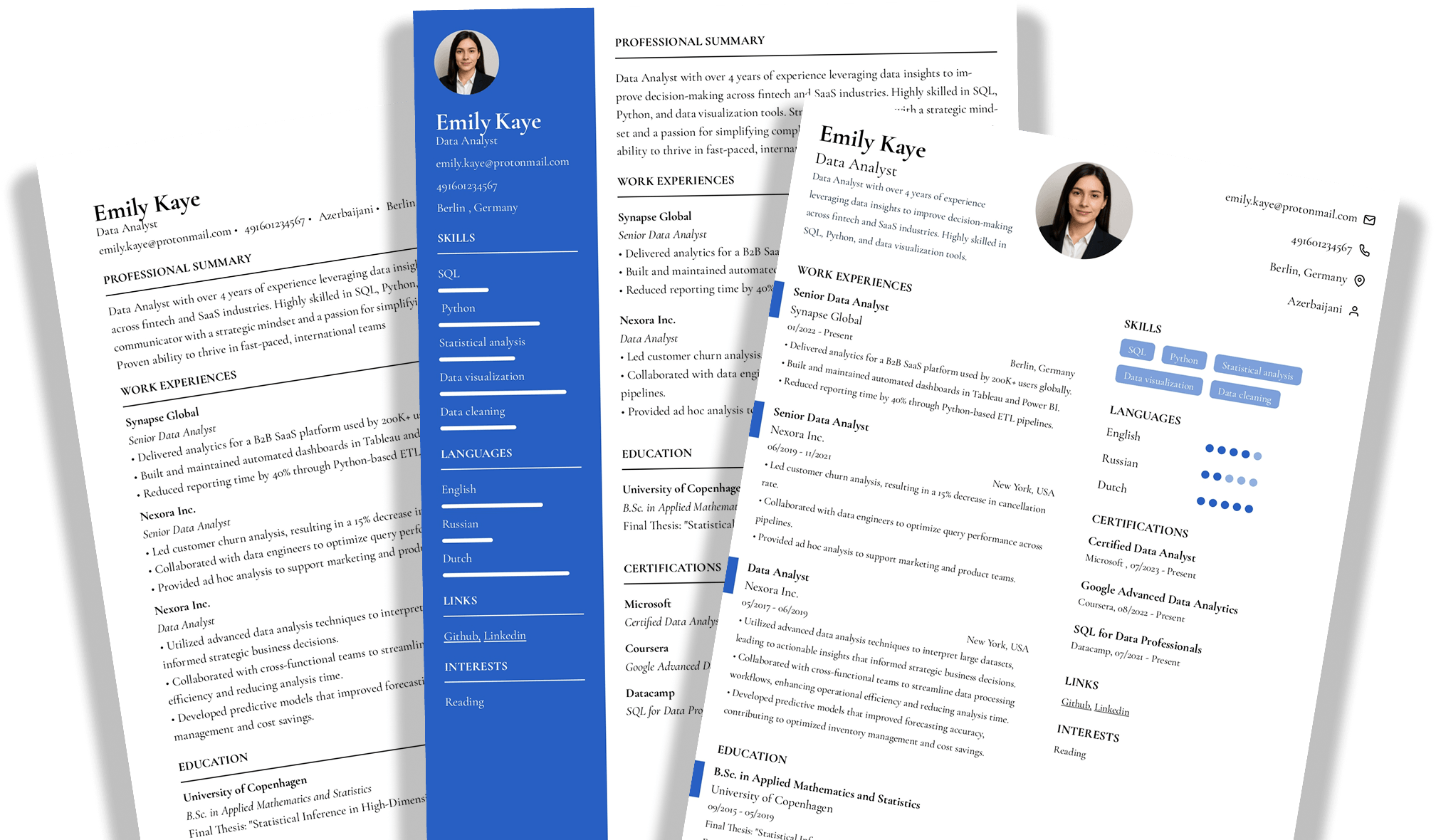
Edit this resume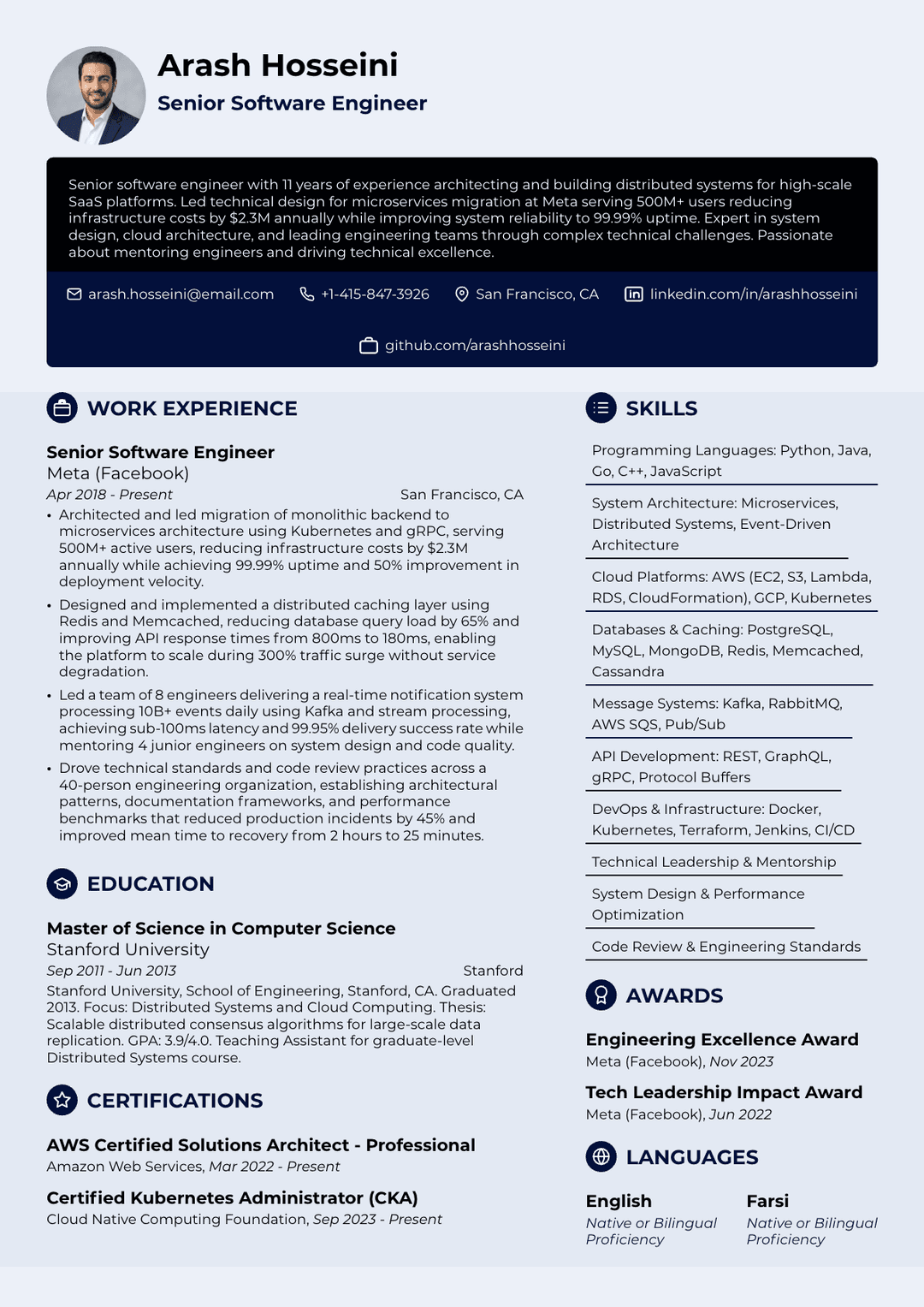
A software engineer resume is a structured overview of a developer’s technical expertise, programming experience, and project contributions, designed to show employers how they build, maintain, and improve software systems.
The harsh reality is that most candidates never even get a human read. Nowadays, many resumes get filtered out by applicant tracking systems (ATS) before a recruiter ever lays eyes on them. This means you could be the best engineer on the planet and still land in the rejection pile because your resume wasn't optimized for the right keywords or formatted correctly.
That's what this guide fixes; you'll learn exactly how to structure, write, and format a software engineer resume that clears ATS filters and impresses the humans reviewing your application.
- A software engineer resume highlights programming languages, frameworks, system scale, and measurable project outcomes to demonstrate real technical impact.
- The reverse-chronological format is typically the most effective and ATS-friendly, clearly showing career progression and recent engineering work.
- Strong resumes quantify achievements using metrics such as performance improvements, cost reductions, user growth, or system reliability gains.
- Key sections include contact details with GitHub and LinkedIn links, a focused summary or objective, work experience with measurable results, a structured technical skills section, and relevant projects.
- Common mistakes include listing responsibilities instead of outcomes, failing to tailor keywords for ATS, including outdated technologies, omitting GitHub or portfolio links, and using overly complex formatting.
What Is a Software Engineer Resume?
A software engineer resume is a document that showcases your technical skills, project work, and career achievements to potential employers in the software development field.
This might sound straightforward, but this type of resume is genuinely different from a generic resume. Here, it's not enough to list where you worked and what you did; hiring managers in tech want to see your language stack, the frameworks you've worked with, the scale of systems you've built, and the measurable outcomes of your work.
According to the Bureau of Labor Statistics, the job outlook for software developers is projected to be 15% through 2034, which is a rather fast rate compared to any other occupation. Therefore, a standout software engineer resume is the best step you can take to stand out among the competition and land the desired job.
Software Engineer Resume Examples by Career Level
Before we show you how to write a resume, seeing a full software engineer resume example is one of the fastest ways to understand what works and what doesn't. Here are three distinct resume examples by career level, each with its own strategic focus:
#1. Entry-Level Software Engineer Resume Example

#2. Mid-Level Software Engineer Resume Example

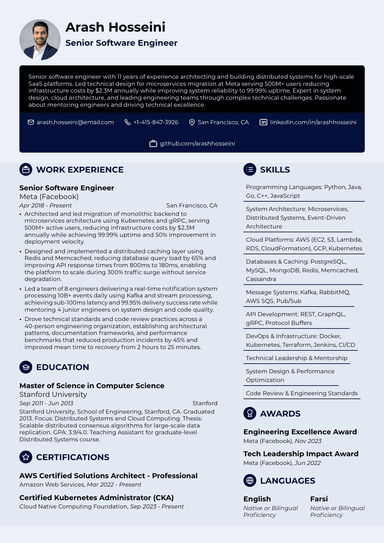
#3. Senior Software Engineer Resume Example

#4. Software Developer Resume Example

How to Write a Software Engineer Resume: Writing Process Explained
Writing a software engineer resume involves more than listing your tech stack and hoping for the best. Each section has a purpose, and how you present your experience matters just as much as what you include.
Let’s walk you through each step you should follow to get a solid, interview-ready document by the end.
#1. Choose the Right Resume Format
The right resume format for a software engineer depends on your experience level and career history. For most engineers with any amount of professional experience, reverse-chronological is the gold standard; your most recent role appears first, making it easy for recruiters to see your career trajectory at a glance.
If you're making a significant career change and your job titles don't directly reflect your engineering skills, a functional format can emphasize your technical abilities over your job history. Meanwhile, a combination one works well for engineers with a mix of relevant freelance, open-source, and full-time experience that doesn't fit neatly into a single chronological narrative.
Let’s break down each of the options:
| Format | Best For | ATS-Friendly? |
|---|---|---|
Experienced engineers with clear career progression | Yes | |
Career changers, skill-heavy profiles | Sometimes flagged | |
Mixed freelance/full-time, portfolio-heavy candidates | Yes (if clean) |
#2. Add Your Contact Information and Links
A solid contact section should include:
- Your full name
- Phone number
- Email address
- LinkedIn profile URL
- GitHub URL
- City and state (skip the full street address; it's outdated and wastes space)
For software engineers, a GitHub profile is essentially an extension of a resume, and recruiters will definitely check it. Therefore, make sure your pinned repositories are polished, your README files are readable, and your commit history shows consistent activity. That being said, a sparse or messy GitHub on a resume can quietly hurt your chances even when your application is strong.
An example of a well-written contact resume section looks like this:
Daniel Brooks
San Diego, CA
(619) 555-0172
daniel.brooks@email.com
linkedin.com/in/danielbrooks123
github.com/danielbrooks123
#3. Write a Compelling Resume Summary or Objective
A software engineer resume summary is a short paragraph at the top of your resume that highlights your specialty, years of experience, and your most impressive technical achievements. Its purpose is to hook the reader immediately and make them want to check out the rest of your resume.
If you have 3+ years of experience, use a summary; however, if you're entry-level or changing careers, it might be best to use a resume objective that focuses on what you're aiming to achieve and what relevant skills you bring.
The distinction matters because a senior engineer writing "seeking an opportunity to learn" sounds out of place, just as an entry-level engineer claiming "10 years of full-stack expertise" would raise red flags.
Let’s have a look at a good resume summary example:
Experienced software engineer with 8+ years building distributed backend systems in Python and Go. Led architecture redesign at [Company] that reduced infrastructure costs by 22%. Passionate about clean code, system reliability, and mentoring junior engineers.
Meanwhile, here’s what a resume objective could look like:
Computer Science graduate with hands-on experience building full-stack web apps using React and Node.js. Completed 3 portfolio projects, including a real-time chat app serving 500+ concurrent users. Eager to contribute to a collaborative engineering team.
#4. Detail Your Work Experience with Impact
The difference between a good resume and a great one often comes down to the work history section. Here, you should list your most recent role first and work backward, and tailor bullet points to each job posting, as this dramatically increases your hit rate.
Use the XYZ formula (Accomplished [X] as measured by [Y], by doing [Z]), or try the CAR framework (Challenge → Action → Result). Either approach pushes you toward quantification, which is what hiring managers need to understand your actual impact. Here’s how to do it:
Software Engineer
BlueWave Technologies, San Diego, CA
March 2021 – Present
- Developed and maintained scalable web applications used by over 50,000 monthly users
- Built RESTful APIs using Node.js and Express, improving application response time by 30%
- Collaborated with product managers and designers to deliver new features in Agile sprints
- Optimized database queries and backend processes, reducing server load by 20%
- Implemented automated testing and CI/CD pipelines to improve deployment reliability
#5. List Your Technical Skills Strategically
Your skills section is where ATS matching happens most directly. Therefore, it’s of utmost importance to build a dedicated space to present your abilities and mirror the exact keywords from each job description you apply to.
The top software engineer resume skills include a combination of technical hard skills (languages, frameworks, cloud platforms, and tools) and the soft skills that show you can work effectively within a team.
Some hard skills you can benefit from if you include them in your resume would be:
- Python, Java, C++, JavaScript, Go
- React, Node.js, Django, Spring Boot
- AWS, Azure, GCP
- Docker, Kubernetes
- SQL, NoSQL, PostgreSQL
- REST APIs, GraphQL, gRPC
- CI/CD, Git, Agile/Scrum
- System Design, Data Structures & Algorithms
On the other hand, the soft ones include:
- Problem-solving
- Technical + non-technical communication
- Collaboration & teamwork
- Adaptability
- Attention to detail
- Time management
- Mentorship & code review
- Ownership & accountability
You can also group them like this:
Programming Languages: JavaScript, Python, Java, SQL
Frameworks & Libraries: React, Node.js, Express, Spring Boot
Tools & Platforms: Git, Docker, Kubernetes, Jenkins
Cloud & Databases: AWS, PostgreSQL, MongoDB
Practices: RESTful API development, Agile/Scrum, CI/CD, Test-driven development
However, don't just stuff in every tool you've ever touched; if you'd struggle to answer basic interview questions about a skill, leave it off.
#6. Showcase Your Projects
For entry-level engineers, bootcamp graduates, and career changers, a projects section can be more valuable than a work experience section. Even for experienced engineers, it demonstrates initiative and shows what you build on your own time.
For each project, include:
- Project name
- Tech stack used
- Live URL or GitHub link
- 1–2 bullet points capturing impact or technical complexity
Aim for 2–4 projects, and prioritize work that reflects real-world use cases, scale, or problem-solving over tutorial clone projects. Here’s one way to do it:
TrackrApp | React, Node.js, PostgreSQL, AWS Lambda | github.com/yourhandle/trackrapp
- Built a habit-tracking web app with 400+ active users, featuring real-time dashboard updates via WebSockets
- Deployed serverless backend on AWS Lambda, cutting hosting costs by 60% compared to EC2
#7. Include Education and Certifications
When it comes to education, all you need to list is your degree, university, and graduation year. Computer Science, Software Engineering, and related STEM degrees are preferred but genuinely not required, as many top engineers are self-taught or bootcamp-trained.
If you completed a coding bootcamp, list it prominently in your education section just as you would a university. Recruiters have become increasingly receptive to bootcamp graduates, especially when their project work is strong.
Finally, relevant certifications add real weight to a software engineer resume. High-value options include AWS Certified Developer, Google Cloud Professional, Meta Frontend Developer, and Microsoft Azure Fundamentals.
You can go with something like this:
Education
Bachelor of Science in Computer Science
University of California, San Diego
Graduated: 2019
Certifications
- AWS Certified Developer – Associate
- Amazon Web Services, 2022
#8. Add Optional Sections
If you've contributed to well-known open source projects, won a hackathon, published a technical paper, filed a patent, or given a conference talk, include that in your resume. These details set senior and specialized candidates apart in ways that job titles alone can't.
That said, only include what's genuinely relevant to your target roles; for instance, an award from 2012 for a project unrelated to software engineering probably isn't helping your case.
Common Software Engineer Resume Mistakes to Avoid
Sometimes, technically strong candidates lose interviews due to avoidable resume mistakes; the good news is that most of these are easy fixes once you know what to look for. Let’s see what the most common errors are and how to make sure they don’t happen:
- Listing responsibilities instead of achievements. Recruiters want impact, not a paraphrased job description. Plus, the ATS systems in modern hiring also respond better to outcome-driven language.
- Not tailoring for ATS. Generic resumes routinely miss the keywords that ATS systems are scanning for. Always mirror the job description's language and tech stack before submitting — even small wording differences matter.
- Including irrelevant or outdated skills. Listing old tasks and projects may dilute the relevance of your current stack, so curate your skills section for each target role.
- No GitHub link or portfolio. As previously mentioned, a GitHub profile is expected for software engineers. Omitting it, especially if you have strong personal projects, is a genuinely missed opportunity.
- Poor formatting or excessive length. More than two pages is rarely needed and often works against you. Also, avoid multi-column layouts, graphics, and tables embedded in your resume; they frequently break ATS parsing.
We Make Your Software Engineer Resume Creation Effortless
Everything in this guide—the structure, the keyword strategy, the formatting rules—is built into ResumeBuilder.so. You don't need to wrestle with margins in Google Docs or wonder whether your layout will survive ATS parsing; our resume builder helps you tackle all that and get an outstanding resume ready for submission.
ResumeBuilder.so offers:
- AI-powered content suggestions tailored for technical resumes, so you're not starting with a blank page
- ATS-friendly resume templates that pass automated screening without sacrificing visual polish
- Fully customizable designs you can adjust to match your personal needs
Final Thoughts
A great software engineer resume comes down to a few non-negotiable things: it has to clear ATS filters, quantify your impact, and be tailored to the specific role you're applying for.
Each piece of your document, be it the format, the summary, the skills section, or the project bullets, has its purpose. If you carefully create each one, your resume becomes a tool that actually opens doors to many exciting job opportunities.
Once you're ready to put it all together, ResumeBuilder.so handles the formatting, the ATS optimization, and the structure. This way, you can focus on what actually matters: showing employers what you've built!
Software Engineer Resume FAQs
#1. How long should a software engineer resume be?
A software engineer resume should be one page for engineers with under 10 years of experience. Two pages are acceptable for senior engineers with extensive project and leadership history. Avoid going longer; conciseness signals strong communication skills, which tech teams genuinely value.
#2. What skills should I put on a software engineer resume?
The best skills to include on a software engineer resume are programming languages you use professionally (Python, Java, JavaScript), relevant frameworks (React, Node.js), cloud platforms (AWS, GCP), databases, and DevOps tools (Docker, Git). Always mirror specific keywords from the job description to pass ATS filters.
#3. How do I write a software engineer resume with no experience?
To write a software engineer resume with no experience, concentrate on personal projects, open-source contributions, academic coursework, internships, and bootcamp work. A strong, active GitHub profile can genuinely compensate for a limited work history, as well as leading with a skills section and using an objective instead of a summary.
#4. Do I need to list GitHub on my software engineer resume?
Yes, you need to list GitHub on your software engineer resume. Recruiters routinely review repositories to assess code quality, project complexity, and coding habits. Make sure your profile is active, your pinned repos are your best work, and README files clearly explain each project.
#5. What resume format is best for software engineers?
The reverse-chronological format is best for most software engineers because it highlights career progression and is the most ATS-friendly structure. Career changers may benefit from a combination or functional format that leads with transferable skills rather than job titles that don't yet reflect their engineering background.

Max Harper is the resume guru who actually makes job searching easier. With years of experience as a hiring manager, Max knows what makes a resume stand out in a pile of 200+ applications. From breaking down ATS myths to helping you craft bullet points that pop, Max shares easy-to-digest, no-BS resume advice.