Journalist Resume: How to Write One in 2026 + Real Examples
This complete guide with detailed explanations and expert tips will teach you how to write an acting resume in record time!
Edit this resume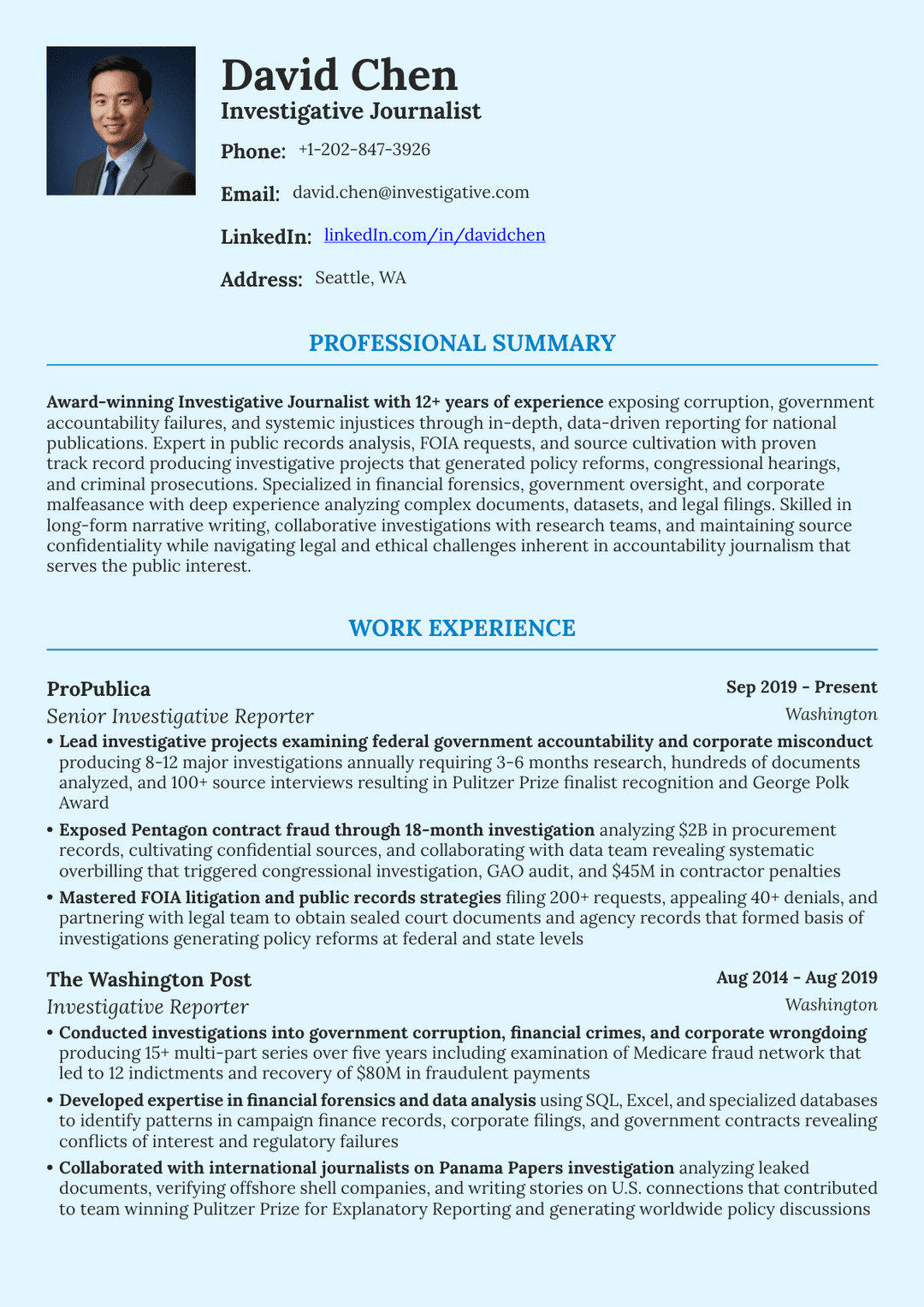
A well-crafted journalist resume opens doors across print, broadcast, digital media, and freelance opportunities. Newsrooms receive hundreds of applications for every open position, so you have little time to prove you're the storyteller they need.
Whether you're chasing breaking news, crafting long-form investigations, or building a multimedia portfolio, your resume needs to demonstrate your technical abilities and your ability to tell compelling stories under pressure.
In this comprehensive guide, we’ll walk you through creating a journalist resume that showcases your reporting skills, published work, and the measurable impact you've made in every newsroom you've touched.
- Journalist resumes require showcasing storytelling abilities, research skills, and published work that demonstrates your range and depth as a reporter.
- Quantifiable achievements like viewership increases, awards won, and story impact (think policy changes or community responses) make resumes memorable.
- Different journalism specializations—broadcast, print, investigative, data journalism—require tailored resume approaches that emphasize the specific skills editors and news directors value most.
- Entry-level candidates should emphasize internships, campus media experience, and relevant coursework to compensate for limited professional experience.
What Is a Journalist Resume?
A journalist resume is a professional document that highlights your reporting experience, writing skills, and ability to investigate, research, and communicate stories clearly. It showcases your published work, relevant beats, newsroom tools, and digital media skills such as SEO writing.
According to the U.S. Bureau of Labor Statistics, the median annual wage for journalists is $60,280, with about 4,100 job openings expected each year. Considering that fewer roles are available, a polished, results-focused resume becomes essential for standing out and securing interviews.
A strong journalist resume focuses on measurable accomplishments—audience reach, engagement growth, or impactful stories—rather than job duties alone. It helps editors and hiring managers quickly assess your writing strengths, credibility, and fit for the role.
Journalist Resume Examples by Specialization
Different journalism specializations require emphasizing different skills and experiences. Let’s examine a few resume examples to see what each type of journalist resume should highlight to match what editors and news directors expect.
#1. Entry-Level Journalist Resume Example

#2. Broadcast Journalist Resume Example


#3. Print/Digital Journalist Resume Example


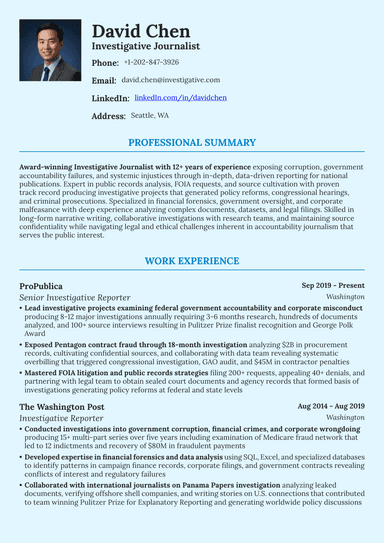
#4. Investigative Journalist Resume Example


#5. Freelance Journalist Resume Example

#6. Sports Journalist Resume Example

#7. Data Journalist Resume Example


#8. Multimedia Journalist Resume Example

How to Write an Effective Journalist Resume: Step-by-Step Guide
Writing your journalist resume from scratch might feel overwhelming, but breaking it into manageable steps makes the process straightforward. Here's a roadmap from a blank document to an interview-worthy resume:
#1. Research the Role and Media Outlet
Start by researching the company, media outlet in this case, and your target role. Study the media outlet's coverage style, their typical story formats, and what skills they emphasize in job postings.
Analyze job descriptions carefully. The requirements and preferred skills and qualifications tell you exactly what keywords and experiences to emphasize.
#2. Choose the Right Resume Format
Most journalists should use the reverse-chronological resume format, which lists your most recent position first and works backward through your career. This familiar structure clearly demonstrates progression—from campus reporter to staff writer to senior correspondent—and works well with applicant tracking systems (ATS).
As an alternative, you can use either a functional resume, which emphasizes skills and suits career changers entering journalism, or combination resume, which blends both approaches.
Regardless of your resume format, keep the design clean and professional. Avoid fancy graphics, unusual fonts, or creative layouts—you're being hired for storytelling ability, not graphic design skills.
#2. List Your Contact Information
Your resume header is the first thing a potential employer sees. Make sure to include the following information:
- Full name
- City and state
- Phone number
- Professional email
- LinkedIn profile
However, what sets journalism resumes apart are the links to published work, portfolio, or byline page. Editors won't take your word that you're a great writer; they'll click through to read your clips within seconds of scanning your resume.
Make it easy by putting your portfolio URL right under your email. If you have bylines scattered across publications, create a simple portfolio site aggregating your best work, or link directly to your author page at your current publication.
Here’s a good example of a resume header:
SARAH MARTINEZ
New York, NY
(212) 555-0147
sarah.martinez@email.com
LinkedIn: linkedin.com/in/sarahmartinez
Portfolio: sarahmartinezwrites.com
#3. Craft Your Professional Summary
Your professional summary needs to grab attention faster than a breaking news alert. This 3-4 sentence section is your elevator pitch that highlights your journalism experience, specializations (investigative, beat reporting, multimedia), and notable achievements that prove you deliver results.
If you’re an experienced journalist, use a resume summary. Here’s a good example:
Award-winning investigative journalist with 7+ years covering government accountability. Broke three front-page stories leading to policy reforms. Skilled in data journalism, FOIA requests, and multimedia storytelling across print and digital platforms.
On the other hand, if you’re an entry-level journalist or student, use a resume objective. For example:
Recent journalism graduate seeking broadcast reporter position to leverage multimedia storytelling skills, campus TV anchoring experience, and passion for community-focused reporting.
Tailor this section to each role by pulling keywords from job descriptions and emphasizing the experience most relevant to that specific newsroom or media outlet.
#4. Detail Your Work Experience With Impact
Avoid generic descriptions in your work experience. Instead, present result-focused bullet points with strong action verbs to prove your stories made an impact.
Quantify your achievements, such as:
- Viewership increases you generated
- Audience growth you drove
- Circulation numbers for your beat
- Social media engagement your stories earned
- Awards you won
- Exclusive stories you broke
That said, let’s see the difference between weak and strong bullet points:
- Reported city hall beat producing 200+ stories annually, including investigation of misallocated funds that recovered $2.3M for taxpayers and earned state press association’s investigative reporting award
- Produced and edited 50+ video stories generating 3.8M views and 45% increase in social media engagement, establishing station’s digital video presence
Weak Bullet Point
- Covered city hall beat for daily newspaper
- Produced video content for news website
#5. Highlight Relevant Skills and Technical Proficiencies
Select journalism skills matching job requirements rather than listing every skill you have. Avoid generic skill lists like "good communicator" or "team player"—these mean nothing without context. Instead, demonstrate these qualities through achievement bullets.
Balance hard skills (technical tools and platforms) with soft skills (interviewing, source relationships, collaboration) but prove competencies through your work experience.
Here’s a good example:
- Collaborated with an investigative team across three bureaus to produce five-part series
#6. Include Education and Relevant Coursework
Most journalism positions expect at least a Bachelor's degree in journalism, communications, or a related field. Present your education clearly:
- Degree earned
- Institution name
- Location
- Graduation year
If you graduated from a respected journalism school, that pedigree matters—news directors notice programs like Columbia, Northwestern, Missouri, or USC Annenberg.
Recent graduates with no experience should include relevant coursework that demonstrates specialized skills, such as investigative journalism, media law, or multimedia storytelling. Academic honors deserve mention too, whether that's Dean's list recognition, journalism scholarships, or thesis projects that resulted in published work.
Also, include your GPA only if you're a recent graduate with 3.5 or above. However, if you’re an experienced journalist you can drop the GPA as professional achievements become more relevant than academic performance.
Here’s how a good entry on your education section might look like:
Bachelor of Arts in Journalism
Northwestern University
Medill School of Journalism
Evanston, IL
May 2022
- Concentration: Investigative Reporting
- GPA: 3.8
- Dean's List (4 semesters)
- Medill Cherub Scholarship Recipient
#7. Awards, Recognition, and Certifications
Awards validate quality in ways job descriptions can't. Create a dedicated section for recognition, including:
- Journalism awards (regional press association awards, investigative journalism prizes, Pulitzer nominations if applicable)
- Commendations from editors or news directors
- Featured stories that gained unusual traction
- Professional certifications (Google Analytics for journalists, hostile environment safety training, specialized beat certifications)
- Professional association memberships (SPJ, NAHJ, NABJ, RTDNA, ONA)
Place this section after your work experience and education. However, if you're early in your career with limited awards, fold recognition into your work experience bullets instead of creating a standalone section.
Essential Journalism Skills for Your Resume
Comprehensive skill lists help you identify what belongs on your journalist resume. However, remember, proving competencies through work experience matters more than simply listing capabilities.
Here’s an organized list of skills you can use on your journalist resume:
- Investigative reporting
- News and feature writing
- AP style editing
- Interviewing sources
- Fact-checking and verification
- Source development
- Beat reporting
- Deadline management
- Research and public records search
- Narrative storytelling
- CMS platforms (WordPress, Drupal, Arc)
- SEO and analytics (Google Analytics, Chartbeat, Parse.ly)
- Video editing (Premiere Pro, Final Cut)
- Audio editing (Audacity, Pro Tools)
- DSLR photography
- Photo editing (Lightroom, Photoshop)
- Data visualization (Datawrapper, Tableau, Flourish)
- Graphic design basics (Canva, InDesign)
- Social media publishing tools
- Adaptability under deadline pressure
- Collaboration with cross-functional teams
- Strong communication skills
- Ethical decision-making
- Critical thinking
- Task and time management
- Cultural awareness and sensitivity
- Crisis reporting composure
- Relationship building with sources
5 Common Journalist Resume Mistakes to Avoid
Frequent errors weaken journalist resumes and cost interview opportunities. Here are the most common resume mistakes and how to avoid them:
| Resume Mistake | Why It Hurts You | What To Do Instead |
|---|---|---|
No Customization | Shows you didn’t research the newsroom; looks mass-submitted. | Tailor your resume to each role: update the summary, highlight relevant beats/platforms, and match keywords to the job posting. |
No Portfolio / Work Samples | Editors won’t evaluate you without proof of work; resume likely rejected instantly. | Add clickable links to your portfolio, bylines, demo reel, or clips prominently near your header + in experience bullets. |
Listing Duties, Not Achievements | Reads like a job description; doesn't show impact or value. | Use action + results. Quantify where possible (audience growth, story performance, awards, scoops). |
Typos / Grammar / AP Style Errors | Suggests weak writing and editing skills—deal breaker for journalists. | Proofread carefully; read aloud; use tools and peer review before applying. Maintain consistency + AP style awareness. |
Irrelevant Information | Wastes space and weakens professional focus. | Include only journalism-related experience, transferable skills, and achievements that strengthen your candidacy. |
Create a Standout Journalist Resume With ResumeBuilder.so
Creating a compelling journalist resume doesn't require struggling since ResumeBuilder.so streamlines the entire resume writing process.
Our platform offers ATS-friendly resume templates tailored for journalism applications, with different customization options. This way, you can easily tailor resumes whether you're applying to broadcast positions, investigative roles, or digital media outlets.
Use our AI-powered resume builder and create your journalist resume today—because your next great story might be the one that lands you the job.
Final Thoughts
According to the Society of Professional Journalists, ethical journalism supports an informed public and strengthens democratic institutions by promoting accuracy, fairness, and transparency. Demonstrating these values through your resume—accurate representation of your work, honest achievements, and clarity in how you contributed—reinforces your credibility.
Professional journalists follow widely recognized ethical principles to guide responsible reporting and decision-making, and aligning your application materials with these expectations helps potential employers see your commitment to integrity. Pair your resume with a well-written cover letter, explaining your journalism passion and fit for the specific role.
Journalist Resume FAQs
#1. What should I include in a journalist resume?
A journalist resume should include contact information with portfolio links, a professional summary highlighting your journalism focus and achievements, work experience with quantified impact, relevant education, journalism skills spanning writing to technical tools, and awards validating your work quality. Published clips or bylines are essential.
#2. How long should a journalist resume be?
A journalist resume should be one page for entry-level journalists and recent graduates, or two pages maximum for experienced professionals with extensive published work, multiple positions, and significant achievements spanning years of journalism.
#3. Should I include a portfolio with my journalist resume?
Yes, absolutely—including a portfolio link, published clips, or byline page is essential for journalist resumes. Hiring managers want to see your writing ability and journalism work quality immediately, not just read descriptions of what you've done.
#4. What skills are most important for a journalist resume?
The most important journalism skills include news writing, investigative reporting, interviewing and source development, AP style mastery, multimedia production, deadline management under pressure, fact-checking, and relevant technical tools like CMS platforms and editing software.
#5. What's the difference between a print and broadcast journalist resume?
Print journalist resumes emphasize writing samples, AP style mastery, published bylines, and digital engagement metrics. Broadcast journalist resumes highlight on-air experience, video editing skills, presentation abilities, viewership numbers, and include demo reel links.
#6. Should I include social media on my journalist resume?
Include professional social media handles like X.com (for news and industry engagement) or LinkedIn that demonstrate your journalism presence and professional networking. Avoid personal accounts without journalism relevance or content that doesn't reflect professional standards.

Ava Sinclair is the Founder of ResumeBuilder.so and a seasoned expert in HR and recruitment. As the driving force behind ResumeBuilder.so, Ava combines her expertise in recruitment and job-seeking strategies to empower job seekers with intuitive, high-impact resume-building tools.