Writer Resume: Examples and Step-by-Step Guide for 2026
This complete guide with detailed explanations and expert tips will teach you how to write an acting resume in record time!
Edit this resume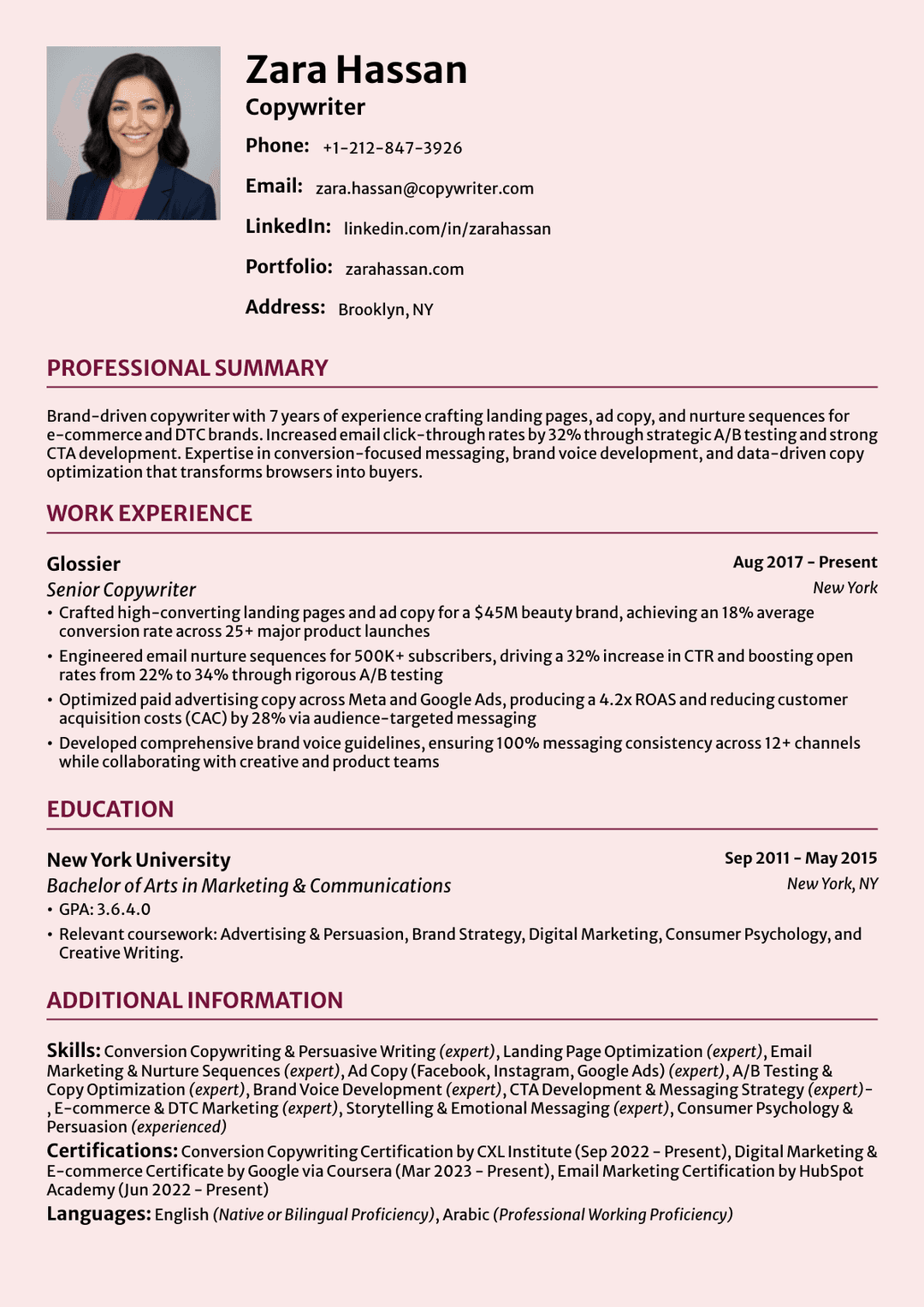
A writer resume is your chance to prove you can do the very thing you're being hired to do—communicate clearly. However, most writers somehow go completely blank when it's time to write about themselves. Hiring managers and editors aren't impressed by a list of job duties. They're looking for evidence, i.e. measurable results, a distinctive voice, and proof that you understand the craft on a professional level.
The solution isn't complicated, but it does require intention. In this guide, we’ll show you how to craft a strong writer resume that highlights your specializations, demonstrates impact with numbers, and passes the ATS filters. Also, we’ll provide you with real-world resume examples you can use for inspiration, no matter your niche or experience level.
- Your writer resume must state your niche—copywriting, technical writing, journalism, and so on.
- Quantified achievements carry far more weight than vague descriptions.
- Portfolio is non-negotiable; include a portfolio link in your contact section or a dedicated clips section.
- Mirror language from the job description to pass automated screening filters.
- Reverse-chronological resume format suits most experienced writers; hybrid works best for freelancers and career changers.
What Makes a Strong Writer Resume?
A strong writer resume showcases your writing skills and specializations, experience, and published work to potential employers or clients. Unlike a standard resume, it serves as a credential document and as a writing sample in its own right.
A hiring manager reading your resume is already assessing your sentence construction, your clarity, and whether your voice feels professional. Every word is being evaluated. Therefore, a writer resume needs to demonstrate not just what you've done but how well you communicate—concisely, compellingly, and with relevance to the role.
According to the U.S. Bureau of Labor Statistics, this profession has a steady job outlook, projected to grow 4% over the next decade. Writers and authors develop written content for various types of media, so there are different writing specializations. The table below outlines the main types:
| Writer Type | What It Focuses On |
|---|---|
Blog posts, SEO articles, web copy, traffic growth metrics | |
Copywriter | Ad copy, landing pages, email campaigns, conversion rates |
Freelance Writer | Client portfolio, niche specializations, deliverable volumes |
Technical Writer | Documentation, user manuals, software guides, clarity metrics |
Creative Writer | Published works, genre, voice, literary awards or recognition |
Each writing specialization emphasizes different credentials. For example, a content writer leans on traffic metrics and SEO expertise, while a technical writer highlights documentation clarity and software familiarity. Knowing which type fits your background determines resume writing.
Writer Resume Examples by Specialization
Before we go on with the guide on how to make a resume, let’s examine a few resume examples of writer resumes by specialization.
Content Writer Resume Example

Copywriter Resume Example

Freelance Writer Resume Example

Technical Writer Resume Example

Creative Writer Resume Example

How to Make a Writer Resume: Step-by-Step Guide
You can make a writer resume by following a structured process—from choosing the right resume format to crafting a compelling summary and showcasing your portfolio. Here's the full process broken down into eight clear actions.
#1. Choose the Right Resume Format
There are three main resume formats for writers:
- Reverse-chronological. It lists your most recent positions first and works best for writers with a consistent employment history. It's also the most ATS-friendly format. If you've been writing professionally for two or more years without major gaps, this is almost always your strongest option.
- Functional format. This one emphasizes skills over experience, which can help writers who are entering the field or switching from an unrelated career. However, many ATS platforms struggle to parse it, so use this one carefully.
- Combination (hybrid) format. It combines a strong skills section up front with a standard chronological work history below. Freelancers especially benefit here; you can lead with specializations and then list clients and projects in order.
#2. Write a Compelling Resume Summary or Objective
A resume summary for a writer is a 2-3 sentence snapshot at the top of the resume that captures your specialization, key skills, and most impressive outcomes. On the other hand, a resume objective is used by entry-level writers or career changers; it focuses on what you're aiming to contribute rather than what you've already accomplished.
Here's the difference in practice:
Results-driven content writer with 6 years creating SEO-optimized long-form articles for B2B tech brands. Consistently ranked target keywords in the top three positions and increased organic traffic by 45%.
Recent journalism graduate with hands-on internship experience in digital content and social media copywriting. Eager to bring strong research skills and a developing SEO foundation to a fast-paced editorial team.
Now, let’s see a few different resume summary examples by specialization:
Results-focused content writer with 7 years of experience producing SEO-driven articles, whitepapers, and email sequences for B2B SaaS companies. Achieved top-three Google rankings for 30+ target keywords and grew organic traffic by an average of 40% year-over-year.
Brand-driven copywriter with 4 years of experience crafting landing pages, ad copy, and nurture sequences for e-commerce and DTC brands. Increased email click-through rates by 28% through strategic A/B testing and strong CTA development.
Versatile freelance writer with 5 years creating long-form content, ghostwritten articles, and editorial features for clients across healthcare, finance, and technology. Manages multiple concurrent client relationships while maintaining 100% on-time delivery.
#3. List Your Writing Experience
Your work experience on resume should do more than list places you've worked. It needs to show what you produced, for whom, and what happened as a result. Use strong action verbs, such as: crafted, produced, optimized, managed, researched, published, launched.
Here three strong examples of bullet-point achievements:
- Produced 80+ SEO blog posts per year, driving a 52% increase in organic search impressions for a fintech brand
- Managed editorial calendar for a 12-publication regional news network, meeting 100% of weekly deadlines across 18 months
- Wrote landing page copy that increased free-trial sign-ups by 34% in a three-month A/B test
If you’re a freelancer, you should list your top clients and quantify results rather than listing yourself as the "employer."
#4. Highlight Your Writing Skills
The key is to balance hard skills—the tools and technical capabilities you've mastered—with soft skills that reflect your professional judgment and communication style.
Hard skills for a writer resume include:
- SEO writing
- Content strategy
- Copywriting
- AP/Chicago style
- WordPress/Webflow
- HubSpot
- Keyword research
- Adobe InDesign
- Video scriptwriting
- Email marketing
- Technical documentation
On the other hand, soft skills worth listing include:
- Communication
- Storytelling
- Critical thinking
- Time management
- Editing and proofreading
- Research and analytical skills
- Adaptability
- Collaboration
Mirror the exact language from the job posting. If the description says "long-form content," don't write "extended articles." ATS systems match strings literally.
#5. Add Your Portfolio and Published Work
If there's one section that separates a strong writer resume from a forgettable one, it's the portfolio. Editors and content managers expect to see your actual work. A resume without a clips link is like a graphic designer submitting a resume with no visuals.
The cleanest approach is to include a portfolio link right in your resume contact information, next to your LinkedIn. If you have a dedicated clips page, you can also add a short "Portfolio" section just below your summary.
Your options include a personal website (strongest), a Contently profile, Muck Rack for journalists, a curated Google Drive folder, or a LinkedIn "Featured" section.
#6. Include Education and Certifications
Degrees most relevant to writing roles include English, Journalism, Communications, and Marketing. That said, many hiring managers in content and copywriting weigh portfolio strength over academic credentials.
There are also certifications that carry real weight, such as:
- HubSpot Content Marketing
- Google Analytics
- SEMrush SEO Fundamentals
- Copyblogger's content marketing courses
These show ongoing professional development and practical tool familiarity, exactly what growing marketing teams want to see. Also, if you don't have a formal degree and education, a strong combination of certifications and published clips can absolutely get you through the door.
#7. Optimize Your Resume for ATS
Over 90% of large companies use Applicant Tracking Systems (ATS), so optimization is usually the cost of entry. To win this battle, it’s key to use the right resume keywords.
To do so, there are a few ATS tips to use. The most important one is to read the job description carefully and pull out the specific phrases used. If the posting mentions "B2B content strategy" and "HubSpot CMS," those exact phrases should appear somewhere in your resume, not paraphrased versions of them.
#8. Write a Matching Cover Letter
Your resume lists the facts while your cover letter tells the story. A well-matched letter reinforces your resume rather than repeating it.
To write a cover letter that matches your resume, start by mirroring the tone. If your resume is polished and formal, your cover letter should be too. Consistency signals professionalism and shows you understand how to adapt your voice for an audience.
Pay close attention to your opening line. Hook the reader with a relevant achievement, a bold statement about your writing philosophy, or a direct reference to the publication or brand you're applying to.
From there, connect your portfolio to their specific needs. Point to one or two samples that align with the type of content the role requires, rather than making vague claims about your abilities. Concrete evidence always speaks louder.
Lastly, close with confidence. A specific, enthusiastic call to action leaves a far stronger impression; it reminds the reader exactly why they should move you to the next round.
That said, here’s a good writer cover letter example:

4 Most Common Writer Resume Mistakes
Even skilled writers stumble when it comes to their own resumes. Knowing what resume mistakes to avoid is just as important as knowing what to include.
- Leading with a generic professional statement. Hiring managers don't need to know you're "seeking a challenging role." Replace it with a sharp resume summary that highlights your niche, experience level, and the value you bring.
- Listing duties instead of achievements. "Wrote blog posts" tells employers nothing. Quantify your impact; mention traffic growth, publishing frequency, or audience reach to make your contributions tangible.
- Ignoring keywords from the job posting. Many applications are filtered by ATS software before a human ever reads them. Mirror the language in the job description to ensure your resume makes it through.
- Skipping a portfolio link. For writers, work samples are everything. A resume without a link to your clips or website is a missed opportunity no cover letter can fix.
Build Your Writer Resume with ResumeBuilder.so
Putting together a standout writer resume doesn't have to be a struggle. ResumeBuilder.so gives you everything you need in one place—from a powerful resume builder that guides you through every section, to a cover letter builder that helps you craft a compelling pitch in minutes.
If you’re not sure where to start, browse our library of professionally designed resume templates built to impress, or draw inspiration from real cover letter examples tailored to different writing roles and experience levels.
Whether you're a seasoned content strategist or a freelancer landing your first byline, ResumeBuilder.so makes it easy to present your best self on the page — and get noticed faster.
Final Thoughts
A writer resume carries more weight than most applicants realize. It's not just a summary of your career, it's proof of your craft. Every sentence, every bullet point, and every word choice is being evaluated by someone who reads for a living.
The fundamentals are consistent regardless of your niche: choose the right format for your experience level, lead with a summary that states your specialization and results, back every claim with a metric, and always include your portfolio link. Those four elements alone put you ahead of most applicants.
Writer Resume FAQs
#1. What should a writer put on a resume?
A writer should include a resume summary, work experience with metrics, a portfolio or clips link, writing-specific skills (SEO, CMS tools, AP Style), education, and relevant certifications. Tailoring these sections to each job description improves both ATS performance and recruiter appeal.
#2. How do I write a resume objective for a writer?
Write a resume objective for a writer by stating your current status, key writing skills, and the specific value you bring to the target employer. Keep it to 2-3 sentences and tailor it for each application.
#3. Do writers need a portfolio on their resume?
Yes, writers should always include a portfolio link on their resume. A collection of published clips or writing samples is often more persuasive than work history alone, and most editors and content managers expect to see it. If you don't have a personal site, a curated Google Drive folder works fine.
#4. What skills should I list on a writer resume?
Key skills for a writer resume include SEO writing, content strategy, CMS proficiency (WordPress, HubSpot), AP/Chicago Style, keyword research, editing, and storytelling. Always mirror the exact language from the job posting because ATS systems match keywords literally.
#5. How long should a writer resume be?
A writer resume should be one page long for those with fewer than 10 years of experience. Senior writers or those with extensive publication histories can justify two pages.
#6. Can I get a writer job without a degree?
Yes, many writers land jobs without a degree by building a strong portfolio, earning relevant certifications (HubSpot Content Marketing, Google Analytics), and demonstrating measurable results. Freelance experience, published clips, and personal blogs can substitute for formal education in most content and copywriting roles.

Max Harper is the resume guru who actually makes job searching easier. With years of experience as a hiring manager, Max knows what makes a resume stand out in a pile of 200+ applications. From breaking down ATS myths to helping you craft bullet points that pop, Max shares easy-to-digest, no-BS resume advice.