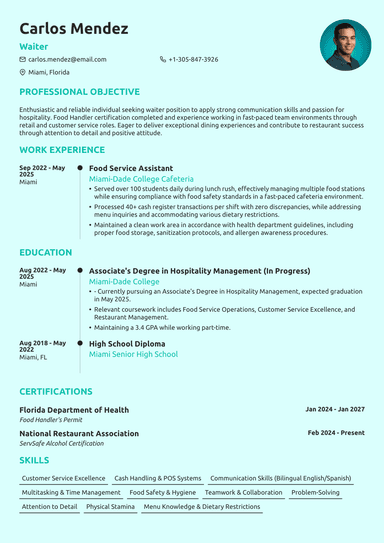
Waiter Resume: Examples and Writing Guide for 2026
This complete guide with detailed explanations and expert tips will teach you how to write an acting resume in record time!
Edit this resume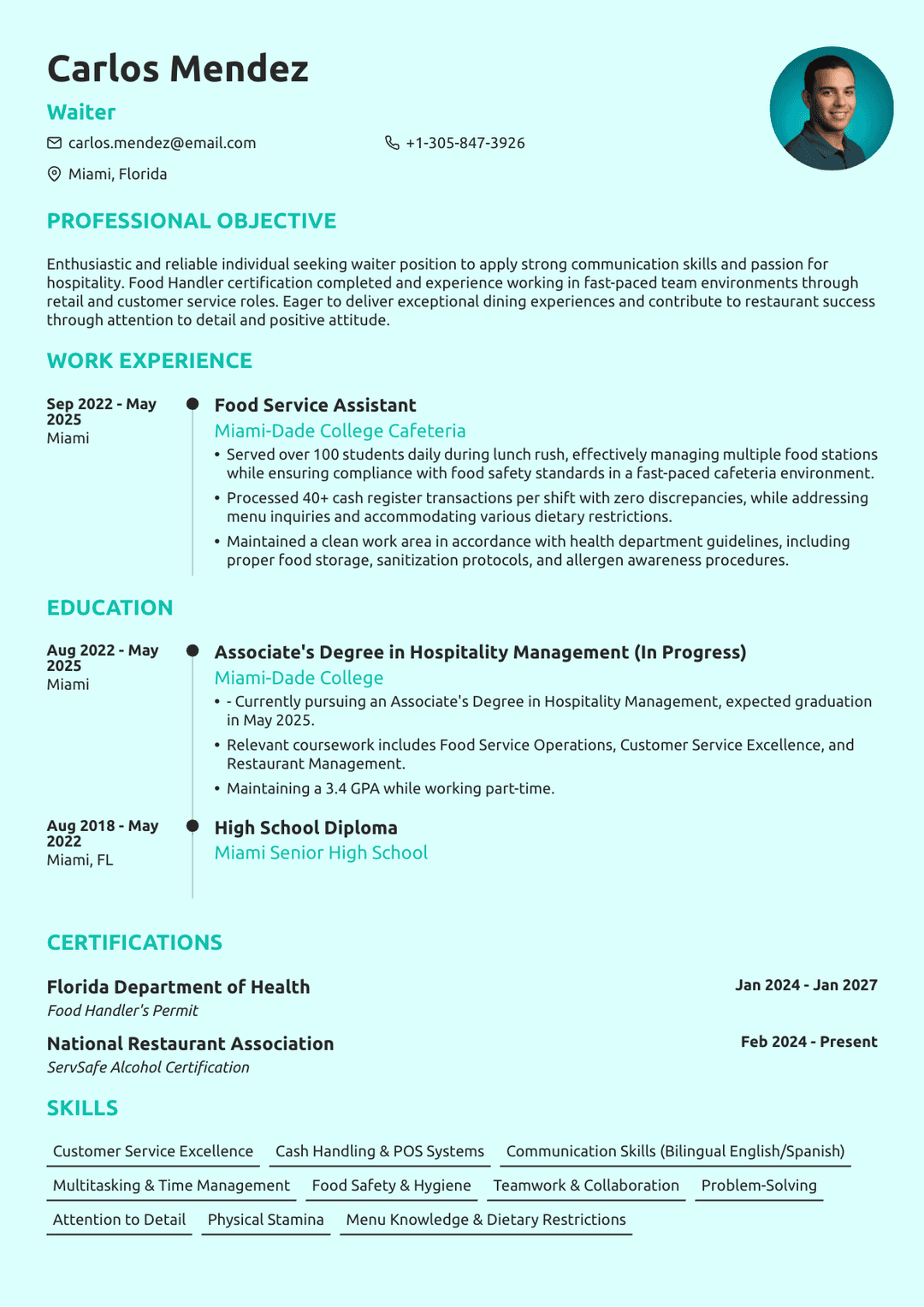
A waiter resume is a professional document that showcases your food service skills, customer service experience, and ability to excel in fast-paced restaurant environments. It's basically your ticket to getting your foot in the door at restaurants, cafes, diners, and other food service establishments.
Whether you're writing from scratch or updating one with years of restaurant experience, the right format and content can make all the difference between getting called in for an interview and having your application overlooked.
Let's explore how to make a waiter resume that secures restaurant positions and stands out from the dozens of other applicants vying for the same role.
- A strong waiter resume focuses on customer service ability, reliability, and performance in fast-paced environments.
- Quantified work experience (tables served, sales increases, accuracy rates, customer satisfaction) is the primary way candidates demonstrate value.
- Relevant skills, certifications, and food safety knowledge strengthen credibility and improve ATS visibility.
- Transferable customer service and multitasking experience can substitute for direct serving experience when properly framed.
- Clear formatting, concise length, and error-free writing significantly affect hiring decisions.
Waiter Resume Examples
Before we show you how to write a resume, here are a few waiter resume examples you can use for inspiration:
Entry-Level Waiter Resume Example

Experienced Server Resume Example

Fine Dining Server Resume Example

How to Write a Waiter Resume: Essential Sections Explained
Writing a good waiter resume matters more than ever with so many candidates competing for these roles. According to labor market projections, about 456,700 waiter and waitress openings are expected each year, mostly due to workers changing careers or leaving the workforce.
Every effective waiter resume contains several key sections that work together to tell your professional story. Let’s examine each one in more detail.
Contact Information
Your contact information should appear at the top of your waiter resume, usually the header, and include:
- Full name
- Phone number
- Email address
- City/state
Here’s how that might look on your resume:
John Martinez
(555) 123-4567
john.martinez@email.com
Phoenix, AZ
However, make sure to use a professional email address, e.g., firstname.lastname@email.com. Also, voicemail greetings should be appropriate. You'd be surprised how many people forget this detail and miss opportunities because potential employers hang up after hearing an unprofessional message.
Professional Summary or Objective
Resume summary (for experienced servers) or resume objective (for entry-level candidates) provides a brief 2-3 sentence overview of your qualifications right at the beginning. This is your elevator pitch on paper.
Experienced servers should highlight years of experience and key accomplishments, while entry-level candidates should emphasize relevant skills and enthusiasm for the position.
Customer-focused server with 5+ years of experience in fine dining establishments. Proven track record of maintaining 95% customer satisfaction ratings and increasing repeat customer visits by 30% through exceptional service and attention to detail.
Enthusiastic and reliable individual seeking a waiter position to apply strong communication skills and passion for hospitality. Food Handler certification completed and experience working in fast-paced team environments through retail and volunteer work.
Work Experience
The work experience section is the core of your waiter resume—this is where you prove you can actually do the job. Structure each position with clear, scannable formatting:
- Job title
- Restaurant name and location
- Employment dates
- 3-5 bullet points describing responsibilities and achievements
Begin each bullet point with strong action verbs, such as served, provided, delivered, maintained, etc. These convey your contributions better than passive descriptions.
Numbers make your accomplishments tangible and impressive. Include metrics such as:
- Number of tables or customers served per shift
- Customer satisfaction scores or ratings
- Sales increases or upselling percentages
- Tip percentages or average ticket sizes
- Speed of service or table turnover rates
- Training accomplishments (number of staff trained)
Let’s compare the following examples to see what works best for work experience section on your waiter resume:
WORK EXPERIENCE
Server | Joe's Diner | Phoenix, AZ
January 2022 - Present
- Served 40+ customers per shift in a high-volume family restaurant, maintaining 98% order accuracy rate across 150+ orders weekly
- Increased dessert sales by 30% through effective upselling techniques, contributing to $2,500+ in additional monthly revenue
- Trained 5 new servers on POS system operation, menu knowledge, and customer service protocols, reducing onboarding time from 3 weeks to 10 days
- Resolved customer complaints with 95% satisfaction rate, earning "Employee of the Month" recognition twice in 2023
- Managed cash and credit transactions totaling $8,000+ weekly with zero discrepancies in cash drawer audits
Weak Example
WORK EXPERIENCE
Server | Joe's Diner | Phoenix, AZ
January 2022 - Present
- Served food and drinks to customers
- Took orders and brought them to the kitchen
- Cleaned tables after customers left
- Handled money and credit cards
- Worked with other servers
If you're new to waiting tables, include other customer service positions (retail, hospitality, call centers) and emphasize transferable skills like communication, problem-solving, and working under pressure. A sales associate at a busy retail store deals with many of the same challenges as a server—multitasking, customer service, and handling complaints.
Education and Certifications
Include your highest level of education, even if it's a high school diploma. Recent graduates can include relevant coursework (like hospitality management or food science), while experienced professionals can keep this section brief—just list the degree, institution, and year.
Also, if you have relevant hospitality certifications or training, include those as well. For instance:
- Food Handler's Permit
- Alcohol Service Certification (TIPS, ServSafe Alcohol)
- First Aid/CPR certification
- Allergen awareness training
- Wine or sommelier certifications
Here’s how these sections could look like on your waiter resume:
EDUCATION
Associate's in Hospitality Management
Phoenix Community College, 2020
CERTIFICATIONS
- Food Handler's Permit (Arizona, 2024)
- TIPS Alcohol Certification (2023)
- First Aid/CPR Certified (2024)
However, don't overthink this section. Restaurant managers aren't expecting PhD credentials, but they do want to see you've completed your basic education and are capable of learning new systems and procedures.
Skills
Create a dedicated skills section with both hard skills and soft skills relevant to waiter positions. This section helps your resume pass through Applicant Tracking Systems (ATS) and shows hiring managers you have the capabilities they're seeking.
Here are the most important skills to include:
- Customer service. This includes greeting guests warmly, anticipating needs before they're expressed, handling complaints professionally without getting defensive, and ensuring every diner has a positive experience they'll remember.
- Communication skills. This includes clearly relaying orders to kitchen staff (because mistakes cost time and money), explaining menu items to guests in a way that makes their mouths water, coordinating with team members during the chaos of dinner rush, and actively listening to customer requests without interrupting.
- Multitasking and time management. Servers must juggle multiple tables simultaneously while ensuring each guest receives prompt attention. Mention your ability to handle high table volumes (like 6-8 tables at once) without sacrificing service quality or making guests feel ignored.
- POS system proficiency. Modern restaurants rely on Point of Sale (POS) systems for order entry, payment processing, and table management—and you need to know how to use them. List specific systems you've used (Toast, Square, Aloha, Micros, Clover) and your proficiency in processing transactions, splitting checks without errors, and applying discounts or promotions accurately.
- Menu knowledge. This enables you to make recommendations confidently, answer questions without running to the kitchen every five minutes, and accommodate dietary restrictions properly. Mention your ability to learn new menus quickly (like within the first week) and upsell specials effectively without coming across as pushy.
- Food safety and hygiene. Understanding proper food handling, storage temperatures, cross-contamination prevention, and hygiene protocols protects customers and demonstrates professionalism. Include any food safety certifications or state-specific food handler permits, and knowledge of health department regulations.
- Physical stamina. Waiting tables requires standing for extended periods, carrying heavy trays loaded with plates and drinks, and maintaining energy throughout long shifts that might run from 5 PM to midnight. While you don't need to elaborate extensively, mentioning your physical fitness and ability to work demanding shifts shows you understand the job's requirements.
- Teamwork and collaboration. Restaurants function as cohesive units where servers, kitchen staff, hosts, and managers must work together seamlessly—or everything falls apart. Highlight your ability to support colleagues during busy periods (like helping run food when someone's in the weeds), communicate effectively with back-of-house staff, and contribute to a positive team environment.
- Problem-solving skills. Demonstrate your ability to think quickly, resolve problems independently (within your authority), and maintain customer satisfaction even when challenges occur. Use specific examples in your work experience section, like "Resolved customer concerns with 95% satisfaction rate, resulting in 25% increase in repeat customers."
How to Showcase Restaurant Experience With No Server Background
If you're entering food service for the first time, you can still create a compelling waiter resume. Focus on skills from other roles that apply directly to waiting tables, such as:
- Customer service from retail or call center positions
- Multitasking from administrative work or managing busy schedules
- Cash handling experience from any type of business
- Teamwork from any collaborative environment (sports, clubs, volunteer work)
- Problem-solving from various situations (you've dealt with upset people before)
- Time management from juggling multiple responsibilities
The key is showing how these skills translate to restaurant work. Also, volunteer experiences can demonstrate your capabilities just as effectively as paid positions. Frame these experiences professionally with the same structure you'd use for paid positions—include the organization name, your role, dates, and bullet points describing your contributions.
Which Format to Use for Your Waiter Resume
The resume format for your waiter resume depends on your experience level and career path. The table below breaks down the three main options:
| Resume Format | Best For | Emphasizes | When to Use |
|---|---|---|---|
Servers with consistent food service experience | Career advancement and recent experience | Ideal if you’ve worked steadily in restaurants and want to show growth and reliability. | |
Career changers with limited serving experience | Transferable skills and abilities | Best if you’re moving into serving from retail, customer service, or another field. | |
Candidates with diverse restaurant backgrounds | Both skills and experience | Great if you’ve worked in different restaurant types and want to highlight varied strengths. |
5 Common Waiter Resume Mistakes to Avoid
Even experienced servers make resume mistakes that can cost them job opportunities. Here's what to watch out for:
- Including irrelevant information. Waiter resumes should focus exclusively on relevant experience and skills. Avoid unrelated work from 10+ years ago, irrelevant hobbies, personal details like marital status or photos, references, and outdated certifications. Keep everything focused on answering: "Why should we hire this person to serve our customers?"
- Using generic descriptions. Phrases like "responsible for serving food" or "provided customer service" are too vague and could describe any server. Instead, use specific examples and quantifiable achievements. Show your impact through concrete results and detailed descriptions rather than generic statements that fail to differentiate you.
- Neglecting formatting consistency. Inconsistent formatting suggests lack of attention to detail—critical for waiters. Ensure consistent date formats, uniform bullet styles, same fonts and sizes for similar elements, aligned margins and spacing, and proper capitalization. Professional formatting demonstrates the precision required in food service roles.
- Overlooking typos and errors. Spelling mistakes and grammatical errors suggest carelessness restaurants can't afford. Proofread multiple times, use spell-check, and have someone review your resume. Pay attention to restaurant names, employment dates, contact information accuracy, and consistent verb tenses to avoid embarrassing mistakes.
- Making it too long. Unless you have extensive upscale experience, keep your waiter resume to one page. Restaurant managers receive numerous applications and appreciate concise, relevant information. Focus on recent and relevant experiences, being selective about inclusions. Every line should strengthen your candidacy.
Create Your Waiter Resume With ResumeBuilder.so Effortlessly

Creating a professional waiter resume is quick and easy with ResumeBuilder.so's AI-powered resume builder. Simply input your information, and our tool generates a polished, ATS-friendly document in minutes instead of hours of frustration.
Choose from professional resume templates designed for hospitality professionals, customize the content to match your experience level and target restaurant, and download your resume in multiple formats.
Our builder ensures proper formatting, optimal keyword placement, and professional presentation—eliminating the guesswork from resume creation so you can focus on preparing for your interview.
Final Thoughts
A good waiter resume highlights your customer service skills, food service expertise, and the ability to thrive in fast-paced restaurant environments. Whether you're an entry-level applicant emphasizing transferable skills or an experienced server with years of hospitality experience under your belt, your resume should clearly communicate your value to potential employers and distinguish you from dozens of other qualified candidates.
Remember to tailor your resume to each restaurant's specific needs and culture, quantify your achievements whenever possible to show concrete impact, and ensure your document is ATS-friendly and easy to read so it actually reaches human eyes. Use action verbs to begin every bullet point, maintain consistent formatting throughout to demonstrate attention to detail, and proofread carefully before submitting to avoid embarrassing errors.
Waiter Resume FAQs
#1. What should I put on my waiter resume with no experience?
If you're creating a waiter resume with no experience, focus on transferable skills from other jobs, volunteer work, or school activities that demonstrate customer service abilities. Include your food handler's permit prominently, emphasize customer service abilities gained elsewhere, highlight your reliability and strong work ethic with specific examples, and showcase relevant soft skills.
#2. Should I include a photo on my waiter resume?
Do not include a resume photo on your resume unless specifically requested by the employer. Photos can introduce bias and are generally not necessary for waiter positions—hiring managers want to evaluate your qualifications and experience, not your appearance. Focus instead on content that demonstrates your skills and qualifications.
#3. What are the most important skills to include on a waiter resume?
The most important waiter skills include customer service excellence, clear communication, multitasking ability, POS system proficiency (with specific systems named), comprehensive menu knowledge, teamwork and collaboration, problem-solving under pressure, and physical stamina for long shifts. Also include relevant certifications like Food Handler's Permit and any specialized knowledge such as wine service or craft cocktails that set you apart.
#4. Should I list every restaurant job I've had?
Include relevant restaurant positions from the past 10 years, prioritizing the most recent and impressive positions that demonstrate growth. If you have extensive experience spanning 15+ years, focus on the most recent and impressive positions that show progression. Older or less relevant positions can be briefly mentioned or grouped under "Additional Experience" without full details.
#5. What's the best resume format for a waiter?
The reverse-chronological format works best for most waiters because it highlights your work experience and shows career progression clearly. This format emphasizes your most recent positions first and is preferred by most hiring managers because it's familiar and easy to scan. Use functional format only if you're changing careers or have limited server experience and need to emphasize transferable skills instead.
#6. How do I address employment gaps on my waiter resume?
Be honest about employment gaps but keep explanations brief and positive in tone. If you were traveling, caring for family members, pursuing education, or dealing with health issues, mention it briefly in your cover letter without dwelling on it. Focus on what you learned during that time (like gaining perspective, developing new skills, or managing responsibilities) and emphasize your current readiness and enthusiasm for returning to work.
#7. Do I need a different resume for different types of restaurants?
Yes, you should tailor your resume for each restaurant type to highlight the most relevant experience and skills. Emphasize fine dining expertise and formal service for upscale establishments (mention wine knowledge and multi-course service), highlight efficiency and high-volume experience for casual restaurants (focus on managing many tables and maintaining quality), and showcase relevant specialized knowledge for bars or themed restaurants (like craft cocktail expertise or specific cuisine knowledge).

Max Harper is the resume guru who actually makes job searching easier. With years of experience as a hiring manager, Max knows what makes a resume stand out in a pile of 200+ applications. From breaking down ATS myths to helping you craft bullet points that pop, Max shares easy-to-digest, no-BS resume advice.