Artist Resume: Writing Guide + Examples for Every Creative Field
This complete guide with detailed explanations and expert tips will teach you how to write an acting resume in record time!
Edit this resume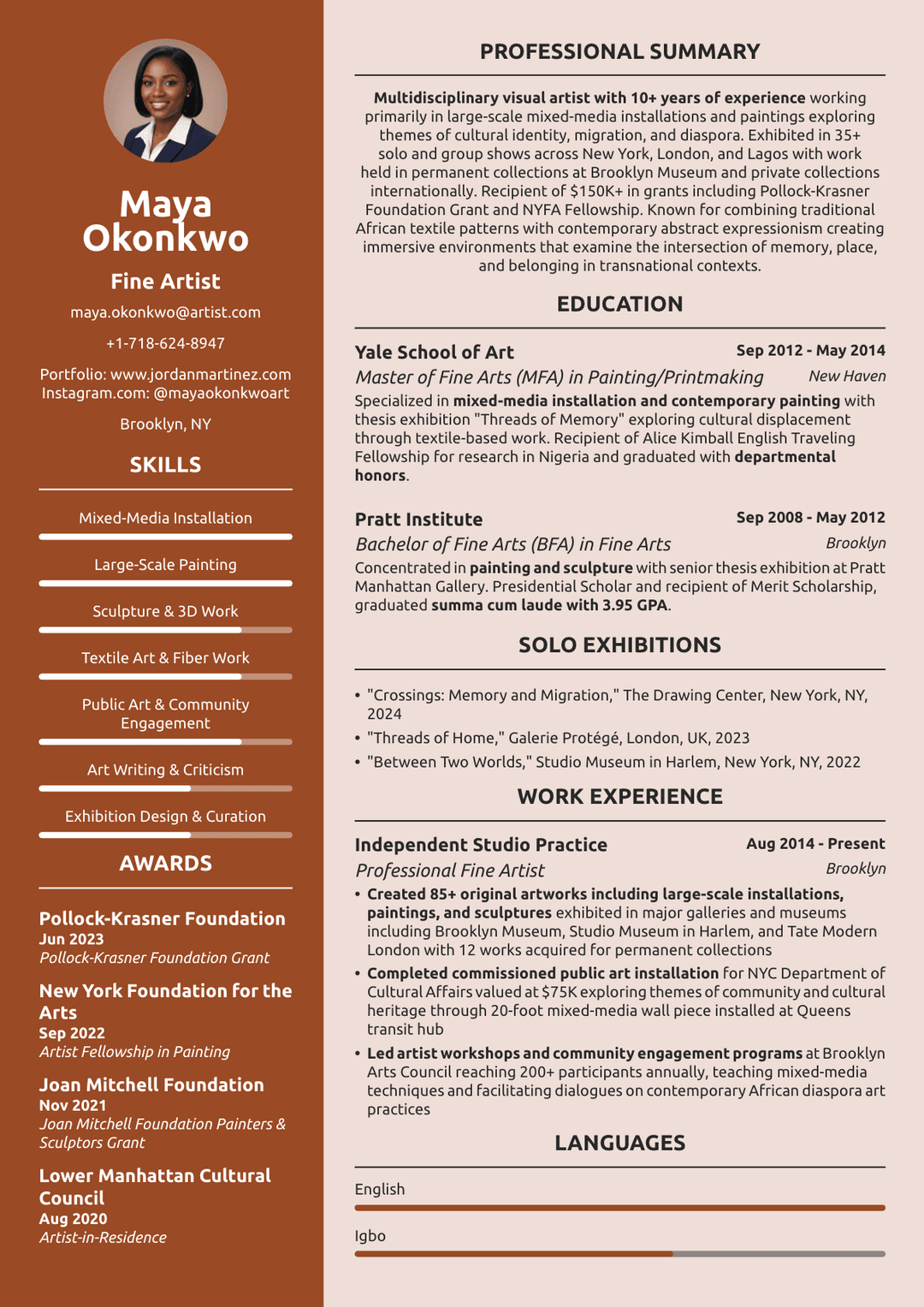
An artist resume is a professional document that highlights your creative work, exhibitions, education, and relevant experience in the art world. However, many artists struggle to present their creative achievements in a resume format that feels both professional and true to their artistic identity. This can lead to missed opportunities—whether you're applying for grants, gallery representation, commissions, or creative roles—because your resume doesn’t clearly communicate your artistic value.
In this guide, we break down exactly how to write an artist resume that showcases your vision, highlights your professional accomplishments, and aligns with the expectations of galleries, clients, and creative employers. Also, we include real world examples for inspiration and expert tips to help you make the best art career resume possible.
- An artist resume highlights exhibition history, education, awards, publications, and professional experience relevant to an artist’s creative practice.
- Artist resumes differ from traditional resumes by focusing on creative achievements rather than standard job responsibilities.
- Key sections include contact information, professional summary or artist statement, education and training, exhibitions, professional experience, awards and grants, and optional sections like publications, collections, and skills.
- Different artistic disciplines require different resume structures—fine artists, commercial artists, and educators highlight different experiences and skills.
- A clear, structured format helps reviewers quickly understand an artist’s background and professional standing in the art community.
What Is an Artist Resume?
An artist resume is a specialized document that presents your creative accomplishments, education, exhibitions, and professional experience in a format tailored to the art world. According to the U.S. Bureau of Labor Statistics, an estimated 84,900 positions become available each year in the arts and design occupations as workers retire or transition out of the field.This steady turnover means that candidates with strong resumes and relevant skills and qualifications can still find solid opportunities.
To make a strong artist resume, it’s important to know that it focuses on exhibitions, shows, and creative projects rather than traditional job duties. You're not listing responsibilities like "managed team of five"—you're showcasing where your work has been seen, who's collected it, and what recognition you've received. Also, in creative resumes, a portfolio link isn't optional; it's essential.
Artist Resume vs. Artist CV
The confusion between artist resumes and CVs causes real problems for applicants. The choice between CV vs. resume depends entirely on the expectations of the institution, gallery, or opportunity you’re pursuing.
Resumes work best when you need clarity, brevity, and easy scanning—common in galleries, teaching roles, fairs, and commercial work. On the other hand, CVs are essential when full career documentation is required, such as academic roles, museum exhibitions, international applications, and in-depth grants.
Here’s a quick overview of when to use an artist resume vs. artist CV:
| When to Use an Artist Resume | When to Use an Artist CV |
|---|---|
Gallery submissions and representation inquiries | Academic positions requiring full career documentation |
Teaching roles at schools or community centers | Major museum exhibitions needing comprehensive records |
Commercial art positions expecting resume—not CV—format | International opportunities (especially in Europe) where CVs are standard |
Short grant applications focused on key achievements | Detailed grant applications requiring depth and full history |
Freelance project pitches needing quick-scan info | Career retrospectives that require complete documentation |
Art fair applications needing concise evaluation details | Any situation where a CV is specifically requested |
Artist Resume Examples by Specialization
Different artistic disciplines require different approaches. Let's examine different resume examples to see what works for each specialization.
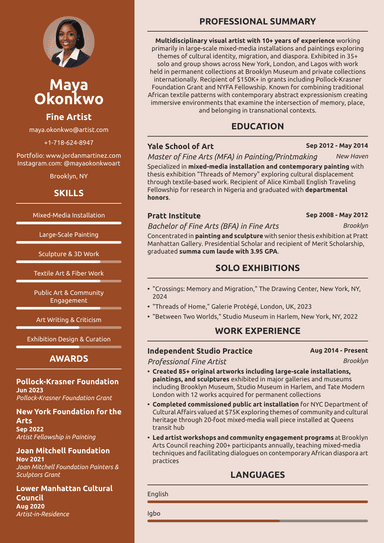
Fine Artist Resume Example

Graphic Designer Resume Example


Illustrator Resume Example


Art Teacher Resume Example

How to Write an Artist Resume: 7 Essential Sections Explained
Writing an effective resume means including the right sections in the right order. Now that you’ve seen the resume examples, it’s time to show you how to incorporate those elements in your artist resume. Let’s begin!
#1. Contact Information and Online Presence
The contact information in your resume header does more than provide ways to reach you. It's the first impression of you. Make sure to include the following info:
- Full name, styled as your artist name if you work under a different name professionally
- Professional email address (e.g. firstname.lastname@email.com)
- Phone number
- City and state (full addresses aren't necessary and can raise privacy concerns).
- Portfolio website link
- Professional social media
Here’s how it looks in practice:
JORDAN MARTINEZ
Visual Artist
Email: jordan.martinez@email.com | Phone: (555) 123-4567
Portfolio: www.jordanmartinez.com | Instagram: @jordanmartinezart
Location: Brooklyn, NY
Make sure your portfolio is mobile-friendly—many gallery directors review submissions on tablets or phones. Keep your social media professional; assume everyone reviewing your application will look at your feeds. A custom domain costs little but adds significant credibility. Also, consider including a QR code that links to your portfolio, especially for printed submissions at portfolio reviews or art fairs.
#2. Professional Summary or Artist Statement
Deciding between a professional summary and an artist statement depends on your target opportunity.
A professional summary introduces your artistic practice, medium, and professional focus. It's your elevator pitch in written form, so make every word count. Summaries work better for commercial positions, teaching jobs, or gallery submissions where brevity matters. On the other hand, artist statements fit fine art submissions, grants, or exhibitions where your conceptual approach matters as much as your technical skills.
Here are a few good examples:
Multidisciplinary visual artist working primarily in large-scale oil paintings exploring themes of urban isolation. Ten years of exhibition history including solo shows in New York and Los Angeles galleries. Work held in private collections across the United States.
Award-winning graphic designer specializing in brand identity and packaging design for sustainable food brands. Five years of agency and freelance experience serving clients from startups to Fortune 500 companies. Proficient in Adobe Creative Suite, Figma, and motion graphics.
Editorial and children's book illustrator with published work in The New York Times, The New Yorker, and fifteen children's books. Known for whimsical watercolor style and ability to visualize complex concepts for diverse audiences.
#3. Education and Training
Education on your artist resume tells galleries and institutions about your technical foundation and artistic lineage. List your degree(s) with your major or concentration clearly stated. Include the institution name and location, graduation year, and relevant coursework or specializations if they strengthen your application.
For instance, recent graduates with exceptional GPAs (3.8+) can include this detail, but it becomes less relevant as you gain professional experience. Academic honors, such as Dean's List, departmental awards, thesis exhibitions, deserve mention as well. These signal you stood out even in competitive academic environments.
Here’s how this might look like on your artist resume:
EDUCATION
Master of Fine Arts (MFA), Painting
Rhode Island School of Design, Providence, RI
Graduated: May 2019
Thesis: "Intersections of Memory and Landscape"
Bachelor of Arts (BA), Studio Art
University of California, Los Angeles, CA
Graduated: May 2016
Concentration: Drawing and Printmaking
Minor: Art History
Additionally, workshops and masterclasses with recognized artists add value, especially if you studied with someone whose name carries weight. Certifications matter—Adobe certifications for commercial artists, teaching credentials for educational positions.
#4. Exhibitions and Shows
This section often separates promising artists from emerging ones. Your exhibition history demonstrates that curators, gallery directors, and institutions have chosen to show your work—it's external validation of your artistic merit.
List exhibitions in reverse chronological order, starting with your most recent show. Separate solo and group exhibitions into distinct subsections—solo exhibitions carry more weight and deserve prominence.
Also, note whether the shows were juried or invitational. Juried exhibitions indicate you competed successfully against other applicants, while invitational shows suggest a curator specifically selected you.
Format your entries like this:
- "Fragmented Narratives," Cooper Gallery, Brooklyn, NY, 2023
- Catalog published with essay by Dr. Sarah Chen
- "Liminal Spaces," The Contemporary Art Center, Seattle, WA, 2021
- Three-month exhibition, featured in Artforum
- "Echo Chamber," Riverside Studios, Portland, OR, 2019
- "Emerging Voices in Contemporary Sculpture," Museum of Modern Art PS1, Queens, NY, 2024
- "Material Matters: New Approaches to Abstraction," San Francisco Arts Commission Gallery, San Francisco, CA, 2023
- Juried exhibition, curated by James Wong
- "Annual Juried Show," Boston Center for the Arts, Boston, MA, 2022
- "Intersections," Gallery 456, Chicago, IL, 2021
- Two-person exhibition with Maria Santos
- "New Talent," The Drawing Center, New York, NY, 2020
- Catalog published
#5. Professional Experience
Professional experience depends on artistic discipline. Fine artists and commercial artists structure this section quite differently.
As a fine artist, you should focus on the following:
- Commissions (both public and private)
- Artist-in-residence positions
- Teaching or workshop facilitation
- Curatorial experience
- Gallery or museum work
All of these experiences should be framed around creative output and professional development rather than corporate-style achievements.
On the other hand, as a commercial artist, you should emphasize:
- Design positions
- Freelance projects with notable clients
- Studio experience (especially at recognized firms)
- Art direction roles
- Significant client work
Start with action verbs and quantify when possible, e.g. number of pieces created, project value, audience size, social media engagement. Emphasize creative problem-solving—show how you approached challenges and delivered solutions. This matters especially for commercial positions where clients care about your process as much as your final product.
Here are a few good examples for different contexts:
Commissioned Artist, Public Art Program, Seattle, WA, 2023
- Created 15-foot sculpture for transit station plaza, selected through competitive RFP process
- Collaborated with city planners and community stakeholders on design development
- Managed $85,000 project budget and fabrication timeline
Senior Designer, Creative Agency, Austin, TX, 2021-2024
- Designed brand identities for 20+ clients across technology, healthcare, and retail sectors
- Led design team of three junior designers on major rebrand project for Fortune 500 client
- Increased client retention rate by 30% through strong presentation and revision processes
Freelance Editorial Illustrator, Various Publications, 2019-Present
- Created illustrations for The Atlantic, Time Magazine, and Scientific American
- Developed commissioned work for children's book publishers including Penguin Random House
- Collaborated with art directors under tight deadlines while maintaining artistic integrity
#6. Awards, Grants, and Honors
Recognition adds credibility that mere self-promotion can never achieve. This section proves that others—curators, grant committees, competition judges—have validated your work.
Include in this section:
- Grants and fellowships (with amounts if substantial)
- Juried awards
- Residency acceptances
- Scholarships (especially competitive ones)
- Competition wins and public art commissions
- Notable purchases or collections
If you have many awards, lead with the most prestigious ones rather than strict chronological order. Recent achievements matter more than decades-old honors, though truly significant early-career recognition can stay on your resume indefinitely.
Format these entries clearly, for example:
AWARDS & GRANTS
- Pollock-Krasner Foundation Grant, Pollock-Krasner Foundation, 2023
- $25,000 grant supporting studio practice and new body of work
- Artist Fellowship, New York Foundation for the Arts, 2022
- $7,000 fellowship in the Painting category
- Emerging Artist Award, The Contemporary Museum, 2021
- Recognizing outstanding early-career artists under 35
- Best in Show, Annual Regional Exhibition, Arts Council of Greater Seattle, 2020
- Jerome Foundation Travel & Study Grant, Jerome Foundation, 2019
- $5,000 for research trip to study mural traditions in Mexico City
- Scholastic Art & Writing Award, Gold Medal in Sculpture, 2015
#7. Additional Sections
These optional sections add depth to your professional narrative. Include them when they strengthen your application.
- Publications and press. List articles featuring your work, exhibition catalogs, interviews in arts publications or podcasts, reviews from recognized critics, and your own published writing about art or technique.
- Collections. Include museums that own your work, corporate collections (especially recognized companies), and notable private collections (when you have permission to mention them).
- Professional affiliations. List artist guilds or associations, professional organizations (College Art Association, AIGA, Society of Illustrators), and gallery memberships.
- Skills. Software proficiencies like Adobe Creative Suite, Procreate, Cinema 4D, or Blender can determine whether you're qualified for certain positions. Languages open doors for international opportunities. Teaching or presentation abilities matter for educational positions and artist talks.
How to Format Your Artist Resume
Formatting your artist resume determines whether people actually read it. Here’s a quick overview of the best resume format and practices:
| Resume Format | Best For | Why It Works |
|---|---|---|
Most artists | Highlights both exhibitions and experience without sacrificing chronology | |
Established artists; teaching positions | Shows clear career progression and employment timeline | |
Career changers; non-linear paths | Emphasizes skills, exhibitions, and strengths over work history |
3+ Common Artist Resume Mistakes to Avoid
Certain resume mistakes appear repeatedly. Learning from others' errors saves you time and rejection. Here are the four most common artist resume mistakes and how to avoid them:
- Including irrelevant information. Don’t list unrelated jobs unless you have no art experience at all. Remove high school details if you hold a college degree. Skip hobbies, salary expectations, and references. Every line must support your artistic narrative—if it doesn’t help you win this opportunity, cut it.
- Poor organization. Keep exhibitions and work experience separate with clear labels. Maintain consistent date formatting and a strong visual hierarchy so reviewers can scan quickly. Use the same structure across sections—if jobs are reverse-chronological, exhibitions should be too.
- Overly complex resume design. Avoid excessive graphics, multiple fonts, or color-heavy layouts that obscure key details. Ensure your design exports cleanly to PDF and works with ATS systems used by institutions. Gallery directors skim quickly—your resume should be instantly readable, not a puzzle.
- Missing contact information. Always include your phone number, professional email, portfolio link, location, and relevant social profiles. Missing or outdated contact details look unprofessional and can cost you opportunities. Verify every link and number to ensure reviewers can reach you without friction.
How to Tailor Your Artist Resume for Different Opportunities
Tailoring your artist resume shows you understand what each opportunity requires. Here’s a short table showing you how to do it for different opportunities:
| Application Type | What to Emphasize | What to Minimize / Notes |
|---|---|---|
Gallery Submissions | Exhibition history (solo first), artist statement, collections, press, awards | Minimize unrelated jobs; de-emphasize commercial work unless prestigious; teaching only if relevant |
Teaching Positions | Education, teaching experience, curriculum development, student achievements, educational training | Artistic practice included but secondary; keep balance between artist and educator roles |
Commercial Art Jobs | Client work, measurable achievements, software skills, process, collaboration, deadlines | Use traditional resume style; focus on business impact as much as creativity |
Grant Applications | Previous grants, awards, exhibitions, publications, artist statement, community impact | Show career trajectory and how the grant fits into your long-term artistic goals |
Start Building Your Professional Artist Resume Today With ResumeBuilder.so
With our smart resume builder and quality resume templates, you can create a document that effectively represents both your artistic practice and your career achievements.
Take the next step in your creative career and build your artist resume today. With ResumeBuilder.so, you can create a document that opens doors to the opportunities you've been working toward.
Final Thoughts
Whether you're seeking gallery representation, teaching positions, or commercial opportunities, a well-crafted artist resume opens doors to new possibilities.
Balance creativity with professionalism—let your work speak through your accomplishments rather than through elaborate resume design. Highlight your unique artistic voice while presenting information in a clear, accessible format.
The difference between a good artist resume and a great one often comes down to specificity, organization, and understanding your audience. Tailoring your resume to each opportunity dramatically improves your success rate.
Artist Resume FAQ
#1. Should I include a photo on my artist resume?
Photos on artist resumes are optional and depend on regional norms and submission requirements. In the United States, resume photos typically aren't necessary and might even work against you. If including one, use a professional headshot, not casual photos or images of artwork.
#2. How long should an artist resume be?
Artist resumes should typically be one page for emerging artists and students, and up to two pages for established artists with extensive exhibition histories. If your career documentation exceeds two pages, you're likely writing a CV rather than a resume.
#3. Should I list all of my exhibitions?
Emerging artists should list all exhibitions to demonstrate growing recognition and activity. Established artists should focus on the most recent and significant shows from the past 10-15 years, prioritizing solo exhibitions and major group shows over smaller group exhibitions.
#4. What file format should I use for my artist resume?
Submit artist resumes as PDF files unless the submission specifically requests another format. PDFs maintain formatting across all devices and platforms, prevent accidental editing, and appear professional.
#5. Do I need different resumes for different opportunities?
Yes, you should tailor your artist resume for each opportunity type. Emphasize exhibitions and awards for gallery submissions, teaching experience and credentials for educational positions, client work and technical skills for commercial jobs, and previous grants plus artistic statement for grant applications.
#6. How do I format exhibition listings?
Format exhibitions in reverse chronological order with the exhibition title in quotes, venue name, city, state, and year. Separate solo and group exhibitions into distinct sections. Include "juried" or "invitational" designations when applicable.
#7. What if I don't have many exhibitions yet?
If you don't have many exhibitions yet, emphasize your education, relevant coursework, student shows and critiques, workshops attended, commissions completed, volunteer work at galleries or museums, internships in art spaces, and participation in artist groups or collectives. Focus on what you have accomplished rather than what's missing.
#8. Can I use a creative design for my artist resume?
You can use creative design elements that reflect your artistic style while ensuring the resume remains professional and readable. Balance creativity with functionality—avoid designs that distract from content, don't print well, or fail to work with applicant tracking systems when applying to institutions. The content matters more than elaborate formatting.

Ava Sinclair is the Founder of ResumeBuilder.so and a seasoned expert in HR and recruitment. As the driving force behind ResumeBuilder.so, Ava combines her expertise in recruitment and job-seeking strategies to empower job seekers with intuitive, high-impact resume-building tools.