Pharmacy Resume: 5 Examples and Writing Guide + Tips [2026]
This complete guide with detailed explanations and expert tips will teach you how to write an acting resume in record time!
Edit this resume![Pharmacy Resume: 5 Examples and Writing Guide + Tips [2026]](/_next/image?url=https%3A%2F%2Fcdn.sanity.io%2Fimages%2Fbcftoxbw%2Fproduction%2F0baf127eef174983f27caf713264684101d3e6c9-1190x1683.png&w=1080&q=75)
Your pharmacy resume is competing with dozens—sometimes hundreds—of other qualified candidates for the same position. Employers skim through resumes, and many health systems rely on strict applicant tracking software (ATS) filters as well. If your resume doesn’t clearly demonstrate medication management expertise, patient-centered care, compliance knowledge, and measurable impact, it risks being rejected before even a human reads it.
In this guide, you’ll see how a well-crafted pharmacy resume isn't just about listing your credentials. With real pharmacist resume examples and expert tips, we’ll show you exactly how to demonstrate your clinical skills, quantifiable achievements, and specialized certifications in a format that satisfies both the ATS and potential employers.
- A pharmacy resume should highlight your PharmD degree, state license, specialized certifications (BCPS, BCACP, immunization certification), and relevant clinical experience.
- Quantify achievements with specific metrics like prescription accuracy rates, patient satisfaction scores, cost savings, and workflow improvements.
- Include both technical skills (medication therapy management, drug utilization review, pharmacy software) and soft skills (patient counseling, communication, attention to detail).
- Tailor your resume format and content to your specific pharmacy setting (retail, hospital, clinical, compounding, or industry).
- Use ATS-friendly formatting and incorporate relevant keywords from the job description to ensure your resume passes automated screening systems.
What Is a Pharmacy Resume?
A pharmacy resume is a professional document that showcases your pharmaceutical education, licensure, certifications, clinical experience, and specialized skills in medication management and patient care. It’s your first impression to potential employers in various pharmacy settings, including retail pharmacies, hospital pharmacies, clinical pharmacy departments, compounding pharmacies, pharmaceutical companies, and healthcare organizations.
According to the U.S. Bureau of Labor Statistics, pharmacists earn a median annual wage of $137,480. Also, employment for these occupations is projected to grow 5% over the next decade, with about 14,200 job openings each year. Despite strong competition, you have real chances of getting your dream job with a well-crafted resume.
A good pharmacy resume demonstrates not only your technical knowledge of medications and pharmacy operations but also your ability to provide exceptional patient care, counsel patients on proper medication use, and collaborate with healthcare teams. The most effective ones are tailored to specific positions and immediately convey your skills and qualifications.
This includes your Doctor of Pharmacy (PharmD) degree, active pharmacy license, specialized certifications, and measurable achievements that demonstrate your impact on patient outcomes, pharmacy operations, and medication safety.
Pharmacy Resume Examples by Specialty
Before we show you how to write a pharmacy resume, let’s take a look at a few resume examples you can use for inspiration.
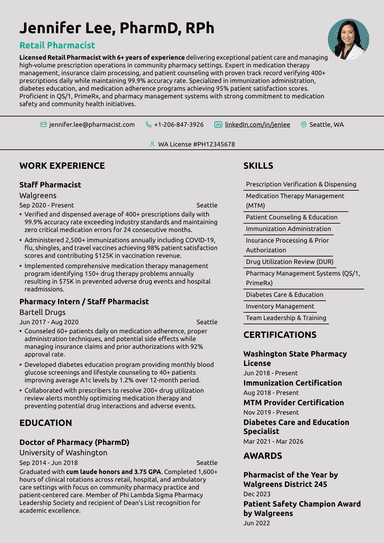
Retail Pharmacist Resume Example

Hospital Pharmacist Resume Example


Clinical Pharmacist Resume Example


Compounding Pharmacist Resume Example


Pharmacy Technician Resume Example

How to Write a Pharmacy Resume: Essential Sections Explained
Writing a pharmacy resume is all about clearly communicating your qualifications. Below, we break down essential sections your resume needs—and how to structure them effectively.
#1. Contact Information and Professional Header
Your pharmacy resume should begin with a clear, professional header that makes it easy for employers to reach you. Make sure to include:
- Full name
- Credentials (PharmD, RPh, or CPhT)
- City and state
- Professional email address
- Phone number
- LinkedIn profile (if relevant)
Some pharmacists also include their state pharmacy license number for immediate verification.
Let’s see what this looks like in practice:
JENNIFER THOMPSON
PharmD, RPh
WA License #PH12345678
Seattle, WA
(206) 555-0147
jennifer.thompson@email.com
LinkedIn: linkedin.com/in/jenniferthompson
#2. Professional Summary or Objective Statement
This comes after your contact information. If you’re an experienced pharmacist, use a resume summary. It is a brief 3-4 sentence elevator pitch that highlights your most impressive qualifications, years of experience, specialized areas of expertise, and key achievements.
Here’s a good example of a resume summary:
Board-certified clinical pharmacist with 8+ years of experience in hospital pharmacy settings. Reduced medication errors by 35% through implementation of comprehensive drug utilization review protocols. Specialized in anticoagulation management and diabetes education, with a proven track record of improving patient outcomes and satisfaction scores.
On the other hand, as an entry-level pharmacist or recent PharmD graduate, you should use a resume objective, emphasizing your education, internships, and relevant skills. For example:
Recent PharmD graduate from [University] with honors. Completed 1,600+ hours of clinical rotations across retail, hospital, and ambulatory care settings. Passionate about medication therapy management and patient education, with a strong foundation in pharmaceutical care and commitment to medication safety.
#3. Licenses and Certifications
Pharmacy licenses and certifications are critical credentials that must be prominently displayed on your pharmacy resume, typically immediately after your professional summary.
At a minimum, include your state pharmacy license number and status (active/current). Many pharmacists place this section before work experience because it's a non-negotiable requirement for practice.
Here are key credentials to include depending on the category:
| Certification Category | Examples | What It Demonstrates |
|---|---|---|
Clinical Certifications | BCPS – Board Certified Pharmacotherapy Specialist | Advanced clinical expertise, evidence-based therapeutic decision-making, specialized patient care |
Operational Certifications | Immunization Certification Compounding Certification (sterile/non-sterile) | Safe vaccine administration, compliance with USP standards, accuracy in dispensing and preparation |
Additional Credentials | MTM Provider Certification Collaborative Practice Agreement authorization | Ability to provide medication therapy management, expanded clinical authority and interprofessional collaboration |
#4. Professional Experience
Your work experience section is where you demonstrate the tangible impact you've made in previous pharmacy roles. Rather than simply listing job duties, showcase your achievements using specific metrics and outcomes that matter to pharmacy employers.
Structure each position with:
Then list 4-6 bullet points that emphasize results, not just responsibilities, starting each bullet point with strong action verbs. Here are a few strong bullet point examples:
- Verified and dispensed an average of 350+ prescriptions daily with 99.8% accuracy rate, exceeding industry standards and maintaining zero critical medication errors for 18 consecutive months
- Implemented a comprehensive medication therapy management program that identified 127 drug therapy problems, resulting in $89,000 in prevented adverse drug events and hospital readmissions
- Counseled 40+ patients daily on medication adherence, proper administration techniques, and potential side effects, achieving 94% patient satisfaction scores
#5. Education
Your education section should prominently feature your Doctor of Pharmacy (PharmD) degree, which is required to practice as a pharmacist in the United States. If you're a recent graduate (within 1-2 years), place this section before your professional experience. Experienced pharmacists typically place education after work experience.
Include the following information:
- Degree type (PharmD, BS in Pharmacy Science)
- University name and location
- Graduation year (or expected graduation date for students)
- Honors or distinctions (magna cum laude, dean's list)
- Relevant coursework or concentrations (for recent graduates)
- 3.5 GPA or higher, and you're within 2 years of graduation
Here’s a good example:
Doctor of Pharmacy (PharmD) University of California, San Francisco
San Francisco, CA
Graduated May 2023
Magna Cum Laude
GPA: 3.8/4.0
You can also include:
- Pharmacy residency programs (PGY1, PGY2) with specialty area
- Fellowship programs
- Relevant undergraduate degrees or minors
- Continuing education (CE) hours in specialized areas
Pharmacy technicians without PharmD degrees should list their highest completed education level along with any pharmacy technician training programs.
#6. Clinical Rotations and Internship Experience
For recent PharmD graduates and those with limited or no experience, your clinical rotations and internships provide valuable evidence of your practical pharmacy skills.
Create a separate section titled "Clinical Experience" or "Pharmacy Rotations" to highlight these experiences. For each rotation, include:
- Rotation type (Community Pharmacy, Hospital Pharmacy, Ambulatory Care, etc.)
- Healthcare facility name and location
- Duration (typically 4-6 weeks per rotation)
- 2-3 bullet points describing key responsibilities and learning outcomes
Let’s see a good example:
Hospital Pharmacy Rotation | UCLA Medical Center, Los Angeles, CA | January - February 2023
- Participated in multidisciplinary rounds with medical teams across ICU, oncology, and cardiology departments
- Prepared sterile IV admixtures and reviewed medication orders for appropriateness, dosing, and potential interactions
- Conducted medication reconciliation for 30+ patients, identifying and resolving 12 drug therapy problems
Community Pharmacy Rotation | Walgreens #4523, San Diego, CA | September - October 2022
- Counseled patients on new prescriptions, OTC medications, and disease state management for diabetes and hypertension
- Processed insurance claims and prior authorizations, achieving 95% approval rate on initial submissions
- Administered 50+ immunizations including COVID-19, flu, and shingles vaccines
#7. Skills Section
Your skills section should be divided into distinct categories that align with job requirements. Employers look for both technical competencies (hard skills) and interpersonal abilities (soft skills) that enable you to provide comprehensive pharmaceutical care.
Here’s a short list of skills you can use on your pharmacy resume:
- Prescription verification and dispensing
- Medication therapy management (MTM)
- Drug utilization review (DUR)
- Pharmacokinetic calculations and dosing
- Sterile compounding (USP 797/800)
- Immunization administration
- Pharmacy management systems (QS/1, PrimeRx, PharmacyKeeper, Epic Willow)
- Insurance processing and prior authorization
- Inventory management
- Clinical decision support tools
- Drug information research
- Pharmacotherapy consultation
- Patient counseling and education
- Medication reconciliation
- Anticoagulation management
- Diabetes care and education
- Pain management protocols
- Infectious disease management
- Oncology pharmacy
- Geriatric pharmaceutical care
- Communication and counseling
- Attention to detail
- Critical thinking and problem-solving
- Team collaboration with healthcare providers
- Time management in high-volume settings
- Conflict resolution
- Cultural competency
Present skills strategically by reviewing job descriptions and incorporating relevant keywords naturally throughout your resume. However, don't simply list every skill you possess—prioritize those most relevant to your target position.
#8. Professional Memberships and Affiliations
Membership in professional pharmacy organizations demonstrates your commitment to staying current with pharmaceutical developments and networking within the profession. Include memberships in organizations such as:
- American Pharmacists Association (APhA)
- American Society of Health-System Pharmacists (ASHP)
- American College of Clinical Pharmacy (ACCP)
- National Community Pharmacists Association (NCPA)
- State pharmacy associations
- Specialty practice organizations (ACOP, PPAG, HOPA)
List leadership positions, committee involvement, or notable contributions. Simply being a member is worth mentioning, but active participation adds more weight. For example:
Member, American Society of Health-System Pharmacists (ASHP) | 2021-Present Residency Affairs Committee Member | 2023-Present
Secretary, California Pharmacists Association, San Diego Chapter | 2022-2024
#9. Awards, Honors, and Publications
If you've received recognition for your work or contributed to pharmaceutical research and literature, create a section to showcase these accomplishments. This section particularly benefits clinical pharmacists, those in academic settings, or candidates pursuing specialized positions.
Include the following information:
- Academic honors and scholarships (Dean's List, Rho Chi Honor Society)
- Professional awards (Employee of the Quarter, Patient Safety Champion)
- Research presentations at conferences
- Published articles in pharmacy journals
- Poster presentations
- Grant funding received
Here’s a good example of an entry for a pharmacy resume:
- "Impact of Pharmacist-Led MTM on Diabetes Outcomes in Underserved Populations" American Journal of Health-System Pharmacy, Vol. 78, Issue 4, 2023 (Co-author)
- Best Poster Presentation, California Society of Health-System Pharmacists Annual Meeting, 2023 "Reducing Opioid Prescribing in Post-Surgical Patients Through Pharmacist Intervention"
How to Choose the Right Pharmacy Resume Format
You can choose between three primary resume formats, each serving different career situations. Let’s examine each one.
#1. Reverse-Chronological Format
The reverse-chronological format is the most common and widely accepted pharmacy resume format. It lists your work experience starting with your most recent position and working backward. This format works best for:
- Pharmacists with a consistent work history
- Candidates progressing within pharmacy specialties
- Those applying to traditional healthcare settings
This format allows hiring managers to quickly see your career progression and most recent experience, which is typically most relevant to the position. It's also highly compatible with applicant tracking systems (ATS), making it the safest choice for most pharmacy professionals.
#2. Functional Format
The functional format emphasizes skills and qualifications over chronological work history. Consider this format if you're:
- A recent PharmD graduate with limited post-graduation experience
- Changing pharmacy specialties (moving from retail to hospital, for example)
- Returning to pharmacy after a career break
- Addressing employment gaps
While this format allows you to highlight your strongest qualifications upfront, some employers view it skeptically because it doesn't clearly show career progression. Use it selectively and be prepared to discuss your work history during interviews.
#3. Combination Format
The combination format merges elements of both chronological and functional formats. It leads with a comprehensive skills section, followed by detailed work experience in reverse-chronological order. This format suits:
- Experienced pharmacists with diverse skill sets
- Pharmacy managers and directors
- Clinical specialists with both operational and clinical expertise
- Candidates transitioning to pharmaceutical industry roles
How to Make Your Pharmacy Resume ATS-Friendly
Here’s a short table that shows how to optimize your pharmacy resume for applicant tracking systems (ATS):
| Optimization Step | What to Do | Why It Matters |
|---|---|---|
Use Standard Section Headings | Use headings like Professional Experience, Education, Licenses & Certifications, Skills | ATS scans for expected labels to organize your resume correctly |
Incorporate Relevant Keywords | Include keywords from job postings: pharmacy software, certifications, clinical skills, regulations | Improves matching scores and prevents automatic rejection |
Choose Clean Formatting | Use simple fonts, avoid graphics/columns, keep bullet points standard, save as .docx/PDF | Ensures ATS can parse text without losing critical data |
Test ATS Compatibility | Paste the full resume into plain text editor and review for missing or scrambled content | Reveals parsing issues before submitting applications |
8 Common Pharmacy Resume Mistakes to Avoid
Avoiding common resume mistakes strengthens ATS performance and recruiter appeal. Below are eight key pitfalls and how to fix them effectively in your pharmacy resume:
- Generic resumes. Tailor each resume to the role by emphasizing the clinical skills, pharmacy setting experience, and achievements most relevant to that employer’s needs. Customization signals genuine interest.
- Focusing on duties instead of achievements. Shift from task lists to measurable results. Highlight patient impact, prescription accuracy, workflow improvements, immunization metrics, or clinical intervention outcomes to show how your work improved care delivery.
- Omitting quantifiable results. Numbers give hiring managers immediate context. Include immunization counts, MTM interventions, medication error reductions, satisfaction scores, cost savings, or prescription volume to validate performance.
- Including irrelevant information. Keep every line connected to pharmacy care, patient interaction, regulatory compliance, or medication management. Remove unrelated jobs or hobbies unless they reinforce essential pharmacy skills.
- Typos and grammatical errors. Proofreading demonstrates the precision required in pharmacy practice, where minor errors can have serious consequences. Review carefully and use tools plus peer verification.
- Unprofessional email addresses. Present polished contact details using a professional format like firstname.lastname@email.com to build instant credibility with pharmacy directors and recruiters.
- Excessive length. Limit your pharmacy resume to one page unless you have 10+ years of clinical experience or extensive research/publications requiring additional space to communicate value clearly.
- Poor formatting and design. Avoid distracting layouts or graphics that confuse ATS parsing. Use clean, readable, resume formatting, and prioritize clarity, structure, and compatibility.
Craft Your Pharmacy Resume With ResumeBuilder.so
Crafting an effective pharmacy resume from scratch can feel overwhelming, especially when you're juggling ATS requirements, formatting concerns, and content strategy. ResumeBuilder.so simplifies the process with AI-powered tools designed specifically for healthcare professionals.
Our resume builder creates polished, competitive resumes stress-free. Choose from industry-specific resume templates—all designed to be ATS-friendly and professional. With guided AI suggestions for bullet points, skills, and measurable achievements, you’ll easily highlight the impact employers want to see.
Final Thoughts
Your pharmacy resume must quickly prove you're qualified, licensed, and capable of delivering safe, effective patient care. Highlight the essentials: PharmD degree, active state license, specialized certifications, and relevant clinical experience. Also, use measurable achievements—accuracy rates, patient satisfaction, cost savings—to show impact, not just duties.
Whether you’re targeting retail, hospital, clinical, compounding, or industry roles, a clear, targeted resume makes you stand out. With proper formatting, strong metrics, and pharmacy-specific keywords, you’ll improve your chances of landing interviews and securing your ideal position.
Pharmacy Resume FAQs
#1. Should I include my pharmacy license number on my resume?
You should include your pharmacy license number on your resume, particularly in the licenses and certifications section immediately after your professional summary. However, some pharmacists prefer to list "Active [State] Pharmacy License - Available upon request" for privacy reasons when posting resumes publicly online.
#2. How do I address employment gaps on my pharmacy resume?
To address employment gaps on your pharmacy resume, be honest and frame the gap positively. If you took time off for family care, continuing education, health reasons, or other legitimate circumstances, briefly mention this in your cover letter rather than trying to hide it.
#3. What software should I list on my pharmacy resume?
You should list software that you've actually used and that's relevant to your target positions. Common pharmacy management systems include QS/1, PrimeRx, PioneerRx, PharmacyKeeper, and Liberty Software for retail settings. However, only list software where you have genuine proficiency.
#4. Is it necessary to include references on my pharmacy resume?
It is not necessary to include references on your pharmacy resume, and doing so wastes valuable space that could showcase your qualifications. Instead, prepare a separate reference sheet with 3-4 professional references (former supervisors, pharmacy managers, preceptors, or professors) and bring this document to interviews, or provide it when specifically requested during the application process.

Chris Nolan is the go-to expert for turning cold connections into career-changing opportunities. He doesn’t just talk about networking—he teaches you how to actually do it without feeling awkward or spammy. From crafting the perfect LinkedIn message to leveraging your existing network for job referrals, Chris makes networking simple and strategic.