Real Estate Agent Resume: Examples, Tips & Guide for 2026
This complete guide with detailed explanations and expert tips will teach you how to write an acting resume in record time!
Edit this resume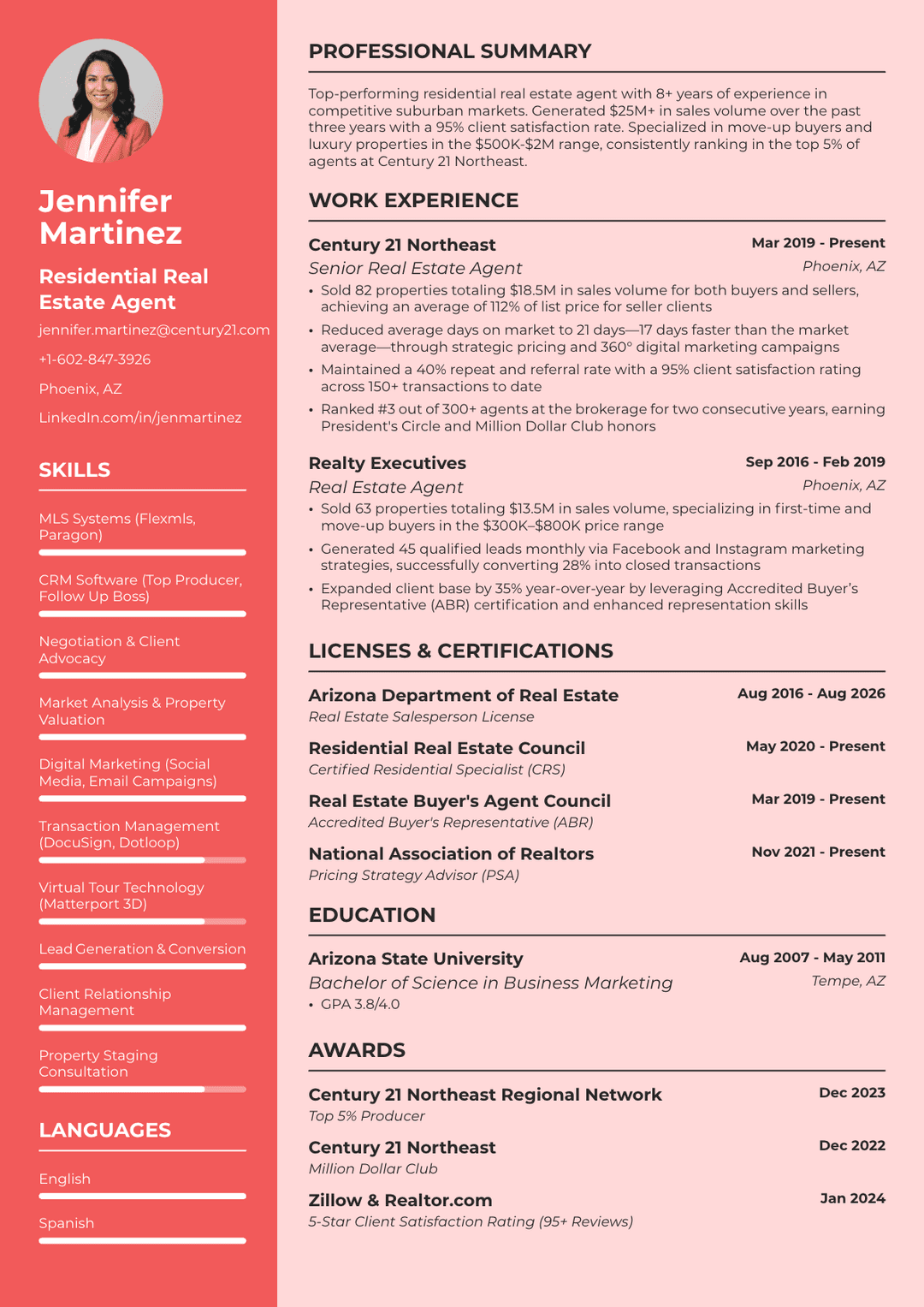
Your real estate agent resume needs to cut through the noise in about eight seconds, which is roughly how long hiring managers spend on their first pass. Whether you're a newly licensed agent looking to join your first brokerage or a seasoned pro eyeing a luxury real estate team, you need to showcase sales achievements, market knowledge, and client relationship skills on your resume that hiring managers actually care about.
To do so, we'll walk you through exactly how to build a real estate agent resume that opens doors—complete with real examples, expert tips, and proven strategies.
- Real estate agent resumes should highlight sales metrics and transaction volumes.
- Include both hard/technical skills (CRM software, MLS systems) and soft skills (negotiation, client relations).
- Quantify achievements with dollar amounts, number of properties sold, and client satisfaction rates.
- Tailor your resume to the type of real estate (residential, commercial, luxury).
- Use an ATS-friendly format to ensure your resume passes automated screening.
What Makes a Strong Real Estate Agent Resume?
A strong real estate agent resume demonstrates proven sales ability, market knowledge, and the kind of client relationship management that turns one-time buyers into lifelong referral sources. The U.S. housing market is growing. For example, sales of existing homes in December 2025 grew by 5.1%, reaching a nearly three-year high.
With the growing housing market, employment of real estate brokers and sales agents is stable, projected to grow 3% over the next decade, with about 46,300 openings each year. Therefore, having a well-written resume is a must.
The best realtor resume leads with numbers, such as transaction volume, commission earned, and properties sold. Also, hiring managers look for market expertise that shows you understand specific neighborhoods, property types, and price ranges. They want to see evidence of client relationship management through repeat clients, referral rates, and satisfaction scores.
Also, technical skills matter more now than ever. Your familiarity with MLS systems, CRM platforms like Top Producer or BoomTown, and virtual tour software tells brokerages you won't need weeks of training to contribute. Don't forget professional credentials—your license number, certifications like CRS or ABR, and continuing education courses signal that you're serious about this career.
Real Estate Agent Resume Examples
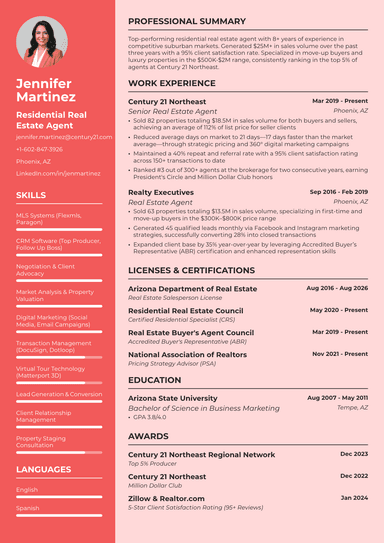
Before we show you how to write your realtor resume, take a look at real-world resume examples that demonstrate how different agents at various experience levels should structure their resumes.
#1. Experienced Residential Real Estate Agent

#2. Entry-Level Real Estate Agent

#3. Commercial Real Estate Agent

#4. Luxury Real Estate Agent

How to Format Your Real Estate Agent Resume?
There are three main resume formats, and each works better in different situations. Before we show you how to write your real estate agent resume, let’s see which format to choose based on your experience level:
- Reverse-chronological format. This is the gold standard for real estate agents with a consistent work history. It lists your most recent position first and works backward, which naturally highlights career advancement and sustained success. Most brokerages prefer this format because it's straightforward and easy to scan quickly.
- Combination/hybrid format. If you're transitioning into real estate from another sales career, a combination format lets you lead with transferable skills while still showing your work history. You'll have a robust skills section at the top, followed by your work experience section that ties those skills to real-world results.
- Functional format. They're useful only if you have significant employment gaps or a very scattered work history across multiple fields. If you're considering a functional format, think twice. Most brokerages view them with suspicion. However, if you absolutely must use one due to employment gaps, be prepared to address those gaps directly in your cover letter.
ATS Optimization
Aside from formatting, if your resume isn't ATS-friendly, it could get rejected no matter how impressive your sales record is. Over 98% of Fortune 500 companies use ATS software, and the trend is growing in real estate as brokerages get larger and more corporate.
The table below outlines key ATS tips you should keep in mind when writing your real estate agent resume:
| ATS Optimization Area | Best Practice |
|---|---|
Section Headers | Use standard titles like Work Experience, Skills, Certifications |
Keywords | Include relevant job-related terms naturally |
Formatting | Use standard fonts, bullets, and layouts |
File Type | Save as .docx or PDF |
Keyword Placement | Add keywords to key sections (summary, work experience, skills) |
Design Style | Avoid tables, columns, and text boxes |
How to Write a Real Estate Agent Resume: Breakdown of Essential Sections
Writing an effective real estate agent resume is all about following a structure that highlights your strengths while making information easy to find. Let's break down the sections that need to be in your resume and what makes each one work.
Professional Summary
Your resume summary sits right at the top, and it's essentially your elevator pitch condensed into 3-4 powerful sentences.
This isn't the place for modesty or vague statements. You want to highlight your specialization, years of experience, and top achievements.
Here are a few good examples of resume summaries for different levels of experience:
Award-winning real estate professional with 10+ years of experience in competitive metropolitan markets. Achieved $50M+ in career sales volume with specialization in luxury condos and waterfront properties. Maintained 4.9/5.0 client satisfaction rating and 50% referral rate through exceptional service and market expertise. Looking to bring proven leadership and sales performance to the growing luxury real estate team.
Newly licensed real estate agent with 8 years of proven sales success in B2B technology solutions. Generated $5M+ in annual revenue through consultative selling and relationship building. Completed intensive real estate training with honors and eager to leverage strong negotiation skills, market analysis capabilities, and client-first approach to excel in residential real estate.
Commercial real estate specialist with 12+ years representing office and industrial properties in major metro markets. Closed $120M+ in lease and sale transactions across 3.2M square feet. Deep expertise in investment analysis, tenant representation, and cap rate evaluation for institutional clients. Seeking a senior agent role focused on multi-tenant office buildings and value-add opportunities.
Work Experience
This is the most critical section of your real estate agent resume, and it deserves the bulk of your space. List your work experience in reverse chronological order, but go beyond just noting where you worked and what your job title was.
Real estate is a numbers game, and your resume better reflects that. Instead of vague statements, use specific metrics that tell the whole story, such as:
- Transaction volume
- Sales performance
- Client satisfaction
- Market penetration
- Growth trajectory
That said, let’s compare weak vs. strong examples:
- Sold 52 properties across 8 neighborhoods totaling $14.2M in volume
- Represented 60% sellers and 40% buyers, maintaining a balanced pipeline
- Implemented a 360° digital marketing strategy that reduced average DOM by 35%
Weak Example
- Sold homes in various neighborhoods
- Worked with buyers and sellers
- Used marketing to promote listings
By comparing the above two examples, you can see how much more powerful quantified achievements are than mere responsibilities.
Skills Section
Your skills section needs to strike a balance between technical proficiencies and the soft skills that make you effective with clients. Also, noting your proficiency levels offers tangible proof of expertise, which boosts your credibility.

Technical skills are the tools and platforms you use daily, such as:
- MLS systems. Most agents work with their local MLS, but mentioning specific systems (like MLS PIN, Flexmls, or Paragon) demonstrates hands-on experience.
- CRM software. Client relationship management platforms, such as Salesforce, Top Producer, and Follow Up Boss, are the backbone of modern real estate practice. If you've used any of them, list them specifically rather than just saying "CRM experience."
- Digital marketing. Social media marketing (particularly Facebook and Instagram for real estate), email campaign management, and virtual tour creation. These skills matter more every year as buyer behavior shifts increasingly online.
- Transaction management. DocuSign, Dotloop, SkySlope, Paperless Pipeline—whatever platform you've used to manage contracts and documentation. Brokerages want agents who can handle paperwork efficiently.
- Market analysis tools. Comparative Market Analysis (CMA) expertise, property valuation experience, and understanding of market trending tools. These demonstrate your analytical capabilities.
- Virtual tour technology. Matterport 3D tours, video walkthrough editing, and drone photography coordination. COVID accelerated virtual home tours, and they're here to stay.
On the other hand, soft skills are the human elements that make you effective with clients. They are harder to quantify but absolutely critical to success in real estate, such as:
- Negotiation. This isn't just about getting the best price. It's about navigating multiple offers, managing inspection repairs, handling appraisal gaps, and finding solutions that satisfy all parties.
- Communication. Clear, timely updates to clients. Ability to explain complex contract terms in simple language. Responsiveness that builds trust. These communication skills often determine whether clients refer you to their friends.
- Market analysis. Reading market trends, pricing properties accurately based on comparable sales, understanding when to recommend price adjustments. This separates agents who close deals from those who have overpriced listings sitting on the market.
- Client relationship management. Building trust and long-term relationships that result in repeat business and referrals. This is about more than just being friendly—it's about understanding client needs and delivering results.
- Time management. Juggling multiple clients at different stages of the buying or selling process. Coordinating showings, inspections, appraisals, and closings without dropping balls.
- Problem-solving. Navigating inspection issues, dealing with financing challenges, handling last-minute closing delays. Real estate transactions rarely go perfectly, and your ability to solve problems calmly and effectively matters tremendously.
- Networking. Building referral sources through other agents, mortgage brokers, attorneys, home inspectors, and past clients. Your sphere of influence often determines your long-term success.
However, given that real estate is fundamentally a sales profession, these skills deserve a mention on their own:
- Lead generation and conversion strategies
- Open house management and staging
- Property staging consultation
- Professional photography coordination
- Social media marketing campaigns
- Email marketing and drip campaigns
- Sphere of influence development
- Cold calling and prospecting techniques
- Door knocking and geographic farming
Certifications and Licenses
This section isn't optional—it's proof you're legally allowed to practice. List your real estate license number, the state where you're licensed, and your status (active, preferably).
Also, include relevant certifications that add to your credibility, such as:
- Certified Residential Specialist (CRS)
- Accredited Buyer's Representative (ABR)
- Seniors Real Estate Specialist (SRES)
- Luxury home certifications (varies by organization)
- Commercial designations like CCIM for commercial agents
It’s important to format this section in a way that makes it easy for employers to verify your credentials quickly. Here’s a good example:
CERTIFICATIONS & LICENSES
- Real Estate License #123456789 | State of California | Active
- Certified Residential Specialist (CRS) | 2022
- Accredited Buyer's Representative (ABR) | 2021
Additional Sections to Strengthen Your Real Estate Agent Resume
Beyond the above-mentioned essentials, there are several optional sections that can strengthen your real estate agent. Let’s explore each one in more detail.
Professional Affiliations
Membership in professional organizations shows you're serious about your career and stay connected to the industry. Consider including:
- National Association of Realtors (NAR)
- State and local realtor associations
- Women's Council of Realtors
- Real Estate Buyers Agent Council (REBAC)
- Commercial Investment Division (CCIM)
- Local business chambers or networking groups
Here’s how that might look on your resume:
PROFESSIONAL AFFILIATIONS
- Member, National Association of Realtors (NAR) | 2019-Present
- Member, California Association of Realtors | 2019-Present
- Board Member, Local Realtors Association | 2022-Present
Awards & Recognition
Awards provide third-party validation of your success and help you stand out from other candidates with similar experience. Don't be modest here. If you've earned recognition, include it:
- Top producer awards (be specific: "Top Producer 2023, 2024")
- President's Circle or Chairman's Circle designations
- Rookie of the Year
- Client satisfaction awards or 5-star ratings
- Community service recognition
- Brokerage-specific awards (Million Dollar Club, etc.)
For example:
AWARDS & RECOGNITION
- Top 5% Producer, Century 21 Regional Network | 2023, 2024
- President's Circle, Century 21 | 2024
- 5-Star Client Satisfaction Rating (95+ reviews) | 2019-Present
Volunteer Experience
Real estate agents often build their sphere of influence through community involvement, so relevant volunteer experience demonstrates:
- Community knowledge and deep local connections
- Leadership abilities (board positions, committee chair roles)
- Commitment to the local area where you practice
- Transferable skills to real estate (fundraising, event planning, marketing)
Languages
In diverse markets, language skills can be a significant differentiator. List any languages beyond English with your proficiency level:
LANGUAGES
- Spanish - Fluent (Business proficiency)
- Mandarin - Conversational
If you serve a community with a significant non-English-speaking population, language skills might be one of your strongest selling points. Don't hide that.
5 Common Mistakes to Avoid on Your Real Estate Agent Resume
These common resume mistakes can tank your chances before you even get an interview:
#1. Listing Duties Instead of Achievements
Your job duties are assumed—what matters is what you accomplished while doing those duties. If your bullet point doesn't answer why it matters or what impact you had, rewrite it with results.
- Wrong: Responsible for showing properties to potential buyers and answering their questions about features and neighborhoods.
- Right: Conducted 150+ property showings annually, converting 35% to offers within 60 days through a consultative selling approach and detailed neighborhood knowledge.
#2. Not Quantifying Results
You need to tell the full story, i.e., how much you exceeded by, for how long, what dollar impact you had, and how you ranked against peers. That's the level of detail that separates you from the crowd.
- Vague: Top producer at my brokerage
- Specific: Exceeded sales quotas by an average of 125% over three consecutive years, generating $8.5M in commission revenue for brokerage and ranking #2 out of 180 agents
#3. Using a Generic Professional Summary
Use a compelling professional summary that immediately demonstrates your value and specialization. Focus on what you offer, not what you want.
- Generic: Licensed real estate agent with a strong professional background. Seeking a position where I can grow and utilize my skills in a dynamic real estate environment.
- Specific: Licensed real estate agent with 6+ years of experience helping buyers and sellers close over $18M in residential property. Specializes in first-time buyers, digital marketing, and client relationship management to drive fast, smooth transactions.
#4. Ignoring ATS Optimization
Applicant tracking systems filter resumes before humans ever see them. If your resume isn't formatted correctly or lacks relevant keywords, it gets rejected automatically. Make sure to:
- Avoid graphics, unusual fonts, tables for layout, and text boxes.
- Use standard section headers like "Work Experience" instead of creative alternatives like "My Real Estate Journey."
- Include relevant keywords from the job description naturally throughout your resume—terms like "buyer representation," "MLS," "transaction coordination," and specific software names.
#5. Including Irrelevant Information
Your resume should focus on real estate-relevant experience, skills and qualifications. The job you had at a retail store 15 years ago should be left out unless it demonstrates transferable sales or customer service skills.
Keep the focus on what matters to real estate hiring managers: your sales ability, market knowledge, client relationship skills, and technical proficiencies. Everything else is just clutter that dilutes your message.
How to Tailor Your Resume for Different Real Estate Positions
The table below outlines what to emphasize on your realtor resume based on the target position:
| Focus Area | Residential Brokerage Positions | Commercial Real Estate Firms | Luxury Real Estate Teams | Property Management Companies |
|---|---|---|---|---|
Transaction Volume | HIGH | MEDIUM | LOW | LOW |
Client Relationships | HIGH | MEDIUM | HIGH | HIGH |
Property Value | MEDIUM | VARIES | HIGH | MEDIUM |
Investment Analysis | LOW | HIGH | MEDIUM | MEDIUM |
Marketing Sophistication | MEDIUM | MEDIUM | HIGH | LOW |
Tenant Relations | LOW | MEDIUM | LOW | HIGH |
Build a Stellar Real Estate Agent Resume With ResumeBuilder.so
ResumeBuilder.so offers specialized tools designed specifically to help you build a resume that gets results.
Our AI-powered resume builder includes professional and ATS-friendly resume templates designed to highlight sales achievements and client success metrics. You simply input your information, and our system formats it in seconds.
Also, if you need to explain career changes or employment gaps, you use our cover letter builder, template, and real-world cover letter examples. This way, you can present your story clearly and positively, showing not just where you’ve been, but where you’re ready to go next.
Final Thoughts
Your real estate agent resume should demonstrate your sales success, market expertise, and client relationship management skills through concrete metrics and achievements, not vague claims about being a "great agent."
Remember to tailor your resume for each position you pursue, emphasizing the skills and experience most relevant to that particular brokerage or market segment. A resume that works for a residential brokerage won't hit the same notes for a commercial firm or luxury team, so take the time to customize.
Whether you're an experienced agent seeking a new opportunity or a newly licensed professional entering the field, a well-crafted resume sets the foundation for career success. Use the examples, tips, and templates provided here to create a resume that opens doors to your next real estate opportunity.
Real Estate Agent Resume FAQs
#1. What should I include in my real estate agent resume?
Include your professional summary highlighting your niche, real estate license information with active status, work experience with quantified achievements like properties sold and sales volume, relevant skills, and certifications. Focus on metrics that demonstrate your sales success and client satisfaction rates rather than generic job duties.
#2. How long should a real estate agent resume be?
One page is ideal for agents with less than 10 years of experience in real estate. Agents with extensive experience, multiple specializations, or significant achievements spanning more than a decade may extend to two pages, but ensure every item adds value and demonstrates relevant expertise.
#3. Should I list every property I've sold on my resume?
No, don't list individual properties as this takes up valuable space and overwhelms the reader. Instead, summarize your achievements with aggregate metrics like total properties sold, sales volume, average sale price, or percentage above asking price. You can mention one or two notable or landmark properties if they're particularly impressive.
#4. How do I write a real estate resume with no experience?
Emphasize transferable skills from previous sales, customer service, or business roles that apply to real estate. Highlight your real estate education, licensing coursework, and any relevant certifications you've earned. Include volunteer work, internships, or shadowing experience with established agents that demonstrate your commitment to the field.
#5. What are the most important skills for a real estate agent resume?
Key skills include negotiation abilities, market analysis expertise, client relationship management, CRM software proficiency (like Salesforce or Top Producer), digital marketing skills, communication excellence, and transaction coordination experience. The best resumes balance hard skills and soft skills to show you're both technically capable and effective with clients.
#6. Should I include my real estate license number on my resume?
Yes, absolutely include your license number, licensing state, and status (active). This information verifies your credentials and shows you're legally authorized to practice real estate in your state. Place this information prominently in either your resume header or certifications section, where hiring managers can easily find it.

Max Harper is the resume guru who actually makes job searching easier. With years of experience as a hiring manager, Max knows what makes a resume stand out in a pile of 200+ applications. From breaking down ATS myths to helping you craft bullet points that pop, Max shares easy-to-digest, no-BS resume advice.