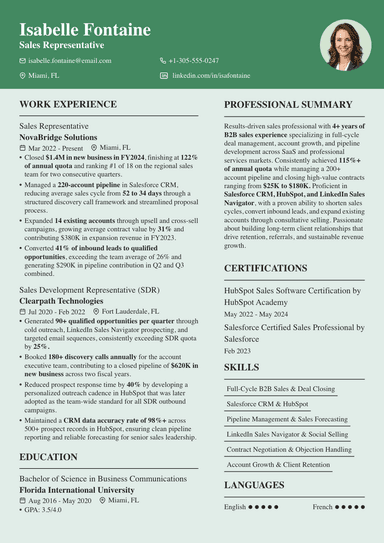
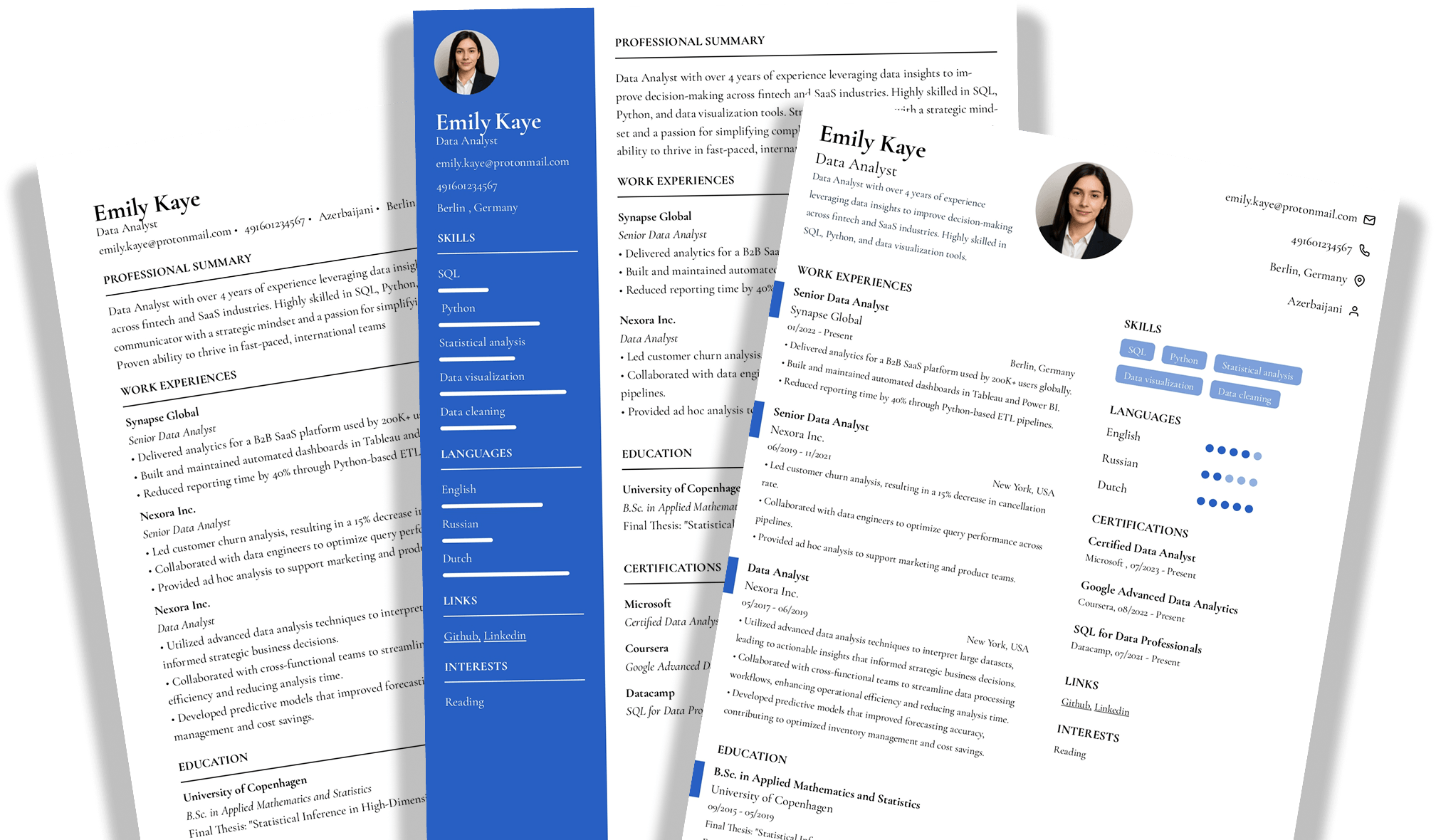
How to Write a Sales Resume That Gets Interviews in 2026
This complete guide with detailed explanations and expert tips will teach you how to write an acting resume in record time!
Edit this resume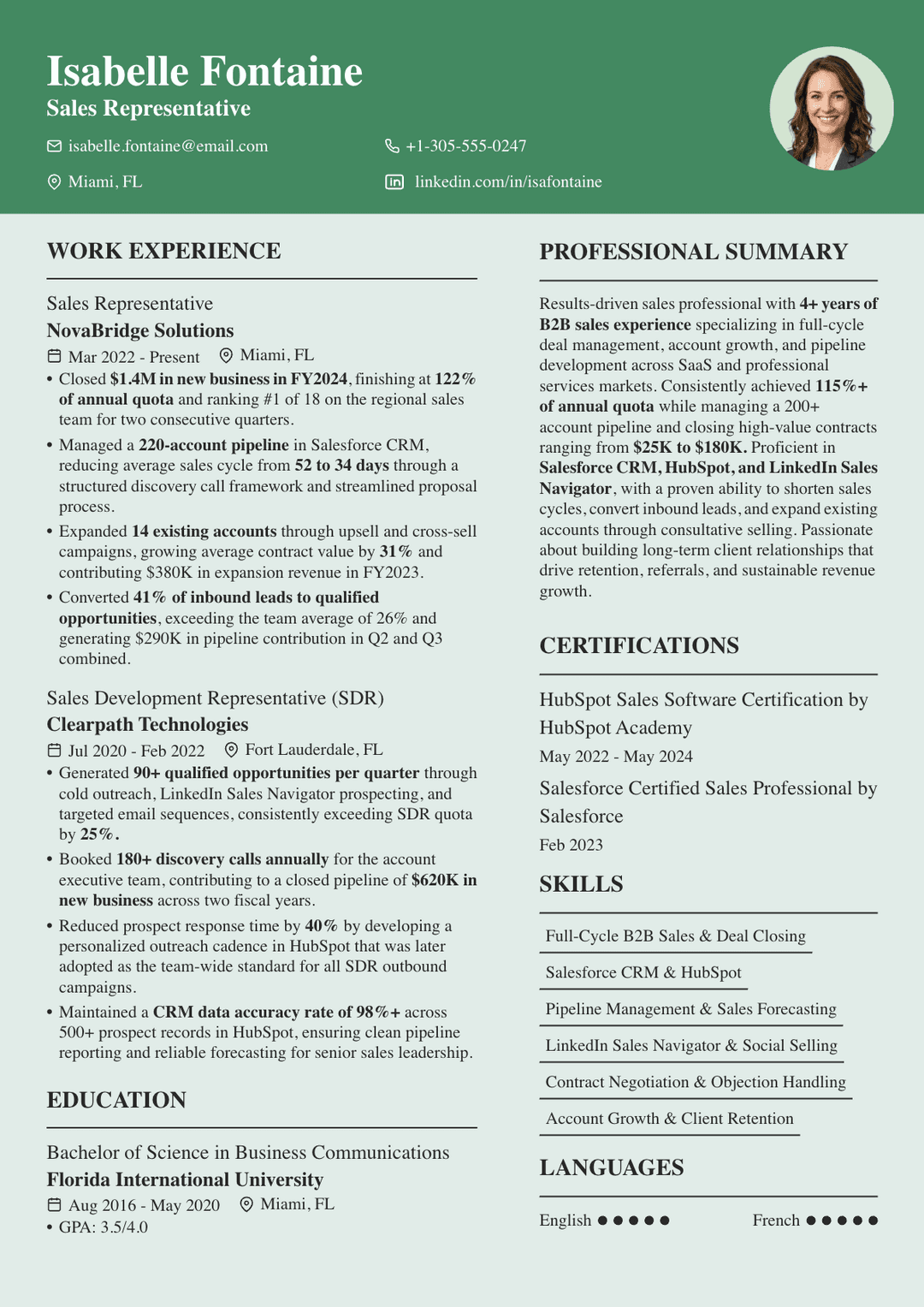
A sales resume is a job application part that shows employers how well you can generate revenue, build client relationships, and hit targets. It needs to highlight the results behind your work, such as meeting quotas, increasing conversions, growing accounts, or closing high-value deals.
The purpose of this document is to show that you understand the sales process, from prospecting and lead qualification to negotiation and retention. This tells recruiters that you both have experience in sales and can deliver measurable business results.
This guide will shed some light on how to write a sales resume that proves your value to hiring managers. It will cover all the sections you should include, which skills matter most, as well as how to describe achievements effectively and format your resume in order to stand out.
- A sales resume should focus on measurable results by showing quota attainment, revenue generated, conversion improvements, deal sizes, and other proof of performance.
- The best format for most candidates is reverse-chronological, and every strong sales resume should include clear sections for contact information, summary or objective, work experience, skills, education, and certifications.
- The work experience section carries the most weight, so each bullet should begin with an action verb and show a concrete result that proves sales impact.
- An ATS-friendly sales resume uses standard section headings, avoids tables and text boxes, mirrors the language of the job posting, and stays clean and easy to parse.
- The biggest mistakes are being too generic, leaving out numbers, using the same resume for every application, overcrowding the page, and writing a weak summary instead of a strong sales-focused pitch.
What Is a Sales Resume?
A sales resume is a professional document that presents your achievements, skills, and experience to persuade a hiring manager that you can drive revenue. In other words, it represents a targeted argument for why you are the best person to hit (and exceed) the number.
What separates a sales resume from a general resume is emphasis. Where many people simply list responsibilities, sales professionals must list outcomes. These include quota attainment percentages, revenue generated, deal sizes closed, conversion rates improved, and sales cycles shortened.
This document also covers the full spectrum of revenue-generating roles such as sales development representatives (SDRs), account executives, account managers, retail sales associates, B2B sales professionals, B2C reps, and sales managers. Great candidates across those roles share one thing in common: their resumes prioritize proof, numbers, and specificity over generality.
3 Great Sales Resume Examples to Use as Inspiration
Sales resume examples help job seekers see how the principles above translate into an actual document. Below are three options that cover different contexts:
#1. Entry-Level Sales Resume Example

#2. Sales Representative Resume Example

#3. Sales Manager Resume Example

How to Format Your Sales Resume
You should format a sales resume with a clean, parser-friendly structure before writing a single bullet point. Format determines whether a recruiter and an applicant tracking system can actually read the document, and a resume that no one can read does not get you an interview.
There are three main resume formats, and here is which one to use and when:
- The reverse-chronological format lists your most recent position first and works backward through your career history. It is the default choice for most sales candidates because it puts your most impressive recent results at the very top, exactly where recruiters look first. If you have a consistent sales background with no major employment gaps, this is your format.
- The functional format leads with a skills section rather than a work history timeline. It is occasionally used by career changers who are entering sales from a different industry and have strong transferable skills but limited direct sales experience.
- The combination format merges a skills or achievements summary at the top with a full reverse-chronological work history below. It gives hiring managers the best of both worlds: a quick snapshot of your strongest capabilities alongside a complete record of where you built them.
How to Write Each Section of Your Sales Resume
A well-structured sales resume includes six core sections. Here is what belongs in each one and how to make every section earn its place on the page.
#1. Contact Information
Your contact section should be clean, current, and professional. It should feature your full name, a professional email address, phone number, location, and LinkedIn profile URL.
Your address on your resume should be city and state only; a full street address is unnecessary and takes up valuable space. You should also leave out headshots, your date of birth, and any personal details unrelated to the job since these do not help your candidacy and can introduce bias.
Jordan Bailey
Dallas, TX | (214) 555-0187 | jordan.bailey@email.com | linkedin.com/in/jordanbailey123
#2. Sales Resume Summary vs. Objective
A sales resume summary is a short statement at the top of your resume whose purpose is to convince the hiring manager to keep reading. Here, you should mention your experience level, lead with a quantified win, and signal that you understand the role you are applying for.
If you are entry-level or switching into sales from another field, you may not have many achievements to mention, which is why it’s better to write a sales resume objective instead. This is similar to the summary, but focuses on the value you bring through transferable skills and where you are headed, rather than where you have been.
Results-driven sales professional with 7+ years of experience in B2B and retail sales environments, specializing in account growth, client retention, lead generation, and revenue expansion. Strong track record of exceeding sales quotas, building long-term customer relationships, and closing high-value deals. Skilled at identifying client needs, presenting tailored solutions, and working cross-functionally to improve the customer experience.
#3. Work Experience
The work experience section of a sales resume should read like a track record and mention your previous/present roles in reverse-chronological order. It should contain your job title, company name, location, and dates of employment for each role, and then three to five bullet points that illustrate your biggest achievements in that position.
Every bullet point needs to start with an action verb and land on a result. Words like closed, surpassed, generated, negotiated, converted, and prospected signal to a hiring manager that you are outcome-focused. Meanwhile, generic openers like "responsible for" or "worked on" do the opposite.
Additionally, every bullet should either show a measurable result or demonstrate a skill the job posting specifically calls for.
- Closed $820K in new business in FY2024, finishing at 118% of annual quota and ranking #2 of 14 on the regional sales team.
- Reduced average sales cycle from 47 to 31 days by implementing a structured discovery call framework across a 200-account pipeline.
- Converted 34% of inbound leads to qualified opportunities, exceeding the team average of 21% and contributing $340K in pipeline in Q3.
If you are earlier in your sales career or transitioning in from another field, lean on customer service metrics, conversion data from non-sales roles, and any freelance or project-based results. Numbers from a retail or customer success role can be just as compelling as formal quota attainment; what matters is proof of impact.
#4. Sales Resume Skills Section
The skills section of a sales resume should include a balanced mix of hard and soft skills. Here are some suggestions on what abilities you can add to each category:
- Salesforce CRM
- HubSpot
- Pipeline management
- Cold calling/cold outreach
- Social selling (LinkedIn Sales Nav)
- Contract negotiation
- Sales forecasting
- Data analysis & reporting
- Consultative communication
- Persuasion & objection handling
- Resilience & persistance
- Active listening
- Time management
- Empathy & emotional intelligence
- Collaboration
- Adaptability
#5. Education
Next, you have the education part, where you need to mention your highest degree, the institution, and your graduation year. Sales roles rarely require a specific degree, but a background in business, communications, marketing, or psychology is a genuine advantage and worth noting clearly.
If you are a recent graduate with limited work experience, you can also add a bullet or two with some relevant coursework in the fields of negotiation, marketing, or data analysis classes, all of which signal readiness for a sales role. Once you have two or more years of professional experience, coursework becomes less relevant and can be removed.
Bachelor of Business Administration
University of North Texas, Denton, TX
Graduated: 2015
#6. Certifications & Additional Sections
Sales certifications signal commitment and technical depth to any hiring manager. The most recognized ones to list include:
- Salesforce Certified Sales Professional
- HubSpot Sales Software Certification (free, widely respected)
- Sandler Sales Training
- SPIN Selling or Challenger Sale certification (if applicable)
Beyond this, consider adding sections for awards and recognition; President's Club membership, top-performer rankings, or regional sales awards carry significant weight. If you are fluent in a second language or hold professional memberships (e.g., NASP), those belong here too.
- Certified Professional Sales Person (CPSP), National Association of Sales Professionals (NASP) | Expires: 2028
- HubSpot Sales Software Certification, HubSpot Academy | Expires: 2029
In competitive markets, a portfolio link (in the form of a personal site, a LinkedIn with rich deal case studies, or a one-page "brag book" PDF) is a low-effort addition that very few candidates include and that many hiring managers notice.
The formatting rules for listing certifications on a resume (order, date format, issuing body) are worth getting right, since a poorly formatted section can undermine an otherwise strong document.
How to Make an ATS-Friendly Sales Resume
You can make an ATS-friendly sales resume once you learn what these systems actually do. Namely, this software filters, ranks, and sorts resumes before a human reviewer ever sees them. If your resume cannot be parsed correctly, it never reaches the hiring manager, no matter how qualified you are.
To avoid this, you should follow these rules before every submission:
- Use normal section headings. Work Experience, Skills, and Education work well here, while creative alternatives like Where I've Won, or My Toolkit, don’t.
- Don’t include any tables, columns, text boxes, or headers/footers. These elements frequently cause parsing errors in ATS software.
- Submit as a PDF. Unless the posting specifically asks for a Word document, a PDF preserves your formatting while remaining machine-readable.
- Replicate the job posting's language. Copy the exact phrases used in the job description and weave them naturally into your resume.
- Do not keyword-stuff. Use each keyword in context (a sentence or bullet) rather than listing terms in white text at the bottom, which ATS systems flag.
Candidates who invest in building a genuinely ATS-friendly resume from the start, rather than retrofitting keywords after the fact, consistently see higher callback rates across the same pool of applications.
5 Typical Mistakes to Avoid When Creating Your Resume
Here are the sales resume mistakes that often cost candidates interviews:
- Writing duties, not achievements. Listing what the job required rather than what you delivered is the single most damaging resume mistake in sales.
- Skipping the numbers. Vague phrases like "increased sales" or "improved performance" are invisible on a sales resume. Add the specific figure, be it the percentage, the dollar amount, the rank, the timeframe, or anything similar; a number is the difference between a claim and proof.
- Using one resume for every application. A single generic resume applied to thirty jobs is far less effective than thirty tailored resumes. Tailoring takes fifteen minutes but dramatically improves ATS keyword match rates and signals to the hiring manager that you actually read the job posting.
- Overcrowding the page. Dense, wall-to-wall text gets skipped, while white space, clear section breaks, and consistent bullet formatting allow a recruiter to scan the page in ten seconds and land immediately on your strongest points.
- Ignoring the summary. Many sales candidates leave the summary blank or write something generic like "Motivated professional seeking an opportunity." This is the first thing a recruiter reads and should function like an elevator pitch: your strongest win, your top skill, and the role you are targeting, all that in three sentences.
Final Thoughts
A sales resume is, at its core, a sales pitch. It needs a compelling hook in the summary, proof of performance through quantified experience, and a clean format that lets your results breathe on the page.
Of everything covered in this guide, tailoring your resume to the specific role you are applying for is the single highest-ROI action you can take.
When you are ready to put it together, the professional sales resume template at ResumeBuilder.so can help you do it effortlessly. Our AI generator can draft your sales resume summary in seconds once you input your role, experience, and top achievements, and all this can be done within minutes!
Sales Resume FAQ
#1. How do you write a summary for a sales resume?
You write a sales resume summary by drafting two to four sentences that cover your years of experience, your top quantified achievement, a key skill, and the specific role you are targeting. Put the numbers in the spotlight (quota attainment percentage, revenue generated, or team rank), and close with a brief nod to the type of position you want.
#2. What skills should I put on a sales resume?
The best skills to put on a sales resume include a mix of technical and interpersonal abilities: CRM proficiency (Salesforce, HubSpot), pipeline management, quota attainment, contract negotiation, cold calling, social selling, communication, and data analysis. Always cross-reference the job posting and use the exact terminology the employer used.
#3. How long should a sales resume be?
A sales resume should typically be one page long. The exception when it can have two pages is when it belongs to a senior professional with an extensive multi-company history. Don’t forget that every single sentence in your resume has to make sense and be relevant; if it’s not, you should lose it.
#4. Do I need a cover letter with a sales resume?
You should include a cover letter with your sales resume because it gives context to your numbers and lets your personality come through in a way a resume cannot. Use it to narrate the story your resume only summarizes: why this company, why this role, and what specific result you will drive for them.

Max Harper is the resume guru who actually makes job searching easier. With years of experience as a hiring manager, Max knows what makes a resume stand out in a pile of 200+ applications. From breaking down ATS myths to helping you craft bullet points that pop, Max shares easy-to-digest, no-BS resume advice.