Personal Trainer Resume: Writing Guide for 2026 + Examples
This complete guide with detailed explanations and expert tips will teach you how to write an acting resume in record time!
Edit this resume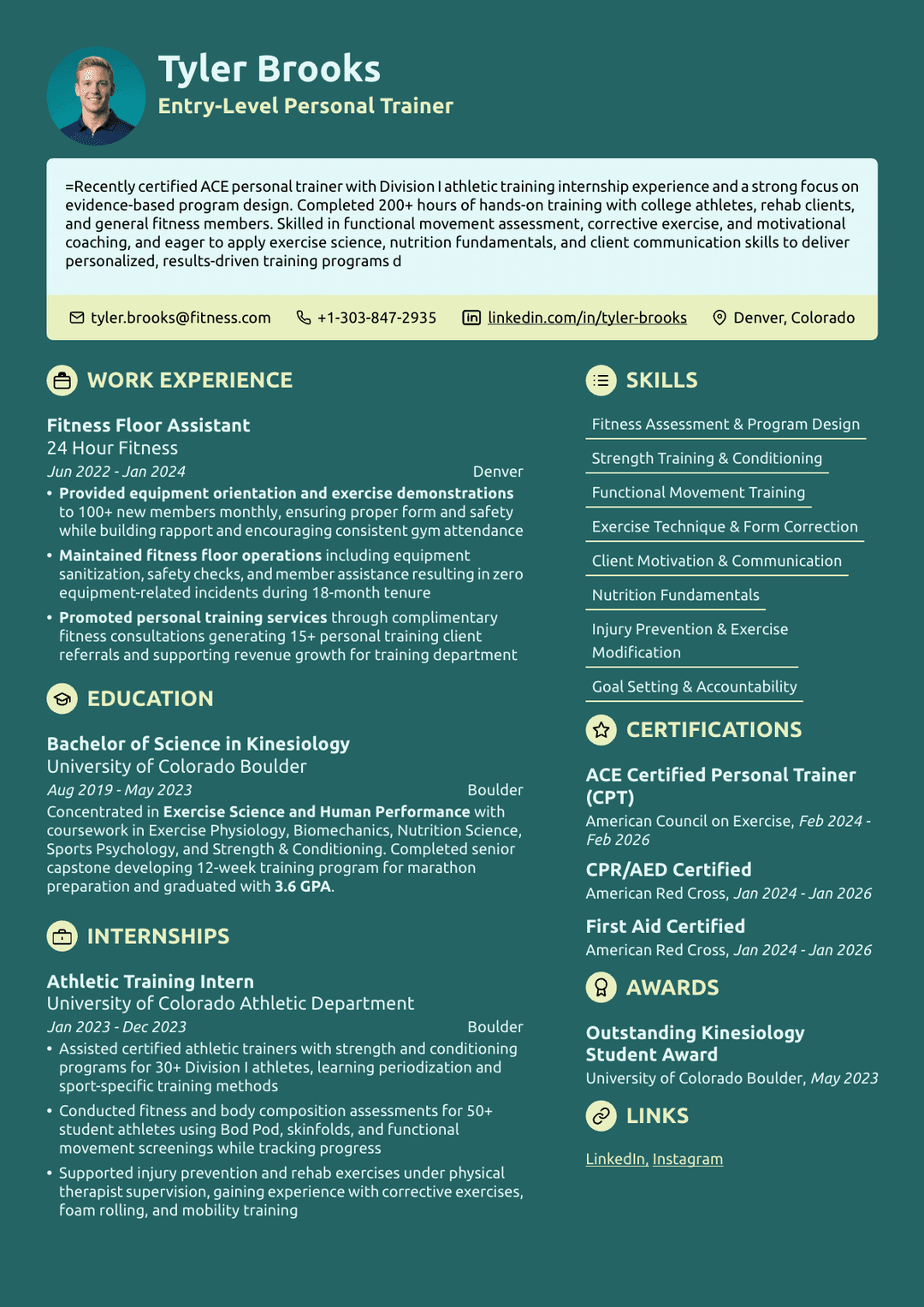
Your personal trainer resume needs to showcase certifications, demonstrate measurable client results, and stand out among hundreds of applications. Whether you're targeting premium boutique studios, corporate wellness centers, or building a private training practice, the way you present your qualifications can make all the difference.
In this guide, we’ll show you how to create a personal trainer resume that captures attention and passes applicant tracking systems. Also, to inspire your own writing, we’ll provide real-world resume examples and expert tips to help you land a job in the fitness industry.
- Personal trainer resume structure prioritizes certifications, measurable experience, and fitness-specific skills to meet both employer expectations and ATS screening standards.
- National certifications such as NASM, ACE, ACSM, and ISSA carry significant weight and are often required for employment consideration.
- Quantified outcomes—such as client retention rates, strength gains, weight loss averages, or revenue generated—distinguish promising from mediocre candidates.
- Employment opportunities for personal trainers continue to expand, with projected industry growth and varied career paths across gyms, studios, and private practice.
What Makes a Personal Trainer Resume Unique?
A personal trainer resume is unique because it must prove both technical expertise and interpersonal effectiveness. While a digital marketing specialist might emphasize campaign metrics, fitness trainers and instructors need to build trust and demonstrate they can safely guide clients through transformations.
Certifications carry enormous weight in this field. Employers don't just want to see that you're certified—they're looking for credentials from nationally recognized organizations, such as:
- National Academy of Sports Medicine (NASM)
- American Council on Exercise (ACE)
- American College of Sports Medicine (ACSM)
- International Sports Sciences Association (ISSA)
These certifications signal you've met rigorous standards and stay current with evidence-based training methods. Many gyms won't even consider applications without them.
Beyond credentials, measurable outcomes are an important factor. Potential employers want to see you've helped clients lose 15 pounds on average, improved strength metrics by 30%, or maintained 95% client retention rates. This results-driven approach extends to specialized training methodologies you've mastered—whether that's high-intensity interval training (HIIT), functional movement, corrective exercise, or sports-specific conditioning.
The soft skills that make you effective (motivating clients through plateaus, adapting workouts for limitations, building accountability) matter just as much as your technical knowledge.
Also, physical demonstration abilities factor in. Personal trainers need to show proper form, spot clients safely, and model movements effectively. Even though your resume won't directly prove these capabilities, emphasizing hands-on experience with diverse populations and equipment types helps paint that picture.
Personal Trainer Resume Examples
Seeing how other successful trainers structure their resumes gives you a blueprint for creating your own standout document. Different resume examples help you visualize the balance between certifications, experience, and achievements—and they show how different experience levels require different approaches.
That said, let’s see some real-world personal trainer resume examples with different specializations.
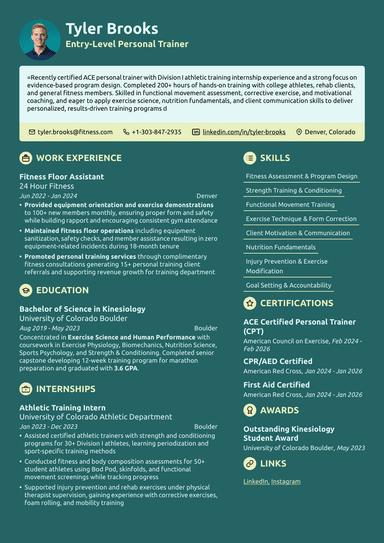
Entry-Level Personal Trainer Resume Example

Certified Personal Trainer Resume Example


Fitness Instructor Resume Example

Gym Trainer Resume Example

How to Write a Personal Trainer Resume: 6 Key Sections Explained
Writing a personal trainer resume is all about following a similar structural blueprint, but each section requires fitness-specific optimization. Let's break down what belongs in each part and how to make it work for your job search.
#1. Contact Information
Your resume header establishes immediate credibility. Make sure to include:
- Full name
- Professional title
- City and state
- Phone number
- Professional email address
Also, many personal trainers forget this, but relevant social media can strengthen your application. If you maintain an Instagram showcasing client transformations (with permission) or a YouTube channel demonstrating proper technique, include those links. They provide proof of your expertise and marketing savvy. LinkedIn works well when they're fitness-focused rather than just repurposed from a corporate career.
Here’s a good example:
Taylor Rodriguez
ACE-CPT
Austin, TX
(512) 555-0193
taylor.rodriguez.trainer@email.com
YouTube: TaylorFitnessTips (12K subscribers)
Instagram: @TaylorTransformsLinkedIn: linkedin.com/in/taylorrodriguezfitness
The example works well because it includes subscriber count on YouTube, demonstrating reach and influence. The Instagram handle suggests transformation content (powerful social proof). The LinkedIn profile is clearly fitness-focused based on the URL.
#2. Resume Summary or Objective
This is where entry-level and experienced trainers diverge. If you've got 2+ years, use a professional summary highlighting your certifications, specializations, and one or two knockout achievements.
Strong resume summaries follow a proven formula. Lead with your certification and years of experience, highlight 2-3 key specializations, include 1-2 impressive metrics, and end with your unique value proposition. For example:
ACE-certified personal trainer with 6 years designing strength and conditioning programs for competitive athletes. Specialized in Olympic weightlifting, plyometric training, and sports-specific performance enhancement. Improved client vertical jump averages by 4 inches and sprint times by 0.3 seconds within 12-week training cycles. Known for creating periodized programs that prevent overtraining while maximizing athletic potential.
On the other hand, entry-level trainers benefit from a resume objective. State your certification, relevant background, and what you bring to the role. For example:
Recently certified ACE personal trainer with Division II athletic training internship experience seeking to apply evidence-based program design and client motivation skills to help members achieve fitness goals at Premier Fitness Center.
#3. Certifications and Licenses
For personal trainers, certifications deserve prominent placement and detailed formatting. Create a dedicated section and present each credential with complete information, including:
- Certification name
- Issuing organization
- Date obtained
- Expiration date (if applicable)
List your primary personal training certification first (NASM-CPT, ACE-CPT, ISSA-CPT, ACSM-CPT). Follow with specialized certifications like Corrective Exercise Specialist, Nutrition Coach, or Group Fitness Instructor. Then include your CPR/AED and First Aid certifications with expiration dates. Some states have specific licensure requirements, so research and include those if applicable.
Note your continuing education commitment. If you've accumulated significantly more CECs than required, mention it. This signals you're invested in staying current rather than doing the bare minimum.
Now, let’s see what a good entry looks like:
CERTIFICATIONS AND LICENSES
Primary Certification:
- NASM Certified Personal Trainer (CPT) | National Academy of Sports Medicine Obtained: March 2021 | Expires: March 2025 60 CEUs completed (20 required for renewal)
Specialized Certifications:
- NASM Corrective Exercise Specialist (CES) | National Academy of Sports Medicine Obtained: August 2022 | Expires: August 2026
- Precision Nutrition Level 1 Certified | Precision Nutrition Obtained: January 2023 | Expires: January 2027
- TRX Suspension Training Certified | TRX Obtained: June 2022 | Valid indefinitely
Safety Certifications:
- CPR/AED Certified | American Red Cross Obtained: September 2024 | Expires: September 2026
- First Aid Certified | American Red Cross Obtained: September 2024 | Expires: September 2026
#4. Work Experience
The work experience section proves you can actually do what your certifications say you can do. It should paint a picture of your client base (demographics, goals, volume), the specialized programs you developed, training methodologies you utilized, and equipment you're proficient with.
If you increased gym membership renewals, generated revenue through personal training packages, or built a loyal client following, quantify those achievements. Structure each position with the job title, employer name, location, and employment dates. Then focus on impact rather than duties using powerful action verbs.
Let's look at strong bullets across different scenarios:
- Trained 45 clients weekly in functional fitness and corrective exercise, achieving 92% client retention rate—18% above gym average
- Developed small-group training program generating $32,000 in additional annual revenue while serving clients unable to afford one-on-one sessions
- Designed post-rehabilitation strength program for 12 clients recovering from knee surgery, achieving average 40% strength improvement in affected leg within 12 weeks
- Implemented fitness assessment protocol improving client goal-setting process, increasing program adherence by 28%
- Coached competitive athletes in Olympic weightlifting technique, with 6 clients qualifying for regional competitions within 18 months
#5. Education
The placement of your education section depends on where you are in your career. Recent graduates should feature education prominently, potentially before work experience. Include degree level, major, university name, and graduation year.
For candidates with no experience, relevant coursework adds value. For instance, Exercise Physiology, Biomechanics, Nutrition Science, or Sports Psychology all reinforce your technical foundation. Academic achievements (cum laude, Dean's List) are worth mentioning if you graduated within the past 3-4 years. After that, they matter less than your track record with real clients.
However, if you've got 5+ years of training experience, education can move below certifications and experience. The degree matters less than what you've accomplished since earning it.
#6. Skills Section
The skills section serves a dual purpose:
- It helps ATS systems find your resume
- It gives hiring managers a quick capabilities snapshot
These skills should mirror the target job's requirements while showcasing genuine expertise. Start by analyzing the job description. If it mentions "experience with special populations" three times, that's a priority skill. If it asks for "group fitness instruction" but only once, it's secondary. Create your skills list to align with their priorities.
Next, divide your abilities into hard skills (technical competencies) and soft skills (interpersonal strengths).
Hard Skills
Hard skills might include fitness assessment techniques, program design and periodization, nutrition guidance, specific training methods (TRX, kettlebell training, Olympic lifting), injury prevention and exercise modification, and fitness software proficiency (Trainerize, MyFitnessPal, Mindbody).
However, don't just list "equipment operation"—get specific about what you can teach: "Pilates reformer instruction," "rowing technique coaching," or "suspension training programming."
Soft Skills
Soft skills are important in client-facing roles such as this one. Highlight client motivation and communication, goal setting and accountability systems, empathy and active listening, time management, adaptability, and sales or business development if relevant to the position.
Also, problem-solving skills and collaboration skills round out your interpersonal capabilities. Whether you're working around client injuries, coordinating with physical therapists or nutritionists, or addressing training plateaus creatively, these skills keep clients progressing toward their goals.
How to Format Your Personal Trainer Resume
Formatting impacts how quickly hiring managers grasp your qualifications and whether ATS systems can parse your information correctly. There are three main resume formats you can choose from for different situations, including:
- Reverse-chronological format. It works best for trainers with consistent fitness industry work history. This format is also the most ATS-friendly and generally preferred by corporate gyms and larger fitness chains.
- Functional format. It's ideal for entry-level trainers fresh off certification, career changers entering fitness from related fields (physical therapy, athletic training, military fitness), or professionals with employment gaps they'd prefer not to highlight. However, some recruiters view this format skeptically, assuming you're hiding something.
- Combination/hybrid format. It offers the best of both worlds when you've got diverse experience or specialized expertise across multiple areas. It features a prominent skills section followed by detailed chronological work history.
Common Personal Trainer Resume Mistakes to Avoid
Even certified fitness professionals make resume mistakes that cost them interviews. Recognizing these pitfalls helps you sidestep them entirely.
Here’s a short table of the most common personal trainer resume mistakes:
| Mistake | What It Looks | Like Why It Hurts | What to Do Instead |
|---|---|---|---|
Expired or irrelevant certifications | Expired NASM-CPT listed with no context | Signals poor professionalism and lack of ongoing development | Remove expired certs or add “renewal in progress” with a date |
Listing job duties instead of achievements | “Trained clients in gym setting” | Fails to show impact or differentiation | Add specifics, outcomes, and measurable results |
Overcrowding with irrelevant experience | Old retail or unrelated jobs dominate space | Dilutes fitness expertise and focus | Keep experience relevant; summarize transferable roles briefly |
Poor formatting and readability | Dense text, tiny fonts, ATS-unfriendly design | Hurts scanability and may trigger ATS rejection | Use clean layout, standard fonts, clear headers, white space |
Omitting key certifications or licenses | Core certs buried or missing | Causes instant disqualification | Add a dedicated, prominent certifications section |
Create a Standout Personal Trainer Resume With ResumeBuilder.so
Creating a professional, ATS-optimized resume from scratch takes hours of formatting headaches and second-guessing your wording. ResumeBuilder.so streamlines the entire process with tools designed specifically for career-focused professionals.
Browse our gallery of resume templates or start writing with our AI-powered resume builder designed to help fitness professionals land more interviews. Your next great training position is one well-crafted resume away.
Final Thoughts
Your personal trainer resume is more than a list of qualifications—it's your first opportunity to demonstrate the professionalism and attention to detail that clients will expect from you. Focus on showcasing nationally recognized certifications, quantifying your client results, and highlighting specializations that set you apart.
The fitness industry offers strong prospects, with employment projected to grow 12% in the next decade—much faster than average. With a median wage of $46,180, positions range from entry-level gym roles to lucrative private training practices. Whether you're just starting out or have years of experience, a well-written resume opens doors in this growing field.
Personal Trainer Resume FAQ
#1. What certifications should I include on my personal trainer resume?
Include all current certifications from organizations like NASM, ACE, ACSM, or ISSA in a dedicated certifications section. Add specialized credentials (corrective exercise, nutrition coaching, sports-specific training), required safety certifications (CPR/AED/First Aid), and any state-mandated licenses. Prioritize certifications most relevant to your target position and remove or update any expired credentials.
#2. How long should a personal trainer resume be?
One page works best for entry-level trainers with less than 5 years of experience. You can extend to two pages if you've got extensive certifications, multiple specializations, and substantial accomplishments justifying the space. Prioritize recent, relevant experience and current certifications. If you're struggling to fit everything, focus on the past 10 years of experience and remove outdated or less-relevant positions.
#3. Should I include client testimonials on my resume?
Brief metrics referencing client feedback work well in experience bullets. However, full testimonial quotes belong in your portfolio or cover letter, not on the resume itself. Focus on quantifiable results (pounds lost, strength gained, retention rates) rather than subjective praise. Never include identifying client information, names, or photos without explicit written permission.
#4. How do I showcase client results without violating privacy?
Use aggregated data and percentages instead of individual stories, e.g. "Helped 30+ clients achieve average 15-pound weight loss within 16-week programs" or "Improved client squat strength by average 40% across 20-person caseload." Never include names, before/after photos, or identifying details unless you have signed photo releases and explicit permission.
#5. What's the difference between a personal trainer resume and CV?
The CV vs. resume difference is in comprehensiveness. Resumes are concise documents (1-2 pages) focused on relevant experience, skills, and achievements. They're standard for U.S. fitness positions at all levels. CVs are comprehensive documents (often many pages) that include every publication, presentation, research project, and professional activity throughout your career.
#6. Should I include non-fitness work experience?
Include non-fitness experience if it demonstrates transferable skills (sales, customer service, management), you're entry-level without substantial fitness experience, or you have employment gaps that need explaining. Experienced trainers can minimize or completely omit unrelated positions.
#7. How often should I update my personal trainer resume?
Update immediately when you earn new certifications, complete significant continuing education, change positions or get promoted, achieve notable client milestones (major retention improvements, program successes), or develop new specializations. Even when not actively job searching, review your resume quarterly and add recent accomplishments while they're fresh.

Max Harper is the resume guru who actually makes job searching easier. With years of experience as a hiring manager, Max knows what makes a resume stand out in a pile of 200+ applications. From breaking down ATS myths to helping you craft bullet points that pop, Max shares easy-to-digest, no-BS resume advice.